Key takeaways
- Metal de-shedding comb: useful for loose undercoat on many double-coated dogs, but use lightly and avoid repeatedly scraping the same area.
- Slicker brush: better for removing loose surface hair and working through long coats in small sections.
- Pin brush: gentler for longer, flowing coats, though it may collect less dense undercoat.
- Clipper: helpful for controlled trimming of suitable coats, but it is not appropriate for every breed or tangled coat.
- Cleaning brush: removes hair from upholstery, floors, and the machine’s pre-filter; it does not replace a proper grooming tool.
- Crevice or narrow nozzle: useful for edges and hard floors, but avoid directing strong suction at the animal’s skin.
The best pet grooming vacuums for most homes are compact, variable-suction grooming systems with a metal or ceramic clipper, a 2–3 litre hair container, washable filtration, and at least 1.5 metres of hose; choose a quieter, lower-suction model for nervous cats and a stronger, larger-capacity system for thick-coated dogs.
Unlike an ordinary vacuum, a grooming vacuum collects loose fur as you brush or clip. That can reduce airborne hair and shorten cleanup, but the right choice depends on coat type, the animal’s tolerance of noise, and how often you groom. A powerful machine is not automatically the best one: excessive suction can tug the coat, while a narrow hose or small bin quickly becomes frustrating.
Our top picks


As an Amazon Associate we earn from qualifying purchases at no extra cost to you. Ratings are shown as listed on Amazon.
Best pet grooming vacuums by situation
| Situation | Best choice | Useful target specifications | Why it fits |
|---|---|---|---|
| First-time owner or occasional grooming | Entry-level 5-in-1 or 7-in-1 kit | 3 suction levels, 1.5–2 L bin, 1.5 m hose, 3–5 attachments | Affordable and flexible without requiring professional technique |
| Large dog with a dense double coat | High-capacity corded grooming vacuum | 2–3 L bin, 400–600 W motor, metal de-shedding comb, washable filter | Handles prolonged brushing with fewer stops to empty the container |
| Long-haired dog or cat | Variable-speed system with slicker and de-matting tools | At least 3 power settings, 1.5 m or longer hose, self-cleaning brush function | Allows gentle work around tangles and sensitive areas |
| Nervous cat or sound-sensitive pet | Low-noise, low-suction grooming vacuum | Under about 65 dB on the lowest setting, gradual power control, soft brush | Lower noise and gentler airflow are easier to introduce gradually |
| Small apartment or limited storage | Compact canister with wall or tool storage | Under 5 kg, 1–1.5 L bin, hose storage, cord length of 4 m or more | Uses less cupboard space and remains easy to carry |
Head-to-head: the features that matter most
Suction control versus maximum power
Look for a slider, dial, or at least three selectable suction levels rather than a single on/off motor. Low suction is useful for the face, ears, legs, and cats. Medium suction usually works for routine brushing. High suction is better reserved for loose undercoat on a cooperative, thick-coated dog.
Manufacturers do not use a consistent measurement for pet-grooming suction, so wattage alone is a poor comparison. A 500-watt motor may perform worse than a better-sealed lower-wattage unit if hair leaks around the bin or the filter clogs quickly. A useful design has a smooth hose interior, secure seals, and a filter that can be cleaned without dismantling the motor housing.
Noise and pet acceptance
Noise is often the deciding factor. A vacuum listed around 60–65 dB on its lowest setting may be easier to introduce than one that immediately runs at full power, although measurements vary by distance and testing method. Brush vibration and the sudden sound of hair entering the hose can also unsettle an animal.
Do not begin by grooming. First let the pet investigate the switched-off machine, then run it several feet away for a few seconds. Reward calm behaviour and increase the duration over several sessions. If the animal shows persistent distress, stop; a grooming vacuum is optional, not a substitute for a calm grooming routine or professional help.
Brush attachments and coat compatibility
- Metal de-shedding comb: useful for loose undercoat on many double-coated dogs, but use lightly and avoid repeatedly scraping the same area.
- Slicker brush: better for removing loose surface hair and working through long coats in small sections.
- Pin brush: gentler for longer, flowing coats, though it may collect less dense undercoat.
- Clipper: helpful for controlled trimming of suitable coats, but it is not appropriate for every breed or tangled coat.
- Cleaning brush: removes hair from upholstery, floors, and the machine’s pre-filter; it does not replace a proper grooming tool.
- Crevice or narrow nozzle: useful for edges and hard floors, but avoid directing strong suction at the animal’s skin.
Short-haired cats and dogs usually need a soft brush and modest suction rather than an aggressive de-shedding rake. Thick double coats benefit from a larger bin and a brush with widely spaced, sturdy teeth. Curly coats need special care: vacuuming loose hair does not remove mats, and clipping a tight mat can irritate or injure skin. Severe matting is a job for a qualified groomer or veterinary professional.
Filtration and hair capacity
Choose a sealed, multi-stage system with a washable pre-filter and a replaceable fine filter. “HEPA-style” wording is not the same as a certified HEPA specification, so treat it as a description rather than a guarantee. Good filtration matters particularly in small rooms, where fine dander and dust can otherwise return to the air.
Capacity affects convenience more than cleaning power. A 1-litre bin may be adequate for a short-haired small dog groomed every few weeks. A 2–3-litre container is more practical for a large, shedding dog or a household with several pets. Transparent bins are useful because they show when the airflow path is filling.
How much capacity do you need?
Suppose a grooming session produces about 150 millilitres of loose hair and debris. A 1-litre container might appear to provide roughly six sessions, but it should not be filled to the top: airflow often declines once hair reaches around 70–80% of usable capacity. In practice, that means emptying after about four sessions. A 2.5-litre bin could provide approximately 11–13 similar sessions before reaching the same working limit.
The actual amount varies widely with coat length, shedding season, and whether the hair is damp or tangled. The calculation shows why a large dog owner should prioritise bin size and easy emptying over a long list of minor attachments.
Named models and what to compare
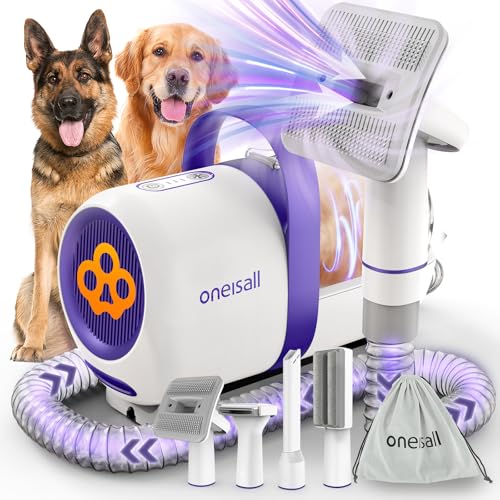
Products such as the Neakasa P1 Pro and Oneisall 7-in-1 Pet Grooming Kit represent the compact all-in-one category. Their appeal is the combination of a grooming brush, de-shedding tool, clipper, and collection unit in one package. Before buying, check the exact regional version, included attachments, replacement-filter availability, and whether the clipper can operate independently of the vacuum.
These compact kits are generally best for home grooming rather than continuous professional use. A groomer handling several large, heavily shedding dogs each day should instead consider a more robust canister-style unit with a larger motor, longer duty cycle, stronger hose fittings, and readily available consumables. If a listing does not specify how filters, blades, and hoses are replaced, ownership may become inconvenient even when the initial price is attractive.
Ownership costs and parts that wear first
Expect general-market prices of roughly $50–$100 for basic kits, $100–$200 for better-equipped home systems, and $200 or more for heavier-duty equipment. The purchase price is only part of the cost. Filters, clipper blades, brush heads, and sometimes batteries or chargers may need replacement.
- Filters: wash only when the instructions permit it, and let them dry completely before reinstalling. A damp filter can restrict airflow and encourage odour.
- Clipper blades: clean and oil them as directed. Dull blades pull hair and generate more heat.
- Hoses: inspect the ends for packed fur, especially where the hose connects to the bin or brush head.
- Brushes: remove wrapped hair after every session. Bent teeth and cracked plastic are signs to replace the attachment.
- Battery systems: store the battery according to the manufacturer’s guidance and avoid starting a long grooming session with a nearly empty charge.
A common mistake is vacuuming a wet coat. Damp hair clumps inside the hose and filter and can create odour or damage components unless the machine is specifically designed for wet collection. Another is using the strongest setting everywhere. Start low, keep the tool moving, and stop if the skin is being pulled or the pet becomes uncomfortable.
Simple buying checklist
For most households, prioritise variable suction, a washable multi-stage filter, a transparent 2-litre-or-larger bin, a hose of at least 1.5 metres, and a soft brush plus a de-shedding tool. Add low-noise operation for cats or anxious pets, and choose a metal-bodied clipper only if you regularly trim an appropriate coat.
The best pet grooming vacuums are the ones your animal will tolerate and that you will maintain consistently. A quieter medium-power machine with accessible filters can outperform a louder high-power model that stays in a cupboard because grooming becomes stressful or cleanup is difficult.