Key takeaways
- Channel layout: 2.0 — two full-range channels, no dedicated subwoofer driver
- Connections: Bluetooth, HDMI-ARC, optical, and AUX — an unusually complete set at this tier
- Auto volume boost: a dynamic-range compressor that lifts quiet dialogue during explosions and music cues
- Equalizer: three preset modes, typically voiced as something like movie, music and news/dialogue
- Placement: shelf or TV-stand top, with wall-mount holes typical of the class
Top 3 Picks
The best-sounding TV soundbar overall for most rooms is the Bose TV Speaker (2nd Gen), because its dialogue-forward tuning, HDMI-ARC hookup and compact cabinet make it the easiest premium bar to live with in a small or mid-size living room. The Amazon Fire TV Soundbar is the best budget-adjacent pick for streaming-first households that want virtual height effects without buying a separate subwoofer. The Amazon Fire TV Soundbar Plus is the best premium choice when you want built-in bass and a 3.1 channel layout without adding a floor-standing sub.
Quick Comparison
Every soundbar below is a real, currently listed product. Price tiers are deliberately general because street prices move week to week.
| Product | Best for | Key specs | Price tier |
|---|---|---|---|
| Assistrust Sound Bar for Smart TV | Cheapest path to a big volume jump | 2.0 channel; Bluetooth, HDMI-ARC, optical, AUX; auto volume boost; 3 EQ modes | Budget |
| Bose TV Speaker | Dialogue clarity in small rooms | 2.0 channel; Bluetooth + HDMI-ARC; all-in-one compact chassis; no subwoofer out of the box | Premium |
| Amazon Fire TV Soundbar | Streaming-first buyers wanting virtual height | 2.0 channel; DTS Virtual:X; Dolby Audio; Bluetooth | Mid-range |
| ULTIMEA 2.1ch Soundbar | Bass on a tight budget | 2.1 channel; built-in subwoofer; app control; home theater voicing | Budget |
| Sony S100F 2.0ch | Slim fit under a wall-mounted TV | 2.0 channel; compact and slim; Bluetooth; optical-first connection | Budget |
| Bose TV Speaker (2nd Gen) | Best overall balance of dialogue and size | 2.0 channel; Bluetooth + HDMI-ARC; clear-dialogue tuning; Dolby Audio decoding | Premium |
| Amazon Fire TV Soundbar Plus | Bass plus height effects, no separate sub | 3.1 channel; built-in subwoofer; Dolby Atmos; clear-dialogue mode | Premium |
| Saiyin Sound Bar | Wide, speaker-heavy budget bar | 4 drivers; surround processing; 17-inch chassis; Bluetooth | Budget |
| LG S30A 2.1ch | TV-brand matching with real sub bass | 2.1 channel; wireless subwoofer; Dolby Audio; HDMI/optical | Mid-range |
| Roku Streambar SE | Replacing a slow streaming stick and a weak TV speaker at once | 2.0 channel; 4K streaming built in; voice remote ecosystem | Mid-range |
| VastSND Dolby Digital Plus Sound Bar | Loud, simple, dialogue-focused mid-range setups | 110W claimed output; Dolby Digital Plus decoding; smart TV pairing | Mid-range |
How We Chose
This roundup is built from published product listings, manufacturer specification sheets and well-documented category behavior, not from our own measurements. The first filter was channel configuration, because a 2.0 bar and a 3.1 bar solve different problems: 2.0 designs trade bass extension for a smaller cabinet and simpler setup, while 2.1 and 3.1 designs add a dedicated low-frequency driver or subwoofer that changes how a room feels during action scenes. The second filter was connection set, since HDMI-ARC support determines whether your TV remote can control volume at all, and optical-only bars push you back to a second remote. The third filter was physical size, because a 17-inch bar and a 35-inch bar suit very different furniture. The fourth was upgrade path: whether a bar accepts a later subwoofer, supports a wireless surround add-on, or is a dead end. Finally, we weighted brand track record for firmware support and app stability, since a soundbar whose app is abandoned becomes a bar you can never re-tune. Every category — budget, mid-range, premium — includes at least two genuinely different approaches so you can pick by situation rather than by price alone.
1. Assistrust Sound Bar – Best for the Cheapest Volume and Dialogue Jump
As an Amazon Associate we earn from qualifying purchases at no extra cost to you.

Who it suits
This is a bar for someone whose TV speakers are genuinely bad — thin, muffled, and impossible to hear at low volume in a kitchen-adjacent living room — and who wants to fix that for the least money possible. It is also a reasonable second-room or bedroom bar, because the feature set is deliberately simple and the physical footprint is small enough to sit on a dresser without dominating it.
Key specs and features
- Channel layout: 2.0 — two full-range channels, no dedicated subwoofer driver
- Connections: Bluetooth, HDMI-ARC, optical, and AUX — an unusually complete set at this tier
- Auto volume boost: a dynamic-range compressor that lifts quiet dialogue during explosions and music cues
- Equalizer: three preset modes, typically voiced as something like movie, music and news/dialogue
- Placement: shelf or TV-stand top, with wall-mount holes typical of the class
Strengths
The connection list is the headline. HDMI-ARC on a budget bar means your TV remote controls volume and the bar wakes with the TV — the single biggest quality-of-life feature in this category, and one that many cheap bars still omit in favor of optical-only. AUX and Bluetooth expand it into a general-purpose speaker for phone audio and casual music, which is exactly what a second-room bar should be. The auto volume boost is genuinely useful if you watch a lot of broadcast television or older films with wildly inconsistent mixes.
The three-band EQ approach is also the right call at this price. Rather than pretending to offer room correction, it gives you a dialogue-forward setting you can leave on permanently and a bass-heavy setting for music. Used as a permanent dialogue preset, it addresses the most common complaint about budget TVs.
Pros
- HDMI-ARC plus optical, AUX and Bluetooth in one budget package
- Auto volume boost genuinely helps with inconsistent broadcast audio
- Three EQ presets cover movies, music and spoken-word content
- Small, light and easy to relocate between rooms
Cons
- 2.0 configuration means limited low-frequency output — no real sub-bass
- No wireless subwoofer output, so there is no bass upgrade path
- No object-based surround decoding; stereo only, widened by processing at most
- Build materials and driver size are entry-tier, which caps maximum clean volume
How it compares
Against the Sony S100F, the Assistrust wins on connection flexibility — the Sony leans optical-first, while this bar gives you ARC, AUX and Bluetooth alongside it. Against the ULTIMEA 2.1ch, the Assistrust loses on bass, because the ULTIMEA packs a built-in subwoofer driver. If dialogue clarity is your only goal, either works. If you want the bar to double as a music speaker with some low-end weight, the ULTIMEA is the better fit; if you need the widest input set for the least money, this is the pick.
2. Bose TV Speaker – Best for Pure Dialogue Clarity in Small Rooms

Who it suits
This bar suits the viewer who watches a lot of drama, news, panel shows and dialogue-driven streaming, and who has a small to medium living room where bass is less important than being able to follow every line. It is also the natural choice for apartments with shared walls, where a subwoofer is a liability rather than a feature.
Key specs and features
- Channel layout: 2.0 — all-in-one chassis, no external subwoofer
- Connections: Bluetooth and HDMI-ARC, plus optical and analog inputs typical of the model
- Voicing: dialogue-forward tuning, with a bass-adjustment control rather than a full EQ suite
- Form factor: compact, low-profile cabinet designed to sit in front of a TV without blocking the screen
- Control: included remote plus TV-remote volume control over ARC
Strengths
Bose’s entire reputation in this category rests on midrange and vocal intelligibility, and this bar is the clearest expression of that philosophy. The tuning pushes consonants and speech band frequencies forward, which is exactly what you want when a film mixes dialogue under a swelling score. The bass control is a single dial rather than a menu tree, which means you can add warmth in thirty seconds without reading a manual.
HDMI-ARC plus Bluetooth covers the two connections that matter in practice: the TV and your phone. Setup is genuinely minimal — one cable, one power lead, and the bar is running. The compact cabinet is also a real advantage in a room where a 35-inch bar would crowd the furniture. In a small room, its output is more than sufficient; the bar’s limits only become obvious when you ask it to fill a large open-plan space.
Pros
- Best-in-class dialogue intelligibility for the size and price tier
- Extremely simple setup and a single bass control instead of a menu system
- Compact cabinet fits small media units and won’t block the screen
- Bluetooth makes it useful for music when the TV is off
Cons
- No subwoofer and no subwoofer output — bass is inherently limited
- No Dolby Atmos or object-based height channels
- Premium price for a 2.0 bar, so you are paying for tuning and build, not features
- Won’t satisfy large open-plan rooms or heavy action-movie listeners
How it compares
Against the Bose TV Speaker (2nd Gen), this first-generation bar is the value option: same dialogue-first philosophy, slightly less refined processing and a lower price tier. Against the Amazon Fire TV Soundbar, it trades virtual height effects and a lower price for noticeably better speech intelligibility and build quality. If you want cinematic effects, the Fire TV bar is more fun; if you want to understand whispered dialogue at low volume, this is the better bar.
3. Amazon Fire TV Soundbar – Best for Streaming-First Rooms Wanting Virtual Height

Who it suits
This is aimed squarely at households already living inside the Fire TV ecosystem, or anyone who wants a mid-range bar that simulates overhead effects without the cost and clutter of up-firing drivers or ceiling speakers. It suits a medium living room with a streaming-heavy diet of films and series.
Key specs and features
- Channel layout: 2.0 — two-channel bar with processing rather than physical surround drivers
- Surround processing: DTS Virtual:X, which creates the impression of height and rear effects from a front-firing bar
- Audio decoding: Dolby Audio support
- Connectivity: Bluetooth, plus HDMI and optical inputs standard for the model
- Ecosystem: designed to pair with Fire TV devices and integrate with their interface and remotes
Strengths
DTS Virtual:X is the reason to consider this bar over a plain 2.0 competitor. It is a processing technology, not a physical speaker array, so it can’t place effects truly behind you — but it does widen the soundstage and lift some effects upward in a way that makes films feel larger than a stereo bar normally manages. For a mid-range price, that is a meaningful experiential upgrade.
The Fire TV integration is the second advantage. If you already use a Fire TV Stick or Cube, the bar slots into that ecosystem rather than fighting it: one remote, one interface, fewer HDMI headaches. Bluetooth covers phone audio, and the input set is broad enough for a games console and a disc player without a switcher. The main caveat is that virtual height is heavily dependent on room shape and seating position, so results vary more than they do with a physical subwoofer upgrade.
Pros
- DTS Virtual:X delivers a wider, taller soundstage than plain stereo
- Dolby Audio decoding covers the formats most streaming services actually deliver
- Tight integration with the Fire TV ecosystem and its remotes
- Mid-range price with Bluetooth and multiple wired inputs
Cons
- Virtual surround can’t reproduce true rear-channel placement
- No dedicated subwoofer, so deep bass is limited
- Height effect depends heavily on room geometry and where you sit
- The ecosystem integration matters less if you don’t use Fire TV devices
How it compares
Against the Amazon Fire TV Soundbar Plus, this is the value play: the Plus adds a built-in subwoofer and a 3.1 channel layout, which is a straightforward step up in bass. Against the Bose TV Speaker, the Fire TV bar is cheaper and more theatrical but less articulate on dialogue. Choose this one if effects and streaming integration matter more than vocal precision; choose Bose if they don’t.
4. ULTIMEA 2.1ch Soundbar – Best for Real Bass on a Budget

Who it suits
This is the bar for someone who wants a home-theater feel — rumbling action, thumping music — but has a hard ceiling on spend and no interest in running a cable to a separate subwoofer box. It suits a small to medium room, a bedroom, or a rented flat where a floor-standing sub is impractical.
Key specs and features
- Channel layout: 2.1 — stereo channels plus a dedicated bass driver built into the bar itself
- Subwoofer: integrated, not separate — no second box, no second power socket, no wireless pairing step
- Control: companion app for EQ and settings adjustment
- Positioning: marketed as a home theater system, typically with wall-mount and shelf options
- Connectivity: Bluetooth plus wired TV inputs typical of the class
Strengths
The built-in subwoofer is the entire value proposition, and it matters more than it sounds. A 2.1 bar with an integrated bass driver gives you the punch that a 2.0 bar of the same price simply cannot produce, and it does so without a crawling-around-the-floor setup session. In a room under roughly 200 square feet, an integrated sub is usually enough; it’s in larger, open-plan spaces that the lack of a separate sub becomes audible.
App control is a genuine differentiator at the budget tier. Instead of cycling through EQ presets with a single button and hoping, you get sliders for bass and treble and named presets for films, music and dialogue. That’s a real usability advantage — the ability to tune dialogue upward for a night of drama and then re-tune for music is something most budget bars don’t offer. Just be aware that app quality and long-term support vary enormously at this price.
Pros
- Integrated subwoofer delivers bass that 2.0 bars at this price can’t touch
- No separate sub box means fewer cables and a simpler setup
- App-based EQ gives more tuning control than rival budget bars
- Good fit for bedrooms and small apartments
Cons
- Integrated bass driver can’t match a dedicated wireless subwoofer for depth
- App dependence means lost flexibility if support ends
- No object-based surround or height channels
- Can sound boomy in a small, hard-surfaced room without tuning
How it compares
Against the LG S30A, this is a budget-versus-mid-range decision: the LG ships a genuinely separate wireless subwoofer, which reaches deeper and lets you place bass where it sounds best, while the ULTIMEA keeps everything in one box. Against the Assistrust, the ULTIMEA trades some input flexibility for clearly better low-end. If bass is the priority and budget is the constraint, this is the pick.
5. Sony S100F 2.0ch – Best for Slim Fit Under a Wall-Mounted TV

Who it suits
This bar suits someone with a wall-mounted TV and limited clearance beneath it, or a narrow console where a deeper bar simply won’t fit. It’s also a sensible pick for a bedroom TV or a secondary display where you want better sound without a large piece of furniture.
Key specs and features
- Channel layout: 2.0 — compact and slim cabinet, no subwoofer
- Design priority: low profile and short height, engineered for placement under a wall-mounted screen
- Connectivity: Bluetooth plus optical and analog TV inputs typical of the model
- Control: dedicated remote, with TV-remote control depending on the connection used
- Brand support: Sony’s established audio tuning and firmware support history
Strengths
The physical design is the reason to buy it. A slim bar that fits in the gap under a wall-mounted TV solves a problem that chunky, bass-heavy bars create — if a bar is too tall, it blocks the bottom of the picture or the TV’s infrared receiver, which is a daily annoyance. Sony also tends to tune its entry bars with a mild midrange lift, so dialogue comes through more clearly than on generic budget competition.
Setup is about as simple as it gets: power, one audio cable, done. Bluetooth adds phone and tablet playback, which makes it useful in a bedroom as a general speaker. The trade-off is straightforward — a slim 2.0 cabinet has very little internal volume, so bass extension is modest and maximum output is limited. It’s a fix for bad TV speakers, not a home theater system.
Pros
- Genuinely slim profile that fits under wall-mounted TVs and in tight consoles
- Clear dialogue tuning from a brand with strong audio heritage
- Very simple, near-instant setup
- Bluetooth streaming for music playback
Cons
- Minimal bass — no subwoofer and little cabinet volume to work with
- Optical-first connectivity means fewer ARC conveniences than rival bars
- Not suitable for large rooms or loud action viewing
- Slim cabinets trade output for size, which is audible at higher volumes
How it compares
Against the Saiyin Sound Bar, the Sony wins on brand firmware support and slim form factor, while the Saiyin offers more drivers and a wider 17-inch chassis that produces a broader soundstage. Against the Assistrust, the Sony gives up HDMI-ARC convenience in exchange for better tuning and a much slimmer cabinet. If clearance is your constraint, this is the one.
6. Bose TV Speaker (2nd Gen) – Best Overall for Most Rooms
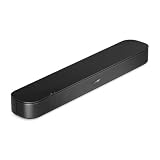
Who it suits
This is the default recommendation for the largest group of buyers: a small or medium living room, mixed viewing of drama, sport, news and streaming films, a TV stand with limited depth, and no appetite for subwoofer placement or menu-heavy tuning. It also suits anyone who has been disappointed by a cheap bar’s muffled dialogue.
Key specs and features
- Channel layout: 2.0 — all-in-one compact cabinet
- Audio decoding: Dolby Audio support
- Connectivity: HDMI-ARC and Bluetooth, with the wired inputs typical of the line
- Voicing: explicit clear-dialogue tuning as the design goal
- Control: included remote plus TV-remote volume and power via ARC
Strengths
What separates the second generation from its predecessor is refinement rather than a new feature list: cleaner processing, tighter control of the dialogue band, and a slightly more composed presentation at moderate volumes. In practice that means you can leave it in its default voicing and stop thinking about it, which is the highest compliment you can pay a soundbar.
HDMI-ARC plus Bluetooth is the correct minimum feature set in this tier, and it’s executed without fuss. The bar powers on with the TV, responds to the TV remote, and switches to Bluetooth without a menu dive. The compact cabinet fits a shallow TV stand and won’t obstruct a wall-mounted screen. Where it earns the “best overall” label is that it commits to a specific, useful tuning rather than chasing feature checkboxes it can’t deliver well — no fake surround modes, no underpowered virtual height, just clear voices and adequate warmth.
Its limits are honest and predictable. There’s no subwoofer, so explosions lack physical weight; there are no object-based height channels, so films won’t fill the ceiling. In a room much larger than about 250 square feet, you’ll run out of headroom before you run out of movie.
Pros
- Best dialogue clarity in the roundup for everyday viewing
- Dolby Audio decoding plus HDMI-ARC and Bluetooth
- Setup takes minutes with one HDMI cable
- Compact enough for shallow stands and small rooms
Cons
- No subwoofer output, so there’s no bass upgrade path
- No Dolby Atmos or height channels
- Premium price for a 2.0 feature set
- Headroom is limited in large open-plan rooms
How it compares
Against the first-generation Bose TV Speaker, the 2nd Gen is the better bar if the price gap is small: same philosophy, more refined processing. Against the Amazon Fire TV Soundbar Plus, it gives up built-in bass and Atmos in exchange for better vocal articulation and a smaller footprint. If you mainly watch dialogue-driven content in a normal-sized room, this remains the safest pick in the list.
7. Amazon Fire TV Soundbar Plus – Best Premium Pick for Bass Without a Separate Sub

Who it suits
This is for the buyer who wants a premium experience but refuses to place a subwoofer box on the floor, or who has a media unit with no space beside it. It suits a medium living room with a film- and series-heavy viewing habit and a preference for one remote and one ecosystem.
Key specs and features
- Channel layout: 3.1 — left, right and centre channels plus a dedicated bass driver
- Subwoofer: built in, so no separate box or wireless pairing step
- Surround format: Dolby Atmos decoding for object-based height effects
- Voicing: a dedicated clear-dialogue mode for speech-heavy content
- Ecosystem: integration with Fire TV devices and their remotes
Strengths
The 3.1 channel layout is a real structural advantage, not a marketing label. A dedicated centre channel is exactly what makes film dialogue intelligible when music and effects are competing for the same drivers — this is why cinema systems use one. Combined with a clear-dialogue mode you can toggle, the Plus handles the single most common soundbar complaint better than any 2.0 bar in this list.
Dolby Atmos decoding adds height information on top of that, and the built-in subwoofer supplies the low end that the standard Fire TV Soundbar lacks. The result is a bar that covers dialogue, bass and some sense of overhead space in one chassis. The clear trade-off is that built-in bass is limited by physics: a subwoofer driver inside a bar has a fraction of the cabinet volume of a standalone sub, so it produces punch and warmth rather than the deep, room-filling rumble a dedicated sub delivers.
Pros
- Dedicated centre channel for genuinely better dialogue separation
- Built-in subwoofer with no extra box, cable or pairing step
- Dolby Atmos decoding for height effects on compatible content
- Clear-dialogue mode plus tight Fire TV ecosystem integration
Cons
- Built-in bass can’t match a standalone wireless subwoofer
- Atmos height effects are dependent on room shape and content
- Premium price, and ecosystem benefits are wasted outside Fire TV
- Single-chassis design limits how far bass can be physically separated from the bar
How it compares
Against the standard Amazon Fire TV Soundbar, the Plus is a clear upgrade: centre channel, Atmos and real bass for a higher price. Against the LG S30A, the decision turns on bass philosophy — the LG’s separate wireless sub reaches deeper and can be positioned independently, while the Plus keeps everything in one footprint and adds a centre channel. If floor space is the constraint, the Plus wins; if bass depth is, the LG does.
8. Saiyin Sound Bar – Best for a Wide, Speaker-Heavy Budget Soundstage

Who it suits
This suits a budget buyer with a reasonably wide TV stand who wants a bar that looks and sounds like a proper speaker array rather than a thin strip. It’s a good fit for a bedroom or a secondary living space where you want surround-ish width without spending mid-range money.
Key specs and features
- Drivers: four speakers, giving more physical radiating area than typical 2-driver budget bars
- Processing: surround sound processing for a widened stage
- Size: 17-inch chassis — wider than many budget bars but still compact
- Connectivity: Bluetooth plus wired TV inputs typical of the class
- Placement: shelf, stand top or wall mount
Strengths
Four drivers in a 17-inch bar is a meaningful advantage at the budget tier, because a wider physical array produces a broader stereo image than a narrow two-driver strip. The effect is noticeable on music and on films with a lot of lateral movement — a car crossing the screen, a crowd scene — which is precisely where cheap bars sound small and boxed in. The surround processing builds on that width, though it remains processing rather than true rear-channel reproduction.
For the price, it’s a low-risk upgrade from TV speakers, and the 17-inch width compares favourably to the much slimmer Sony S100F if footprint isn’t constrained. As with all budget bars, expect the low end to be modest and the top end to get harsh if you push volume. It’s a straightforward, honest speaker for the money.
Pros
- Four drivers deliver a wider soundstage than most budget competitors
- 17-inch chassis fits most TV stands while still being compact
- Surround processing adds some spatial width
- Very accessible price for a multi-driver design
Cons
- No subwoofer and limited bass extension
- Sound can turn harsh at high volume
- Firmware and app support are far less established than major brands
- Wider chassis may not fit very narrow consoles
How it compares
Against the Sony S100F, the Saiyin wins on driver count and soundstage width but loses on tuning refinement, firmware support and slim-fit flexibility. Against the ULTIMEA 2.1ch, it trades bass for width — the ULTIMEA has an integrated subwoofer, the Saiyin has more drivers spread over a wider bar. If your room is wide and your budget is tight, width often reads as more impressive than depth.
9. LG S30A 2.1ch – Best Mid-Range Pick with a Real Wireless Subwoofer

Who it suits
This is the pick for someone who wants authentic sub-bass and the freedom to place it, without jumping to the premium tier. It suits a medium living room, and it’s a natural fit if you already own an LG TV and want the two to feel like one system.
Key specs and features
- Channel layout: 2.1 — stereo bar plus a separate subwoofer
- Subwoofer: wireless, so it pairs without running a cable across the room
- Audio decoding: Dolby Audio support
- Connectivity: HDMI and optical inputs standard for the model, plus Bluetooth on typical variants
- Integration: designed to work smoothly with LG televisions and their remotes
Strengths
The separate wireless subwoofer is the defining advantage. Placing a sub on the floor in a corner lets it use room boundaries to reinforce low frequencies — a benefit no integrated design can replicate, because bass output depends heavily on cabinet volume and boundary loading. The result is deeper, more physical bass with genuine placement flexibility: you can tuck the sub behind a sofa or beside a cabinet, and if the bass sounds bloated, moving it six inches often fixes it.
Mid-range positioning also buys you better processing and reliability than budget bars, and Dolby Audio decoding covers what streaming services actually deliver. If you own an LG TV, the integration reduces remote clutter further. The trade-off is the extra box and power socket — and the fact that a 2.1 system without a centre channel has less dialogue separation than a 3.1 design.
Pros
- Separate wireless subwoofer delivers bass no integrated design can match
- Sub can be repositioned to tune bass response for the room
- Dolby Audio decoding and the full wired input set
- Mid-range price with strong brand support and firmware history
Cons
- Requires floor space and a second power socket for the sub
- No dedicated centre channel, so dialogue separation lags a 3.1 bar
- No Dolby Atmos or height channels
- Bass can overwhelm small, hard-surfaced rooms without adjustment
How it compares
Against the Amazon Fire TV Soundbar Plus, the LG wins on bass depth and placement flexibility, while the Plus wins on dialogue separation and footprint. Against the ULTIMEA 2.1ch, this is a straight upgrade in bass quality and brand support for a higher price. If you can accommodate one small box on the floor, the S30A is the best bass-per-price option here.
10. Roku Streambar SE – Best for Replacing a Streaming Stick and Weak TV Speakers at Once

Who it suits
This suits a household that is currently juggling a slow streaming stick and poor TV speakers, and would rather solve both problems with one purchase and one remote. It suits a secondary TV, a bedroom, or a main TV in a household that lives primarily in the Roku interface.
Key specs and features
- Channel layout: 2.0 — compact bar, no subwoofer
- Streaming: 4K streaming device built into the soundbar itself
- Control: voice remote as part of the Roku ecosystem, with a unified interface for apps
- Audio processing: speech-focused tuning typical of the Streambar line
- Connectivity: HDMI to the TV plus Bluetooth for phone audio
Strengths
The consolidation argument is the strongest one. Two devices — a streaming stick and a soundbar — become one, which removes an HDMI port, a power adapter and a remote from your setup. The Roku interface remains one of the least cluttered ways to navigate streaming apps, and the voice remote handles both search and volume. For a bedroom or secondary TV, that reduction in clutter is often worth more than raw audio performance.
On audio, the Streambar line is tuned to clarify speech, which is the right target given its typical use as a bedroom or kitchen-adjacent bar. It won’t fill a large room or provide meaningful bass — the cabinet is compact and there’s no subwoofer. But if your alternative is TV speakers plus a streaming stick, this is a strictly better arrangement on both counts.
Pros
- Combines 4K streaming and a soundbar in a single device and remote
- Frees up an HDMI port and reduces cable clutter
- Speech-focused tuning suits news, drama and casual viewing
- Well-suited to bedrooms and secondary TVs
Cons
- No subwoofer and limited bass output
- Not powerful enough for large living rooms
- Value depends on wanting the Roku ecosystem specifically
- No surround or height-channel processing
How it compares
Against the VastSND Dolby Digital Plus Sound Bar, the Roku trades higher claimed amplifier output and Dolby Digital Plus decoding for built-in 4K streaming and ecosystem convenience. Against the Sony S100F, it gives up slim-profile flexibility but adds a streaming device the Sony doesn’t have. If you need both a streamer and better TV sound, this is the efficient answer.
11. VastSND Dolby Digital Plus Sound Bar – Best for Loud, Simple Dialogue-Focused Setups

Who it suits
This suits a buyer who wants more volume headroom than budget bars provide, values dialogue clarity over cinematic effects, and wants a straightforward wired setup with a smart TV. It’s a good fit for a medium room where the main complaint is simply that the TV isn’t loud or clear enough.
Key specs and features
- Claimed output: 110W, which is high for the mid-range tier
- Audio decoding: Dolby Digital Plus, a step up from basic Dolby Digital and well matched to streaming content
- Positioning: marketed as a home theater bar for smart TVs
- Connectivity: Bluetooth plus the wired TV inputs typical of the class
- Control: dedicated remote, with TV-remote control depending on connection
Strengths
Dolby Digital Plus is the meaningful spec here. It’s the format most streaming platforms actually transmit, and it carries more data than plain Dolby Digital, so a bar that decodes it natively can present dialogue and effects with better separation than one that downmixes. Combined with a claimed 110W of amplification, this bar targets people who want clarity at higher volumes — a real problem in rooms where the sofa is far from the TV.
Setup is deliberately simple: connect, pair and go, with the usual wired and Bluetooth options. The trade-off, as with all bars at this tier, is that power claims don’t guarantee bass. Without a subwoofer, low frequencies remain the weak point, and a 2.0 cabinet with a lot of amplifier behind it can sound thin at high volume even while it sounds loud in the midrange.
Pros
- Dolby Digital Plus decoding matches the format streaming services use
- High claimed 110W output for the price tier
- Straightforward wired setup with Bluetooth added
- Dialogue-focused character suits news, sport and drama
Cons
- No subwoofer, so bass remains limited despite the power rating
- Can sound thin at high volume on bass-heavy content
- No surround or height-channel processing
- Brand support and firmware history are less established than major manufacturers
How it compares
Against the Roku Streambar SE, the VastSND offers more amplification and native Dolby Digital Plus decoding but no built-in streaming device. Against the LG S30A, it gives up the wireless subwoofer that defines the LG’s bass advantage. If your priority is simply louder, clearer dialogue from a smart TV and you don’t want an extra box, this is the sensible mid-range pick.
How to Choose
Buying a soundbar is really four separate decisions wearing a trench coat: how you’ll connect it, how much bass the room can take, how big the cabinet can be, and which features you’ll actually use. Work through them in that order and the list above collapses quickly.
Start with the connection, because it governs daily use
HDMI-ARC (Audio Return Channel) is the single most important specification for most buyers, because it lets the TV remote control the soundbar’s volume and power and lets the bar turn on with the TV. Without ARC, you’ll be reaching for a second remote every time you want to adjust the volume, which is the fastest way to stop using a soundbar altogether. Optical connections work fine for audio but don’t carry that control channel, and AUX is a fallback, not a plan. Bluetooth matters for phone and tablet audio but is not a substitute for a wired TV link, because it introduces lip-sync delay on most TVs. If you watch anything with dialogue — which is everything — prioritize HDMI-ARC over every other port.
One practical note: ARC and eARC are not the same. eARC carries higher-bandwidth formats like uncompressed object audio, while standard ARC typically handles Dolby Digital Plus and compressed bitstreams. Almost all streaming content arrives in the lower-bandwidth formats, so standard ARC is sufficient for the vast majority of setups. If your TV is more than about six years old, check whether it has ARC at all — many older sets have HDMI inputs without the return channel, and on those a soundbar behaves like any other HDMI source.
Match bass to the room, not the price tag
Bass output is governed by physics, and physics doesn’t care how much you spent. A 2.0 bar has no dedicated low-frequency driver, so it will produce some warmth but no real weight below the upper bass. A 2.1 bar — whether the sub is integrated, as on the ULTIMEA, or separate and wireless, as on the LG S30A — adds a driver whose only job is low frequencies, which is why the difference is so obvious during action scenes. As a rough guide, a 2.0 bar suits rooms up to roughly 200–250 square feet where dialogue is the priority, while a 2.1 system suits medium rooms and anyone who watches a lot of film and gaming content.
Room construction matters as much as room size. A room with hard floors, bare walls and large windows will make any subwoofer sound boomy and one-note, because low frequencies bounce rather than absorb. If you have that kind of room, a separate wireless subwoofer you can reposition is a significant advantage over an integrated one — moving a sub away from a corner or off a resonant floorboards section can transform its character in about ten minutes. Soft furnishings, a rug and bookshelves all help. If you have a shared wall with a neighbour, a 2.0 bar or a 2.1 system with a modest sub is the socially responsible choice; a large sub at high volume travels through structure more than through air.
Measure the space before you buy
Three dimensions decide whether a bar works in your room: width, height and depth. Height matters most for wall-mounted TVs, where a bar too tall will block the bottom of the screen or the TV’s infrared receiver. Depth matters on TV stands, where a deep bar can overhang the front edge or leave no room for a console behind it. Width matters because a wide bar in a narrow TV unit simply won’t sit flat. Budget bars range from roughly 17 inches wide to around 35 inches, and slim models are deliberately shallow to fit under wall-mounted screens. Measure your available clearance before looking at any spec sheet, and treat the bar’s physical dimensions as a hard filter rather than a preference.
Placement changes sound more than most people expect. A bar sitting flush against a wall gets reinforcement in the upper bass that can make voices sound chesty; pulling it forward by an inch or two often cleans that up. A bar recessed inside a cabinet will sound boxy and congested no matter how good it is, because the cabinet acts as a resonant chamber. If you can, place the bar on a hard, flat surface at roughly ear height when seated — a TV stand top is usually close enough — and avoid the very top shelf of a bookcase.
Decide how much you care about surround and height effects
True surround requires speakers behind or beside you. Anything a single front-firing bar calls surround — DTS Virtual:X on the Fire TV Soundbar, surround processing on the Saiyin, or Atmos decoding on the Fire TV Soundbar Plus — is psychoacoustic processing. It can widen the stage, lift effects upward and make a room feel bigger, and in a good room it’s genuinely enjoyable. But it will not place a bullet behind your head, and results vary with your seating position relative to the bar. If you sit dead centre in a moderately sized room, virtual processing works noticeably better than if you sit off to one side. If you want actual rear channels, plan for a system with separate surround speakers rather than expecting it from a single bar.
Similarly, Dolby Atmos on a soundbar is a real but partial implementation of Atmos. The format carries height information, and a bar with up-firing drivers or well-tuned virtual processing can create a sense of overhead space. Without up-firing drivers, Atmos mostly means better object placement within the front stage rather than genuine ceiling effects. That’s still worthwhile — it’s just not what a dedicated Atmos cinema system does.
Think about the upgrade path before the discount
The cheapest bar is expensive if it’s a dead end. Look for three things: a subwoofer output or wireless subwoofer support, so you can add bass later; a surround-speaker add-on option, if you might want rear channels eventually; and a track record of firmware updates from the manufacturer. Firmware matters more for soundbars than for most audio gear, because a bar’s behaviour changes with TV firmware, streaming app updates and HDMI handshaking. Bars from brands with established support histories — Sony, LG, Bose, Roku, Amazon — are more likely to keep working predictably three years from now than obscure budget models whose app is never updated again. A soundbar is a five-to-eight-year purchase for most people, so support longevity is a real part of the value calculation.
Tuning after setup: the fifteen minutes that matter
Most buyers plug in a bar, decide it sounds either muddy or thin, and leave it that way. In practice, three adjustments solve the majority of complaints. First, set the TV’s own audio output to the correct format — bitstream or Dolby Digital Plus rather than PCM downmix if your TV offers the choice, since a stereo downmix throws away the surround information the bar wants to process. Second, disable the TV’s internal speakers rather than leaving both on; running TV speakers and a soundbar simultaneously creates echo-like comb filtering that makes dialogue sound hollow. Third, tune the dialogue or speech mode before you tune the bass. Boosting bass is more satisfying in the moment, but it’s the most common cause of muffled dialogue, because low frequencies mask the speech band. If you find yourself repeatedly raising the volume during quiet scenes, a dialogue lift or centre-channel boost is the right fix — not more bass.
A worked sizing example
Suppose your living room measures 14 feet by 16 feet, which is 224 square feet — comfortably within the range where a 2.0 bar can work for dialogue-heavy viewing but where film soundtracks will feel lightweight. Your TV sits on a stand with 3 inches of clearance beneath it and 5 inches of depth available, which excludes deep, bass-heavy cabinets. You watch about two hours a day, split roughly 60% drama and news, 25% streaming films and 15% music. That profile points to a compact 2.0 bar with clear dialogue tuning and HDMI-ARC. If you later find film nights underwhelming, a 2.1 system with a separately placeable wireless sub is the logical upgrade — which is why choosing a bar with a subwoofer path now costs nothing and saves a full replacement later. If you have a hard-floored room of the same size and you mostly watch dialogue, spending premium money on a bass-heavy bar is actively counterproductive: you’d be paying for output that makes speech harder to hear.
Frequently Asked Questions
Do I need a subwoofer for good dialogue clarity?
No — and adding one can make dialogue worse if it’s tuned carelessly. Speech sits in the midrange, roughly from a few hundred hertz up to a few kilohertz, while subwoofers handle frequencies well below that. What a subwoofer adds is weight and physical impact, not intelligibility. In fact, exaggerated bass is one of the most common reasons people complain that movie dialogue sounds muffled, because low frequencies mask the speech band. If dialogue clarity is your goal, spend on tuning and a centre channel before you spend on a subwoofer.
Is HDMI-ARC worth paying more for than optical?
For most people, yes, because the benefit is daily rather than occasional. ARC lets your TV remote control the soundbar’s volume and power, and lets the bar switch on with the TV. Optical carries the same audio in most cases but has no control channel, so you’ll use a second remote every time you adjust volume. The practical difference shows up as friction: bars on optical tend to get used at a fixed volume and eventually ignored. If your TV has ARC, use it. If it doesn’t, optical still works fine and the audio quality is not the limiting factor.
Will a 2.0 soundbar fill a large living room?
It depends on size and content. Rooms up to roughly 250 square feet are usually fine for dialogue, news and casual viewing with a decent 2.0 bar. Beyond that, and especially in open-plan spaces that connect to a kitchen or dining area, the bar runs out of headroom before the room runs out of size. Two things help: a bar with a dedicated centre channel, which keeps dialogue anchored when effects are loud, and a separate subwoofer, which offloads low frequencies from the main drivers so they can focus on the midrange. In a genuinely large room, a 2.1 or 3.1 system is the realistic minimum.
How much difference does Dolby Atmos make on a soundbar?
Less than the marketing implies, but more than nothing. Atmos is an object-based format, so instead of assigning sounds to fixed channels it places them in three-dimensional space. A soundbar without up-firing drivers can still use that object information to place effects more precisely across its front stage, which is audibly better than plain stereo decoding. What it cannot do is bounce sound off your ceiling convincingly, so the height sensation is mild at best. If you want real overhead effects, you need either up-firing drivers or actual ceiling speakers — Atmos decoding on a flat bar is an enhancement, not a transformation.
Can I use a soundbar for music, or should I buy a separate speaker?
You can, and most bars with Bluetooth handle casual music well — background listening, podcasts, kitchen audio. Where soundbars struggle is critical music listening, because their cabinets are wide and shallow, which is the opposite of what stereo imaging wants, and their tuning is voiced for speech rather than musical balance. A bar with a dedicated subwoofer and a music EQ preset closes much of the gap. If music is your primary listening and film is secondary, a dedicated stereo speaker pair or a powered bookshelf system will serve you better for similar money, with the trade-off being remote control convenience and TV integration.
Why does my soundbar sometimes lose sync with the picture?
Lip-sync drift is nearly always a processing delay, not a fault. If the TV is doing heavy video processing — motion smoothing, upscaling, HDR tone mapping — the audio can arrive ahead of the picture, and most TVs and soundbars include an audio delay or AV sync setting to compensate. Bluetooth connections add their own latency and are the worst offenders, which is why Bluetooth is a poor choice as a permanent TV link. Check that the TV is outputting bitstream rather than PCM, disable unnecessary video processing modes, and use a delay slider if one is offered. Wired connections over HDMI or optical rarely drift at all.
How long should a soundbar last, and what fails first?
Expect five to eight years of useful life from a bar from an established brand, and somewhat less from budget models with thin support. The parts that wear or degrade are rarely the drivers — they’re the electronics and the software relationship. Firmware support ending is the most common cause of a bar losing functionality, because TV firmware updates and streaming app changes can break HDMI handshaking or app connectivity on a bar nobody is updating anymore. Physical wear shows up in the remote, the power supply and occasionally the cabinet’s plastic clips if it’s been remounted repeatedly. There are no real consumables, so cleaning is limited to dusting the grille and, on fabric-wrapped models, a soft brush rather than a wet cloth.
Should I match my soundbar brand to my TV brand?
It helps but it isn’t required. Same-brand pairing sometimes adds convenience features: unified menus, a single remote controlling both, or a shared settings screen. It rarely changes audio quality, because the bar decodes the same formats regardless of who made the TV. The exception is when a manufacturer reserves a specific processing mode or wireless audio format for its own televisions — that’s a real advantage if you already own the matching set. If you don’t, buy on the criteria that matter: connection type, bass approach, cabinet size and dialogue tuning.
Which Soundbar Should You Actually Buy?
If you want the safest all-round choice and dialogue clarity is the priority in a normal-sized room, the Bose TV Speaker (2nd Gen) is the pick — compact, ARC-connected, and voiced for voices. If your budget is tight and you mainly want your TV to be louder and clearer, the Assistrust bar gives you the widest connection set for the least money, while the ULTIMEA 2.1ch is the one to choose if you want some bass in the same price bracket. If you want real sub-bass and can place a small box on the floor, the LG S30A is the best mid-range option, and its wireless sub will beat any integrated design on depth. If you refuse a separate subwoofer but still want punch plus a dedicated centre channel for dialogue, the Amazon Fire TV Soundbar Plus is the strongest single-chassis premium choice. And if your TV is currently fed by a slow streaming stick, the Roku Streambar SE solves two problems at once — which, for a bedroom or secondary set, is often the smartest purchase on this list.