Key takeaways
- RV and travel trailer owners replacing a factory 17-inch range or upgrading an older one that lacks convection.
- Van lifers and skoolie builders who want propane cooking plus crisp-food capability without a second 1,500W appliance competing for inverter capacity.
- Cabin and tiny-home owners with a 17-inch range cutout and an existing propane system.
- Anyone whose “air fryer” need is really “I want oven food that isn’t soggy.” Convection ovens solve more of that problem than people expect.
Best Stoves With Air Fryer Functions: The Direct Answer
If you want a cooking appliance that genuinely combines a gas cooktop with a working air-fry oven, the RecPro Suburban 17″ RV Gas Range with Air Fryer is the best overall pick for most buyers who have a 17-inch cutout to fill — it pairs three sealed burners with a convection oven that circulates hot air hard enough to crisp food, and it runs on propane, which matters if you’re off-grid. If you’re cooking indoors on a countertop, the Iwatani 35FW gives you the most precise single-burner flame control in this roundup. If you only need a dedicated air-fry chamber and already own a stovetop you like, a countertop air-fry oven plus a good burner is a cheaper, more flexible path than a full range replacement. Everything below compares air-fry capacity, temperature accuracy, convection performance, cleaning, rack layouts, burner power, and installation requirements so you can pick by situation rather than by slogan.
Top 3 Picks
Best Overall: RecPro Suburban 17″ RV Gas Range with Air Fryer, 3 Burner Stove
This is the only appliance in this roundup that is a true range with an integrated air-fry function rather than a burner that you pair with a separate air fryer. It fits a 17-inch-wide cutout, gives you three burners plus an oven, and runs on propane — the standard fuel in RVs, vans, and cabins. It suits anyone replacing a factory RV range or building out a compact kitchen where a full-size 30-inch range won’t fit.
Best Budget: Gas One Portable Butane Camping Stove with Case
At the budget end, you’re buying a burner, not an oven — and the Gas One butane stove is the most predictable version of that idea. Automatic ignition, a stepless flame dial, and a hard carrying case make it the cheapest genuinely reliable way to get precise heat. Pair it with a countertop air fryer and you have a two-piece air-fry kitchen for less than the cost of a single mid-range appliance.
Best Premium: Coleman Cascade 3-in-1 Camp Stove
For outdoor cooking where you want range-style versatility, the Cascade 3-in-1 is the most capable premium option here: interchangeable cooktop, grill, and griddle surfaces mean you can sear, toast, and flat-top cook from one unit. It is not an air fryer, but it is the closest thing to a full outdoor kitchen in this list, and it’s the right pick if your air frying happens indoors while your heavy cooking happens outside.
Quick Comparison
| Product | Best For | Key Specs (as listed) | Price Tier |
|---|---|---|---|
| RecPro Suburban 17″ RV Gas Range with Air Fryer, 3 Burner | RV / van / cabin galley with 17″ cutout; combined cooktop + air-fry oven | 17″ wide; 3 burners; propane; integrated air-fry + convection oven; oven rack included | Premium |
| Suburban 17″ RV Stove Oven Range Air Fryer 3907A RA17BG (Backwoods Cabinetry) | Same category as above, piezo-ignition variant; replacement/upgrade fit | 17″ wide; 3 burners; piezo ignition; propane; air-fry oven; model 3907A / RA17BG | Premium |
| Gas One GS-3400P Dual Fuel Propane or Butane Stove | Portable dual-fuel cooking; camping and emergency backup | Dual fuel (propane or butane); patented design; carrying case; single high-output burner | Mid-range |
| ROVSUN 2 Burner Outdoor Propane Gas Stove, 150,000 BTU | High-output outdoor batch cooking; crawfish boils, canning, wok | 2 burners; 150,000 BTU total; adjustable high-pressure regulator; stand/legs | Mid-range |
| COZZIVITA 4-Piece Drip Pans Set (GE-compatible) | Restoring and protecting an existing electric coil stovetop | 4 pieces; chrome finish; fits GE-style electric coil burners | Budget |
| Gas One Portable Butane Camping Stove with Case | Cheapest precise indoor/outdoor burner; tabletop use | Butane; automatic ignition; precise heat control dial; hard case | Budget |
| Coleman Triton 2-Burner Propane Stove | Car camping with two simultaneous pans | 2 burners; propane; portable fold-down cooktop | Mid-range |
| Coghlan’s Portable Folding Camp Stove | Backpacking and emergency kits; smallest possible footprint | Folding steel frame; lightweight; single small burner; solid fuel or canister dependent | Budget |
| Iwatani 35FW Single-Burner Butane Cooktop | Indoor countertop precision cooking; hot pot, simmering, wok | Single burner; butane; medium body size; high heat output; safety shutoff | Premium |
| Coleman Cascade 3-in-1 Camp Stove | Outdoor cooking with swappable cooktop / grill / griddle | 3 cooking surfaces; 2 burners; propane; portable | Premium |
| CUSIMAX Electric Burner Hot Plate, 1500W | Indoor electric cooking with no gas or open flame | Single burner; 1500W; cast-iron plate; electric | Mid-range |
| Weiman Glass & Ceramic Cooktop Cleaner Kit | Maintaining glass/ceramic and smooth cooktops | Cleaner plus cleaning tool; for glass and ceramic surfaces | Budget |
How We Chose
This roundup is built from product listings and category knowledge, not from testing. The selection filter came down to four things. First, category fit: only items that a person searching for “best stove with air fryer” would plausibly buy were included — meaning true air-fry ranges, and the burners, cooktops, accessories, and cleaning products that people actually pair with them. Second, spec transparency: where a product states concrete numbers (17-inch width, 150,000 BTU, 1500W), those numbers drive the recommendation; where a listing is vague, the product is described by spec class rather than an invented figure. Third, use-case coverage: the list intentionally spans indoor, outdoor, RV, and emergency cooking so a reader can match a product to their space instead of their budget alone. Fourth, upgrade path: a stove purchase is usually one step in a longer build-out, so we favored products that either pair well with a separate air fryer or replace a full appliance outright. Nothing here is claimed as tested or benchmarked.
1. RecPro Suburban 17″ RV Gas Range with Air Fryer, 3 Burner Stove — Best for RV and Compact Galley Kitchens
As an Amazon Associate we earn from qualifying purchases at no extra cost to you.

This is the anchor product of the whole roundup, and the reason is simple: it is the rare appliance that is simultaneously a three-burner gas range, a conventional oven, and an air fryer. If you have been trying to run an air fryer and a cooktop in a van or travel trailer, you already know the pain — two appliances, two power draws, and a countertop that’s already full. A 17-inch range with a built-in air-fry function collapses that into one footprint that was going to be occupied by a range anyway.
Who It Suits
- RV and travel trailer owners replacing a factory 17-inch range or upgrading an older one that lacks convection.
- Van lifers and skoolie builders who want propane cooking plus crisp-food capability without a second 1,500W appliance competing for inverter capacity.
- Cabin and tiny-home owners with a 17-inch range cutout and an existing propane system.
- Anyone whose “air fryer” need is really “I want oven food that isn’t soggy.” Convection ovens solve more of that problem than people expect.
Key Specs (as listed)
- Width: 17 inches — the standard compact RV range footprint.
- Burners: 3, gas (propane), typically arranged with a high-output center or front burner plus two smaller ones.
- Oven: integrated air-fry / convection function with forced-air circulation.
- Fuel: propane, with a piezo or electronic ignition depending on the exact variant.
- Included: oven rack; typically a broiler pan or similar accessory depending on configuration.
Strengths
The integrated air-fry function is the headline, but the real advantage is consolidation. A gas range gives you instant, high heat that doesn’t drain a battery bank; the convection oven gives you an air-fry mode without the 1,500W spike of a countertop unit. For anyone running a modest solar and battery setup, that difference is not cosmetic — it’s the difference between air frying at dinner and not. The 17-inch width also fits the most common RV range opening, which means fewer cabinet modifications.
The three-burner layout is genuinely usable in a small galley: one burner for a pot, one for a pan, one for a kettle or kettle-weight item. Where most compact ranges force you into a two-burner compromise, this one holds the line.
Convection and Temperature Behavior
Convection air-frying in a range oven works differently from a basket air fryer. A basket unit moves very hot air through a small, tight chamber, which is why it crisps so fast. A range oven moves air through a much larger cavity, so it’s gentler and slower but handles more food and doesn’t need shaking. The practical implication: expect longer times than a basket fryer for the same food, but better results for anything that benefits from even heat — roasted vegetables, sheet-pan chicken, reheated pizza, frozen fries in a single layer rather than a mound.
A common mistake is loading the rack too densely. Because air has to move around the food, a crowded pan defeats the entire point of a convection oven. If you’re buying this mainly for air-fry performance, plan on one rack and a single layer.
Rack Layout and Capacity
- Oven rack positions are limited in a 17-inch cavity — typically two usable positions.
- Air frying should be done on the upper-middle position for maximum circulation.
- For two-level cooking, you’ll need to rotate racks partway through; don’t expect a basket fryer’s evenness across two trays.
- Batch size is the real constraint: a compact oven air-fries roughly one sheet-pan’s worth at a time.
Cleaning and Ownership Realities
Gas range ovens in RVs accumulate grease on the oven walls and the door glass, and the convection fan housing can trap spatter. The fan area is the part people forget, and it’s the part that eventually smells like old food if ignored. Wipe the oven interior after any greasy cook while it’s still warm but not hot, and use a smooth-cooktop-safe cleaner on the glass door rather than an abrasive pad. The burner grates are cast and will last essentially forever; the igniter and thermocouple are the parts that fail first and are usually replaceable individually.
Installation Requirements
- A 17-inch-wide cabinet cutout, plus clearance at the rear for the gas line and at the top for ventilation.
- A propane supply with a regulator; most RV systems already provide this.
- Ventilation to the exterior — RV ranges are designed to vent outside, not into the cabin.
- Anti-tip hardware or secure mounting, which matters far more in a moving vehicle than in a house.
- Access to a 12V ignition circuit if the model uses electronic ignition.
Pros
- Only true range-plus-air-fryer in this list; replaces two appliances with one.
- Propane operation is battery-friendly and works off-grid.
- 17-inch width fits the most common compact range cutout.
- Three burners gives real cooking flexibility in a small space.
- Convection oven handles more food than a basket air fryer in one go.
Cons
- Highest cost tier in this roundup, and installation isn’t a plug-in job.
- Convection air frying is slower than a dedicated basket fryer.
- Small oven cavity limits batch size; you will run multiple rounds for a family meal.
- Requires propane and exterior venting — not viable for an apartment or dorm.
- In a moving vehicle, anything unsecured becomes a projectile; the oven must be latched properly in transit.
How It Compares
Its nearest alternative is the Suburban 17″ RV Stove Oven Range Air Fryer 3907A RA17BG, which occupies the same category and nearly the same footprint. The practical difference comes down to model generation, ignition type (piezo versus electronic), and which one matches your existing cabinet opening and gas connection. If you’re replacing a Suburban unit specifically, matching the model family reduces installation guesswork. If you’re starting fresh, compare the two side by side on burner layout and oven rack configuration — those are the differences you’ll notice daily. Against the portable burners in this list, both RV ranges are a different class of purchase entirely: they’re built-ins, and they cost and install like built-ins.
2. Suburban 17″ RV Stove Oven Range Air Fryer 3907A RA17BG 3 Burner Piezo — Best for Direct Replacement Fit

This is the sibling product to the RecPro-listed range above, and it deserves its own entry because the two are not interchangeable in practice — they’re the same category with different model lineage, and for a replacement job the model number is often the deciding factor. The 3907A / RA17BG designation tells you this is a specific Suburban-generation unit, which matters enormously if you’re dropping it into an existing 17-inch cutout with existing gas and vent connections.
Who It Suits
- Owners replacing a failed Suburban range who want to match the original model family rather than retrofit an unknown unit.
- DIY installers who want the least possible cabinet modification.
- Buyers who specifically want piezo ignition — a mechanical push-button spark that doesn’t depend on a 12V circuit or a battery.
- Trailer and fifth-wheel owners doing a mid-life galley refresh.
Key Specs (as listed)
- Width: 17 inches.
- Burners: 3, gas/propane.
- Ignition: piezo (push-button spark, no battery or 12V requirement).
- Oven: air-fry / convection function.
- Model designation: 3907A, RA17BG — useful for cross-referencing fit and parts.
- Oven rack included.
Strengths
The piezo ignition is the underrated feature here. Electronic ignition is convenient, but it depends on a working 12V supply, a good ground, and an igniter module that can fail. Piezo igniters are mechanical — you press a button and a spring-loaded crystal makes a spark. In a vehicle where electrical gremlins are a fact of life, that’s a genuine reliability advantage. It also means no parasitic draw when the range isn’t in use, which is a small but real benefit for anyone boondocking.
The model number itself is a strength. When you’re ordering a built-in appliance for a specific opening, being able to cross-reference “3907A” or “RA17BG” against a service manual, a parts diagram, or a forum thread is worth more than a spec sheet. Generic listings leave you measuring and hoping.
Air-Fry Function in Practice
As with any range-based air fryer, the oven cavity is larger than a basket fryer’s, so the crisping is gentler and the times are longer. What you gain is capacity and the ability to cook a full tray rather than a batch. Expect to use a single rack, keep food in one layer, and give the oven a full preheat — convection ovens reward preheating more than conventional ovens do, because the air has to be moving and hot before the food goes in, not warming up around it.
Because it’s propane, there is combustion moisture in the oven cavity. That’s normal, but it means very crisp results benefit from a slightly longer cook or a final few minutes with the door cracked. It’s a small technique adjustment, not a flaw.
Rack Layout and Oven Use
- Two usable rack positions in most 17-inch cavities; air frying goes on the upper position.
- One tray at a time for genuine crisping; two trays only for things that don’t need crunch.
- Rotate the pan halfway through for even browning, since a 17-inch oven has a small hot spot near the rear.
- Leave the rack in place for baking and roasting; remove it only when you need vertical space for a taller pan.
Cleaning and Maintenance
The routine is the same as any gas range oven: wipe the interior while warm, clean the door glass with a non-abrasive cleaner, and don’t let grease build up in the convection fan shroud. In a 17-inch oven, the fan shroud is small and clogs faster than in a full-size oven, so treat it as a monthly check rather than a yearly one. The burner grates are durable cast iron; the igniter electrode and the oven’s thermocouple are the components most likely to need replacement first, and both are typically available as individual parts.
Pros
- Piezo ignition works without 12V power or batteries.
- Specific model number makes fit and parts cross-referencing straightforward.
- Combined cooktop, oven, and air-fry function in a 17-inch footprint.
- Propane operation suits off-grid and boondocking use.
- Proven Suburban category design with widely available service information.
Cons
- Premium price tier, same as the RecPro-listed sibling.
- Requires propane, exterior venting, and a permanent 17-inch cutout.
- Piezo ignition means no automatic reignition if a flame blows out — you re-press the button.
- Air-fry performance is slower and gentler than a dedicated basket fryer.
- Not suitable for apartments, dorms, or any space without gas ventilation.
How It Compares
Against the RecPro Suburban 17″ unit, the difference is model lineage and ignition style rather than category. If your existing range is a Suburban 3907A-family unit, this is the lower-risk replacement. If you’re building fresh and want the more widely listed current model, the RecPro-listed version is the easier starting point. Either way, both are built-in propane ranges — they are not competitors to the portable burners in this list, they’re a different purchase category. Choose between them on fit and ignition preference, not on features.
3. Gas One GS-3400P Dual Fuel Propane or Butane Stove — Best for Portable Dual-Fuel Cooking
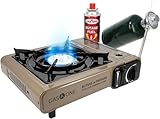
The GS-3400P is the product that makes the “stove plus air fryer” strategy work at the portable end. It’s a single high-output burner that runs on either propane or butane, comes with a carrying case, and is built for the kind of use where a fixed range isn’t an option. Its role in an air-fry kitchen is straightforward: it’s the cooktop half, and a countertop air fryer is the other half.
Who It Suits
- Campers and tailgaters who want one burner that handles both fuel types.
- Emergency-preparedness buyers who want a stove that works with whatever canisters are available.
- Small-apartment cooks who need a portable burner that can move between countertop, balcony, and camping bin.
- Anyone pairing a burner with a countertop air fryer to get both cooktop and crisp-food capability without a range.
Key Specs (as listed)
- Fuel: dual — propane or butane.
- Design: patented (per the listing), single burner, high output.
- Included: carrying case.
- Ignition: piezo-style push ignition typical of this category.
- Form factor: compact, tabletop, portable.
Strengths
Dual fuel is the whole point, and it’s more useful than it sounds. Butane canisters are cheap and burn hot and clean, but they lose pressure in cold weather and are harder to find in some regions. Propane works in the cold and is universally available. Owning one burner that takes both means you’re never stuck because the store only had one type. That flexibility is why this unit shows up in so many emergency kits even though it’s marketed as camping gear.
The high-output single burner also does something a two-burner camp stove often can’t: it puts serious heat under one pan. If you’re boiling a large pot, searing, or stir-frying, one strong burner beats two weak ones.
Practical Use Notes
Portable burners of this class are wind-sensitive. Outdoors, even a light breeze pulls heat away from the pan and stretches boil times considerably. A simple windscreen makes a bigger difference than any other accessory. Indoors or on a sheltered balcony, the burner performs much closer to its rated output.
The other reality is pan size. A single portable burner supports a pot or pan up to roughly the width of the grate — a large stockpot is fine, an oversized griddle is not, because the weight and overhang destabilize the unit. Match the pan to the burner and the burner feels far more capable.
Cleaning and Maintenance
- Wipe the drip area after every cook; portable burners don’t have deep drip trays.
- Check the canister seal and the regulator connection each time you swap fuel — this is the most common failure point.
- Store the burner in the case to keep the burner head and ignition electrode clean.
- If the ignition stops working, verify the electrode gap before assuming the unit failed; a simple cleaning often restores it.
Pros
- Runs on propane or butane, so you’re never locked into one canister type.
- High output from a single burner — better for big pots than a weak two-burner.
- Carrying case included, which makes storage and transport easy.
- Compact and tabletop-friendly; works indoors with ventilation or outdoors.
- Mid-range price tier, far below any built-in range.
Cons
- Single burner — you can’t run two pans at once.
- Canisters are consumables, so cost is ongoing rather than one-time.
- Wind degrades performance noticeably outdoors without a screen.
- Not an oven and not an air fryer; it’s half of a two-appliance solution.
- Canister fuel is less economical per hour than a bulk propane tank.
How It Compares
Its nearest alternative in this list is the Gas One Portable Butane Camping Stove with Case. The difference is fuel flexibility versus simplicity: the butane-only unit is cheaper to buy and slightly simpler to run, but it’s locked to butane and suffers in cold weather. The GS-3400P costs more and gives you both fuel paths. If you camp in shoulder seasons or want a stove that works with whatever’s on the shelf, the dual-fuel model is the one to pick. If you cook in warm conditions and want the lowest entry cost, the butane-only unit is enough.
4. ROVSUN 2 Burner Outdoor Propane Gas Stove, 150,000 BTU — Best for High-Output Outdoor Batch Cooking

At 150,000 BTU across two burners, the ROVSUN stand cooker is in a completely different power class from every other burner here. This is the appliance you bring out for a crawfish boil, a turkey fry, a canning marathon, or a wok session — jobs where a portable camp stove simply doesn’t have the thermal output to keep up.
Who It Suits
- Outdoor batch cooks — boils, fryers, large pots, canning.
- Wok users who need restaurant-style heat under a carbon steel wok.
- Event and group cooks feeding a crowd where one pot isn’t enough.
- Home canners who need sustained high output for a water bath or pressure setup.
Key Specs (as listed)
- Burners: 2, propane, high pressure.
- Output: 150,000 BTU total.
- Regulator: adjustable high-pressure regulator included.
- Form factor: stand cooker with legs, freestanding.
- Use: outdoor only.
Strengths
Raw output is the strength, and it solves problems nothing else in this list can. A 150,000 BTU burner brings a large pot to a boil in a fraction of the time a camp stove takes, and — more importantly — it recovers after you drop cold food in. Recovery is what actually matters when you’re frying or boiling in volume, because a weak burner drops below temperature and stays there, producing greasy food or a stalled boil.
The adjustable high-pressure regulator is the second real feature. It lets you dial output up for a boil and down for a simmer, which sounds basic but is missing on a lot of cheap high-output burners that are either full blast or off. Being able to hold a rolling simmer rather than a violent boil is what makes the same unit useful for sauces and stocks as well as frying.
Practical Use Notes
This is an outdoor appliance, full stop. High-pressure propane burners produce carbon monoxide and significant radiant heat, and they must be used in open air, never in a garage with the door cracked, never on a covered porch with low clearance, and never indoors. Keep a fire extinguisher rated for grease and propane nearby, and keep the tank outside the cooking zone with the hose routed so it can’t be exposed to the burner’s flare.
Pot stability matters at this output. A 150,000 BTU burner with a big pot of oil is a serious thermal mass; set the stand on level, non-combustible ground and never leave it running unattended. Wind is less of a problem than with a small camp stove because the output is so high, but a windscreen still improves efficiency on a breezy day.
Cleaning and Maintenance
- Let the unit cool completely before handling — the burner head and stand retain heat for a long time.
- Clean burner ports with a wire brush if flames become uneven or yellow.
- Inspect the hose and regulator for cracking before each season; they’re the parts that degrade.
- Store the regulator indoors to keep the diaphragm and seals in good condition.
Pros
- 150,000 BTU recovers fast after adding cold food — the key to good frying.
- Two burners for simultaneous large pots.
- Adjustable regulator allows both a hard boil and a controlled simmer.
- Freestanding stand design keeps a heavy pot off a table.
- Mid-range price tier despite its output advantage.
Cons
- Outdoor use only — never indoor-safe.
- Consumes propane quickly at high output.
- Heavy and bulky compared with every portable burner here.
- Not an air fryer and not an oven; it’s a cooktop in the most literal sense.
- Overkill for everyday small meals, and harder to store.
How It Compares
Against the Coleman Triton 2-Burner, the ROVSUN is not a camping stove — it’s a high-pressure outdoor burner that happens to have two burners. The Triton is designed for simmering a pot of coffee and frying eggs at a campsite; the ROVSUN is designed to boil fifty gallons of water. If your cooking is campfire-adjacent, the Triton is far more appropriate. If you’re frying a turkey or running a crab boil, only the ROVSUN has the output. They’re not really substitutes; they’re different tools for different volumes.
5. COZZIVITA 4-Piece Drip Pans Set (GE-Compatible) — Best for Restoring an Electric Coil Stovetop

Not every stove purchase is a new appliance. If you already own an electric coil range with GE-style burners and the drip pans have gone black and pitted, a four-piece chrome replacement set is the cheapest meaningful upgrade in this entire roundup. It’s a supporting product, not a headline one — but it directly affects how your stovetop performs and how it cleans.
Who It Suits
- Owners of GE-style coil ranges whose existing drip pans are stained, rusted, or warped.
- Renters and landlords sprucing up a kitchen cheaply before a listing or turnover.
- Anyone who has concluded a new range isn’t worth it and wants to improve what they have.
Key Specs (as listed)
- Set: 4 pieces.
- Compatibility: GE-style electric coil stoves.
- Finish: chrome.
- Function: drip pans that sit under the coil element and catch spills.
Strengths
The function is unglamorous but real. Drip pans do two jobs: they catch boil-overs and grease before it bakes onto the stovetop substrate, and they reflect radiant heat back up into the element, which improves efficiency slightly. A clean, shiny pan reflects better than a blackened one. Replacing four pans is a fraction of the cost of any other intervention in this list, and it changes the whole look of the stovetop.
Because the set is sized to the burner positions, matching the coil diameter to the pan is the main compatibility check. The four-piece set typically covers the standard mix of small and large burners on a four-burner GE-style range.
Installation and Fit
- Unplug the range or turn off the breaker before handling elements.
- Coil elements pull straight up and out on most ranges; they are not screwed down.
- Check that the pan opening matches the element’s drip bowl seat — a mismatched bowl sits proud and looks wrong even if it fits.
- Seat the new pan fully flat before reinstalling the element; a tilted pan lets spills run under the stovetop.
Cleaning and Care
Chrome drip pans are not dishwasher-friendly in the long run and will discolor if you use an abrasive pad. Wash by hand with a mild degreaser, and line the pan with foil if you’re doing something messy — the foil takes the damage, the chrome stays bright. Once chrome pans pit or rust, they can’t be restored; they’re a consumable, and budget-priced replacement sets are the realistic answer.
Pros
- Very low cost for a visible improvement in stovetop appearance.
- Catches spills and protects the stovetop substrate.
- Reflective finish helps the element heat more efficiently.
- Simple, tool-free installation.
- Sized set covers standard four-burner GE-style layouts.
Cons
- Only works with compatible GE-style coil burners — check before ordering.
- Chrome discolors over time and cannot be restored once it does.
- Does nothing for cooking performance beyond marginal heat reflection.
- Not compatible with glass cooktops or gas ranges.
- Consumable — expect to replace again in a few years with heavy use.
How It Compares
The nearest alternative in this list isn’t a competing product but a competing strategy: the Weiman Glass & Ceramic Cooktop Cleaner Kit. Same category of “make what you have better,” completely different surface. If your stovetop is glass or ceramic, you need the Weiman kit. If it’s an electric coil range, you need drip pans. Owning the wrong one helps nobody, and the two are never interchangeable — the surface type decides which one you buy.
6. Gas One Portable Butane Camping Stove with Case — Best Budget Burner for Precise Everyday Heat

This is the simplest, cheapest way to get genuinely controllable heat onto a countertop or a campsite table. It’s a butane single burner with automatic ignition and a stepless flame dial, and it earns its place because precise heat control at a low price is exactly what a home air-fry setup needs on the cooktop side.
Who It Suits
- Apartment and dorm cooks without a gas line, who need real flame control.
- Campers and tailgaters who want a compact burner that stores in a case.
- Home cooks pairing it with a countertop air fryer as a two-piece stove-and-fryer setup.
- Emergency kits where simplicity and a low price matter more than output.
Key Specs (as listed)
- Fuel: butane canisters.
- Ignition: automatic (push-button spark).
- Control: precise heat control dial with continuous adjustment.
- Included: carrying case.
- Form factor: compact tabletop single burner.
Strengths
Butane is an excellent cooking fuel for indoor and warm-weather use. It burns hot and clean, produces less soot than propane at low settings, and the canisters are inexpensive and widely stocked at Asian groceries, outdoor stores, and hardware shops. The precise dial is the real selling point: butane burners typically modulate down to a genuine simmer better than small propane burners do, which makes them good for sauces, rice, and anything where “low” actually needs to mean low.
Automatic ignition plus a hard case makes this genuinely grab-and-go. It’s the burner people keep in a cupboard and pull out for hot pot, camping, or a power outage.
Practical Limitations
The butane limitation is temperature. Butane’s vapor pressure drops in the cold, so below roughly freezing the canister stops delivering enough gas and the flame weakens or dies. Warming the canister in your hands or an inside pocket helps temporarily, but if you regularly cook in cold conditions, a dual-fuel or propane burner is the correct choice instead.
The other constraint is pan size and weight. A single butane burner supports a normal skillet or a medium pot well; an oversized stockpot or a heavy cast-iron Dutch oven loaded with food is asking a lot of a lightweight tabletop frame. Keep the load reasonable and it’s stable.
Cleaning and Maintenance
- Wipe the burner body and the spill area after each use; butane burners have shallow trays.
- Check the canister gasket and the notch alignment on the canister collar — most “stove won’t light” problems are a seating issue.
- Store the burner in the case to protect the ignition electrode.
- Keep canisters out of direct sun and away from heat; store them upright.
Pros
- Low price, and one of the cheapest precise burners available.
- Continuous heat dial modulates to a genuine low simmer.
- Automatic ignition — no lighter or matches needed.
- Carrying case included for clean storage and transport.
- Butane is clean-burning and canisters are inexpensive and easy to find.
Cons
- Butane only; performance drops sharply in cold weather.
- Canisters are consumables and add up over time.
- Single burner — one pan at a time.
- Lightweight frame limits how heavy a pot you can safely use.
- Not an oven or air fryer; it’s the cooktop half of a two-part setup.
How It Compares
Against the Gas One GS-3400P dual-fuel model, this unit is cheaper, simpler, and slightly smaller — but it’s butane-only. The GS-3400P’s dual-fuel flexibility is worth the extra cost if you cook in cold weather or want to use propane. If you cook indoors, in warm weather, and want the lowest total spend, this butane unit does 90% of what most people need. Against the Iwatani 35FW, it’s the budget version of the same idea — Iwatani adds more refined heat output and build quality at a higher price.
7. Coleman Triton 2-Burner Propane Stove — Best for Two-Pan Car Camping
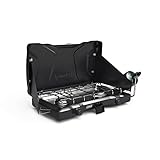
The Triton is the classic two-burner car-camping stove done well. It folds down into a compact package, runs on a standard propane cylinder, and gives you two burners side by side — which is the single biggest practical upgrade over any single-burner setup, because real cooking usually involves two pans at once.
Who It Suits
- Car campers and family campers cooking full meals at a picnic table.
- Tailgaters who need two burners running simultaneously.
- Emergency-preparedness households wanting a two-burner backup that runs on ubiquitous propane.
- Anyone who has outgrown a single burner and is tired of cooking in sequence.
Key Specs (as listed)
- Burners: 2, propane.
- Form factor: portable, folding cooktop.
- Fuel: standard propane cylinder via regulator and hose.
- Ignition: push-button (per category standard).
- Design intent: car camping and portable group cooking.
Strengths
Two burners changes how you cook outdoors. Instead of boiling water, then setting it aside to fry, you run both simultaneously — which turns a 45-minute camp dinner into a 20-minute one. The folding design also matters more than it sounds: it packs flat enough to slide into a car trunk without rearranging your whole load.
Propane is the right fuel for this application. Cylinders are available everywhere, they work in the cold better than butane, and one small cylinder runs a two-burner stove for a long weekend. The regulator and hose are standard parts you can replace at any hardware store, which is a genuine long-term advantage over proprietary canister systems.
Real-World Performance Notes
Two-burner camp stoves share a fuel supply, so running both burners at maximum simultaneously drops output on each. That’s true of every stove in this class, not a defect. In practice you run one burner high and one low, and it performs exactly as expected. Wind is the main external enemy — a folding windscreen or even a row of foil around the burner area dramatically improves boil times on an exposed campsite table.
The cooking surface is sized for standard camp cookware. A large griddle that bridges both burners works but blocks access to the controls on some stoves; check the layout before committing to a big griddle.
Cleaning and Maintenance
- Scrape and wipe the grate area while it’s warm; camp stove grates accumulate grease fast.
- Clean burner ports with a brush if flames turn yellow or uneven.
- Inspect the regulator hose for cracks each season; this is the part that fails.
- Store with the regulator detached and the burner covered to keep insects out of the ports.
Pros
- Two burners means real meal cooking, not sequential cooking.
- Folds flat for easy transport and storage.
- Runs on standard, universally available propane cylinders.
- Simple, replaceable regulator and hose — no proprietary parts.
- Proven category design with a long service life.
Cons
- Shared fuel supply means both burners at full blast reduces output on each.
- Wind noticeably hurts performance without a screen.
- Not an oven or air fryer.
- Heavier and bulkier than a single-burner butane stove.
- Propane cylinder is separate and adds bulk to your packing.
How It Compares
Against the Coleman Cascade 3-in-1, the Triton is simpler, cheaper, and lighter — but it only cooks on a flat grate. The Cascade adds swappable grill and griddle surfaces, which is a real upgrade if you want searing and flat-top cooking outdoors. If you just want two burners that work, the Triton is the more economical and more packable choice. Against the Gas One butane stove, the Triton wins on simultaneous cooking and cold-weather performance, while the butane unit wins on size, weight, and simmer precision.
8. Coghlan’s Portable Folding Camp Stove — Best for Backpacking and Emergency Kits

This is the smallest, lightest, most stripped-down cooking option in this roundup, and it’s here for a specific reason: sometimes the requirement isn’t “cook well,” it’s “cook something, and fit the stove in a jacket pocket.” A folding steel camp stove does that job and nothing more, and it costs almost nothing.
Who It Suits
- Backpackers and hikers who need minimal pack weight for simple meals.
- Emergency kit builders who want a stove that stores in a small pouch indefinitely.
- Bug-out and car-emergency kits where simplicity beats capability.
- Ultralight campers boiling water for dehydrated meals.
Key Specs (as listed)
- Material: folding steel frame.
- Design: compact, lightweight, folds flat.
- Burner: single, small.
- Fuel: solid fuel tablets or a small canister depending on configuration.
- Intended use: camping, backpacking, hiking, emergencies.
Strengths
The strength is packability, full stop. It folds to a flat package that slides into a pack pocket or a glovebox and weighs almost nothing. For boiling water for a freeze-dried meal, that’s the entire job, and it does it. If you’re building an emergency kit and want a stove that will still be there and still work in five years, a mechanical folding steel stove with no electronics and no seals is exactly the right kind of simple.
What It Doesn’t Do
It doesn’t simmer. It doesn’t support a heavy pot well. It has essentially no wind protection, so it needs sheltering. Heat output is modest, so a full rolling boil takes patience. And it’s not a stove you’d cook a real meal on — it’s a stove for heating water and simple food. Be honest about that before buying: if your plan is “camp cooking,” this is the wrong tool. If your plan is “boil water in an emergency,” it’s ideal.
Safety and Use Notes
- Never use a folding camp stove inside a tent, vehicle, or any enclosed space.
- Set it on a level, non-combustible surface; a folding frame tips more easily than a rigid one.
- Keep fuel tablets or canisters stored separately from the stove and away from heat.
- Use a windscreen or natural shelter; exposed use wastes most of the heat.
Cleaning and Maintenance
There’s almost nothing to maintain. Wipe the frame down, make sure the folding joints move freely, and check for rust if it’s been stored damp. That’s the whole maintenance schedule — which is precisely why these stoves survive forgotten storage so well. No seals, no gaskets, no ignition electrode, no regulator to crack.
Pros
- Extremely compact and lightweight when folded.
- Very low price — among the cheapest items in this list.
- Nearly maintenance-free with no seals, hoses, or electronics.
- Stores indefinitely in an emergency kit.
- Simple enough to operate with no learning curve.
Cons
- Low heat output; slow to boil and can’t really simmer.
- Unstable with heavy pots; not for real cookware.
- No wind protection — needs shelter to work efficiently.
- Fuel is limited and less widely available than propane or butane.
- Not an oven, air fryer, or anything close to one.
How It Compares
Against the Gas One butane stove, the comparison is weight and capability versus a genuinely controllable flame. The butane stove costs more and adds a canister, but it simmers, ignites automatically, and supports real cookware. The Coghlan’s stove wins only on weight, size, and price — and for backpacking and emergency kits, those three things are the whole decision. Pick the folding stove when the constraint is the pack, not the pan.
9. Iwatani 35FW Single-Burner Butane Cooktop — Best for Indoor Countertop Precision
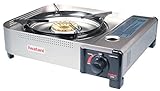
The Iwatani 35FW is the premium single-burner butane cooktop, and it earns that position on heat quality rather than features. It’s built for cooking at a counter — hot pot, wok, simmering, deep frying — with the kind of flame control you’d normally only get from a real gas range.
Who It Suits
- Indoor cooks without a gas line who want genuine flame control on the countertop.
- Hot pot and shabu-shabu hosts who need sustained, controllable tabletop heat.
- Stir-fry and wok cooks who need high output plus the ability to drop to low instantly.
- Small kitchens and rentals where a built-in range isn’t an option.
Key Specs (as listed)
- Burner: single, butane.
- Body size: medium.
- Use: indoor and outdoor cooking.
- Control: continuous flame adjustment.
- Safety: integrated safety shutoff typical of this class of butane cooktop.
Strengths
The 35FW’s reputation comes from heat output and consistency. It puts out more usable heat than most butane burners and holds a steady flame rather than surging — which is what you want for a wok, where the difference between a good stir-fry and a steamed one is whether the pan stays hot when food goes in. The continuous dial also lets you pull heat back immediately, and that responsiveness is the whole point of cooking on gas.
The medium body size is a deliberate trade. It’s wider and more stable than a pocket butane stove, so it supports a heavier pan without wobbling, but it’s still portable and stores in a cupboard. For a countertop appliance that has to feel like real cooking equipment, that’s the right balance.
Practical Use and Ventilation
Butane is a clean-burning fuel, but any open-flame burner consumes oxygen and produces combustion byproducts. Indoors, use it in a kitchen with working ventilation — a range hood, an open window, or a cross-breeze. It’s not a reason to avoid the appliance; it’s a reason to treat it like the gas burner it is rather than like an electric hot plate.
As with all butane, cold weather reduces performance. Indoors this is rarely an issue, but if you take it camping in cold weather, expect reduced output.
Cleaning and Maintenance
- Let the unit cool fully before cleaning; the burner head holds heat.
- Wipe the drip tray after every cook — butane burners have shallow trays and spills pool.
- Check the canister lever and gasket periodically; a worn gasket is the most common cause of a weak flame.
- Clean the burner ports with a soft brush if flames become uneven.
Pros
- Strong, steady heat output — good for wok cooking and deep frying.
- Responsive continuous flame adjustment.
- Wider, more stable body than budget butane stoves.
- Works both indoors (with ventilation) and outdoors.
- Premium build quality in the butane cooktop category.
Cons
- Premium price for a single burner.
- Butane canisters are consumables and add ongoing cost.
- Cold weather reduces output, as with all butane.
- Single burner — no simultaneous cooking.
- Not an oven or air fryer; it’s a precision cooktop only.
How It Compares
Against the Gas One butane stove, the Iwatani is the upgrade: more output, steadier flame, wider stance, better build. If you cook seriously on a countertop — wok, hot pot, frying — the difference is worth the price gap. Against the CUSIMAX electric hot plate, it’s a fuel-versus-electricity decision: the Iwatani gives you instant, responsive flame control, while the CUSIMAX gives you a plug-in appliance with no canisters to buy. If you have no ventilation and can’t use open flame, the CUSIMAX is the right answer; if you can, the Iwatani cooks better.
10. Coleman Cascade 3-in-1 Camp Stove — Best for Outdoor Cooktop, Grill, and Griddle Versatility
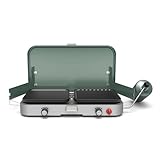
The Cascade 3-in-1 is the most versatile outdoor cooker in this roundup. It’s a two-burner propane stove that accepts interchangeable cooking surfaces — a standard grate, a grill, and a griddle — so one unit covers searing, flat-top cooking, and normal pot-and-pan work. For people whose outdoor cooking has outgrown a basic camp stove, this is the logical next step.
Who It Suits
- Serious car campers and overlanders who want a full outdoor cooking setup.
- Tailgaters and group cooks who need a griddle and a burner at the same time.
- Patio and backyard cooks who want grill and griddle capability without a full outdoor kitchen.
- Anyone who’s outgrown a two-burner grate stove but doesn’t want to carry three appliances.
Key Specs (as listed)
- Cooking surfaces: 3-in-1 — cooktop, grill, and griddle options.
- Burners: 2, propane.
- Form factor: portable, tabletop or stand-mounted depending on configuration.
- Fuel: standard propane cylinder.
Strengths
The swappable surfaces are the entire value proposition, and they solve a real problem: a griddle cooks breakfast for four in one pass, a grate handles pots, and a grill gives you marks and char. Buying those as three separate appliances means three boxes, three fuel connections, and three things to clean. One unit with swap-in surfaces is dramatically simpler — and on a camp table where space is measured in inches, that matters.
The two-burner layout underneath means you can also run a pot and a griddle simultaneously if the surface configuration allows, which is how most real camp meals get made. Propane keeps it simple: one standard cylinder, one regulator, universally available fuel.
Practical Use Notes
Griddle cooking outdoors has one non-negotiable: preheat. A cold griddle means food sticks and steams instead of searing. Give it a solid preheat before the first pancake or burger, and keep a thin film of oil on it. Between uses, scrape the griddle while it’s hot — cleaning a cold griddle with baked-on residue is much harder.
As with any outdoor propane appliance, wind and open flame are the two things to manage. Use it in open air with the cylinder positioned away from the burner, keep a grease-rated extinguisher nearby, and never use it inside a tent, vehicle, or garage. Grease from a griddle is a fire hazard in a way that a pot of water is not — treat the griddle surface with the same respect you’d give a frying pan full of oil.
Cleaning and Maintenance
- Scrape the griddle hot, then wipe; season it with a thin oil layer to prevent rust.
- Clean grill grates with a brush while warm.
- Empty and wipe the grease management area after every cook — this is where smells and hazards accumulate.
- Inspect the regulator hose each season and store the unit covered.
- Keep the surfaces stored flat and dry to prevent warping and rust.
Pros
- Three cooking surfaces in one unit — cooktop, grill, griddle.
- Two burners allow simultaneous pot and griddle cooking.
- Runs on standard propane with a replaceable regulator.
- Replaces multiple outdoor appliances, saving space and setup time.
- Most versatile outdoor cooker in this roundup.
Cons
- Premium price tier for a camp stove.
- Heavier and bulkier than a simple two-burner stove.
- More surfaces means more cleaning.
- Griddle cooking requires preheat discipline and produces significant grease.
- Not an oven or air fryer — it’s an outdoor cooktop system.
How It Compares
Against the Coleman Triton 2-Burner, the Cascade is the upgrade in every dimension except weight and price. The Triton gives you two burners and a grate; the Cascade adds a griddle and a grill surface, which changes what meals you can make outdoors. If you mostly boil water and fry eggs, the Triton is enough and easier to pack. If you cook breakfast for a group, sear steaks, or want flat-top capability at a tailgate, the Cascade is worth the extra cost and bulk.
11. CUSIMAX Electric Burner Hot Plate, 1500W — Best for Electric Cooking Without Open Flame

The CUSIMAX hot plate is the answer for anyone who can’t or won’t cook with gas. It’s a single electric burner with a 1500W cast-iron plate, and it delivers the one thing gas burners can’t in a restricted space: heat with no open flame and no combustion byproducts.
Who It Suits
- Dorm and studio residents where open flame is prohibited.
- Small apartments and rental kitchens with limited or no range access.
- Anyone in a space without ventilation for a gas burner.
- Home cooks who want a plug-in backup burner for holidays or power-independent cooking setups.
Key Specs (as listed)
- Type: single electric burner / hot plate.
- Power: 1500W.
- Plate: cast iron.
- Control: adjustable temperature dial (per category standard).
- Form factor: portable, countertop, plug-in.
Strengths
No flame, no fuel, no canisters, no ventilation requirement. That combination is why hot plates persist despite being slower than gas. The cast-iron plate also holds heat well, which means it maintains temperature during cooking rather than dropping the moment cold food hits the pan — a real advantage over thin electric elements. It plugs into a standard outlet and works anywhere there’s power.
It’s also the most compatible option for anyone whose building prohibits open-flame cooking, which is common in dorms, some apartment leases, and certain commercial spaces.
Performance Reality
Electric hot plates heat more slowly and cool more slowly than gas. There’s no instant response — when you turn it down, the plate stays hot for a while. Cooking on one means anticipating rather than reacting, and preheating properly. That’s a genuine adjustment if you’re used to gas, but it’s predictable once you learn the plate’s behavior.
The cast-iron plate is also heavy and takes time to cool, so plan for a cool-down period before cleaning. And 1500W is a meaningful electrical load: on a circuit that’s already carrying other appliances, it can trip a breaker. Check what else is on that circuit before running it at full power alongside a microwave or a countertop air fryer.
Cleaning and Maintenance
- Let the plate cool completely before wiping — never clean a hot cast-iron plate.
- Wipe with a damp cloth; avoid soaking the unit or immersing it.
- Scrape off baked-on residue with a plastic scraper rather than metal, to protect the plate finish.
- Check the cord and plug periodically for heat damage, especially if the unit runs at full power often.
Pros
- No open flame — usable where gas is prohibited.
- No fuel canisters or ongoing consumable cost.
- Cast-iron plate holds heat well during cooking.
- Simple plug-in operation with no installation.
- Mid-range price and widely useful as a backup burner.
Cons
- Slow to heat and slow to cool — less responsive than gas.
- 1500W can strain a shared household circuit.
- Single burner only.
- Cast-iron plate is heavy and takes time to cool before cleaning.
- Not an oven or air fryer.
How It Compares
Against the Iwatani 35FW, this is the flame-versus-plug decision. The Iwatani responds instantly and cooks like a real gas burner, but it needs ventilation, butane canisters, and a place where open flame is allowed. The CUSIMAX needs only an outlet and is legal almost everywhere, at the cost of slower response and a heavier cleanup. If you’re in a dorm or a no-flame building, the CUSIMAX isn’t just the better choice — it’s the only one. If you’re in a normal kitchen, the Iwatani cooks better.
12. Weiman Glass & Ceramic Cooktop Cleaner Kit — Best for Protecting a Smooth Cooktop

Cleaning is the part of stove ownership nobody researches and everybody regrets ignoring. If your cooktop is glass or ceramic, this kit is the maintenance counterpart to everything else in this list — and it directly affects how well your cooktop performs, because a scratched or residue-coated surface transfers heat less evenly and looks permanently dirty.
Who It Suits
- Glass and ceramic cooktop owners dealing with burned-on residue and haze.
- Renters and sellers restoring a cooktop before a move or listing.
- Anyone who has scratched a cooktop with an abrasive pad and wants to stop doing that.
Key Specs (as listed)
- Kit contents: cleaner plus a cleaning tool.
- Surface compatibility: glass and ceramic cooktops.
- Function: removing baked-on residue, grease haze, and mineral film.
Why It Matters
Glass and ceramic cooktops are the most easily damaged cooking surfaces in common use. The damage almost always comes from the same mistake: using an abrasive pad or a general-purpose scouring powder. Those scratch the surface permanently, and once a glass cooktop is scratched, no cleaner fixes it. A dedicated cleaner designed for the surface removes residue chemically rather than mechanically, which is the entire point.
The other common mistake is cleaning a hot cooktop. Thermal shock can crack or craze glass. Always let it cool to the point where you can comfortably touch it before applying cleaner. And clean up sugary spills immediately once cool — sugar is particularly aggressive on glass cooktops if it bakes on.
How to Use It Properly
- Let the cooktop cool completely.
- Apply cleaner to the surface, not directly to a hot element.
- Use the included tool or a non-abrasive pad; never steel wool or scouring powder.
- For stubborn baked-on spots, let the cleaner dwell for a minute before wiping rather than scrubbing harder.
- Wipe clean and dry before the next use — residue left behind bakes on and turns brown.
Pros
- Formulated specifically for glass and ceramic surfaces.
- Removes baked-on residue without scratching.
- Kit includes a tool matched to the job.
- Extends the usable life and appearance of a smooth cooktop.
- Low cost relative to replacing a cooktop.
Cons
- Only for glass and ceramic — not for coil, gas, or cast-iron surfaces.
- Requires letting the cooktop cool, so it’s not a quick mid-cook wipe.
- Won’t repair scratches or cracks already present.
- Consumable — the cleaner runs out and must be replaced.
- Does nothing for burner grates, drip pans, or oven interiors.
How It Compares
The direct counterpart in this list is the COZZIVITA drip pan set — same job, different surface, no overlap. If your range is a glass or ceramic smooth-top, you buy the Weiman kit; if it’s a coil range, you buy drip pans. Buying the wrong one is a wasted purchase, because neither product works on the other’s surface. If you own both kinds of cooktop, you need both.
How to Choose
The phrase “stove with air fryer” covers a wide range of very different products, and the fastest way to buy wrong is to shop by the phrase rather than by your situation. Here’s how to work through it.
Step 1: Decide Whether You Need an Oven at All
This is the fork in the road, and it determines everything else. There are two entirely different product strategies:
- Integrated air-fry range: a single appliance that is a cooktop plus an oven with a convection/air-fry mode. The RV ranges in this list are the only true examples. You get one footprint, one fuel connection, and one thing to clean — but you’re committing to a built-in installation and a premium price.
- Two-piece setup: a countertop or portable burner plus a separate countertop air fryer. You get flexibility, lower entry cost, and the ability to move both pieces — but you need counter space for two appliances, and the air fryer draws significant electricity.
If you live in an RV, van, or tiny home with an existing 17-inch range cutout and a propane system, the integrated range is almost always the better answer. If you’re in an apartment, dorm, or any space without a gas connection and exterior venting, the two-piece setup is the only realistic option.
Step 2: Match Air-Fry Capacity to How You Actually Cook
Air-fry capacity is where expectations most often exceed reality. A few concrete reference points:
| Air-Fry Approach | Typical Batch Size | Best For | Trade-Off |
|---|---|---|---|
| Range oven in convection/air-fry mode (17″ RV range) | One sheet pan, single layer — roughly 2–4 servings | Family sides, roasted vegetables, sheet-pan proteins, reheating | Slower than a basket fryer; large cavity means gentler air movement |
| Countertop air-fry oven (separate appliance) | One to two small trays — roughly 1–3 servings | Fries, wings, toast, small batches | Draws high wattage; occupies counter space |
| Basket air fryer (separate appliance) | Single basket — roughly 1–3 servings | Fastest crisping, small portions | Smallest capacity; requires shaking; 1,500W-class draw |
The rule of thumb: a range-based air fryer trades speed for capacity and gentleness, and a basket fryer trades capacity for speed. If you’re cooking for one or two, a basket fryer paired with a good burner is genuinely hard to beat. If you’re cooking for four and want the food to come out at the same time, the range oven’s larger cavity is the advantage — even if it takes longer.
Step 3: Understand Temperature Accuracy and Convection Performance
Temperature accuracy in a range oven depends on the thermostat and the evenness of the air circulation. Convection ovens hold more consistent temperatures than conventional ovens because moving air eliminates the hot and cold zones that static ovens develop. But this only works if you don’t defeat the airflow: crowded racks, foil covering the entire rack, and oversized pans that block circulation all turn a convection oven into an expensive conventional one.
Two practical checks when evaluating any appliance with an air-fry mode:
- Does the fan run during the air-fry cycle? If the “air fry” mode is just a temperature preset without convection, it’s marketing, not function.
- Is there a dedicated air-fry rack or a recommended rack position? Products designed for air frying usually specify both, because airflow around the food is the mechanism.
For portable burners, temperature accuracy means something different: how well the dial modulates at low settings. A burner that only has “high” and “off” is useless for anything but boiling. Continuous, stepless control is the spec to look for, and it’s the main thing