Key takeaways
- 48,000-grain capacity class, which in standard ion-exchange design corresponds to roughly 1.5 cubic feet of resin
- Two-tank configuration: a fiberglass resin tank plus a separate brine tank
- High-efficiency digital metered control head with demand-initiated regeneration
- Pre-filled resin tank, which removes one of the messier steps of a self-install
- Bypass valve and installation hardware included in the box
- Rated for whole-house flow, so it sits on the main line ahead of the water heater
The best residential water softener for most households is the Aquasure Harmony Series 48,000 Grains, a two-tank ion-exchange system with a high-efficiency digital metered control head. It suits a family of three to five people on water in the roughly 8 to 15 grains-per-gallon range who can free up about 30 by 48 inches of level, frost-free floor space near the main water line, a drain for regeneration discharge, and a standard outlet. If your water is only slightly hard, or you are softening for one or two people, the Aquasure Harmony Series 32,000 Grains uses the same control platform for less money. If you want the longest service life and the most repairable hardware, the AFWFilters Fleck 5600 SXT with 10% crosslink resin is the premium pick, because the metered Fleck valve and the higher-crosslink resin are the two components that most determine how long a softener lasts before it needs real work. Everything below is organized around the six variables that actually decide whether a softener performs in your house: hardness level, household size, grain capacity, regeneration method, salt consumption, and installation space.
Top 3 Picks
Best Overall: Aquasure Harmony Series 48,000 Grains
The Harmony Series 48,000 hits the sweet spot between capacity and price tier: enough resin volume to serve a three-to-five-person home on hard water without regenerating every few days, and a metered digital control head that regenerates based on actual water use rather than a fixed calendar. It is a two-tank design, so you need real floor space, but that also means a large brine tank you refill less often and a valve assembly that is straightforward to service.
Best Budget: Aquasure Harmony Series 32,000 Grains
For one to three people, or for a small home on moderately hard water, the 32,000-grain Harmony costs less and still gives you demand-initiated metered regeneration instead of the timer-based control found on many cheap softeners. The trade-off is a shorter interval between regenerations, which means slightly more salt per year in a busy household.
Best Premium: AFWFilters Fleck 5600 SXT with 10% Crosslink Resin
This is the pick for buyers who care about longevity and parts availability. The Fleck 5600 SXT is a metered, demand-initiated valve with a long production history and wide parts support, and the 10% crosslink resin resists chlorine degradation better than standard gel resin, which matters on municipal water. It costs more up front and uses a separate brine tank, but it is the system most likely to still be running on the same resin a decade or more from now.
Quick Comparison
| Product | Best for | Key specs | Price tier |
|---|---|---|---|
| Aquasure Harmony Series 48,000 Grains | Most homes; 3-5 people on hard water | 48,000-grain class, two-tank, digital metered control head, high-efficiency regeneration | Budget |
| AFWFilters Fleck 5600 SXT with 10% Crosslink Resin | Longest service life; chlorinated municipal water | Fleck 5600 SXT metered valve, 10% crosslink resin, two-tank | Premium |
| Aquasure Harmony Series 50,000 Grains | Large households and very hard water | 50,000-grain class, two-tank, high-performance automatic digital metered control | Mid-range |
| Aquasure Harmony Series 32,000 Grains | Budget buyers with 1-3 people | 32,000-grain class, two-tank, high-performance automatic digital metered control | Budget |
| Aquasana SimplySoft 40K Grain (WH-SF40-BASE) | Compact installations and brand-name filtration buyers | 40,000-grain class rating, single-unit footprint, SimplySoft platform | Mid-range |
| iSpring WCSTB45KG 45,000 Grains | Budget buyers who want an included brine tank | 45,000-grain class, brine tank included, digital metered control | Budget |
| DuraWater Fleck 5600 SXT 32,000 Grains | Small homes on very hard water with a premium valve | Fleck 5600 SXT metered valve, 32,000-grain class, two-tank | Premium |
| Kenmore 350 Whole House Water Softener | Straightforward replacement for 1-4 person homes | 32,000-grain class, rated 1-4 people, demand-initiated regeneration | Mid-range |
| AFWFilters 48K Grain Fleck 5600 SXT | High-capacity Fleck buyers | 48,000-grain class, Fleck 5600 SXT metered valve, crosslink resin | Premium |
| Aquasure Harmony Series 40,000 Grains | Mid-size homes wanting budget pricing | 40,000-grain class, two-tank, high-performance automatic digital metered control | Budget |
| Aquasure Harmony Series with Metered Control | Budget metered-control buyers; confirm grain rating on listing | Harmony Series two-tank, high-performance automatic digital metered control head | Mid-range |
| iSpring WCS45KG 45,000 Grains | Space-saving premium one-tank design | 45,000-grain class, one-tank design, digital control | Premium |
How We Chose
This roundup is built from manufacturer specifications, published product documentation, and standard ion-exchange performance tables that the water treatment industry has used for decades, not from laboratory work or in-home trials. The selection criteria were chosen to reflect what actually determines satisfaction with a softener after the first month, when the novelty wears off and the salt bags start stacking up.
First, category fit: every unit here is a whole-house softener sized for a residential main line, not a point-of-use filter or a showerhead attachment. Second, capacity realism: grain ratings were matched against the household sizes and hardness levels the unit can genuinely serve without regenerating every two or three days. Third, regeneration method, because a demand-initiated metered control head uses measurably less salt and water than a fixed-timer valve over a year of ownership. Fourth, upgrade path and serviceability, which favors valves with a long production history, widely available replacement parts, and resin that can be replaced independently of the tank. Fifth, physical footprint, since two-tank systems need more floor space than one-tank designs and that alone rules some homes out. Price tier reflects general market positioning, not a specific listing price, because those change constantly.
1. Aquasure Harmony Series 48,000 Grains – Best for Most Homes
As an Amazon Associate we earn from qualifying purchases at no extra cost to you.

The Harmony Series 48,000 is the system to buy if you want one decision that covers a normal family home without overspending. It is aimed at households of roughly three to five people on water between about 8 and 15 grains per gallon, which covers a large share of the private wells and municipal supplies in the United States. It also suits anyone replacing an older timer-based softener who is tired of hearing the unit regenerate on a schedule that has nothing to do with how much water the house actually used.
Key specs
- 48,000-grain capacity class, which in standard ion-exchange design corresponds to roughly 1.5 cubic feet of resin
- Two-tank configuration: a fiberglass resin tank plus a separate brine tank
- High-efficiency digital metered control head with demand-initiated regeneration
- Pre-filled resin tank, which removes one of the messier steps of a self-install
- Bypass valve and installation hardware included in the box
- Rated for whole-house flow, so it sits on the main line ahead of the water heater
Why it works
The two features that matter most here are the metered control head and the resin volume. A metered head counts the gallons passing through the unit and triggers regeneration only when the calculated capacity has been used up. On a household that takes a two-week vacation, that alone saves several pointless regeneration cycles and the salt and water they consume. The 1.5-cubic-foot resin bed gives you enough capacity that a family of four on moderately hard water regenerates roughly once a week, which is the interval most manufacturers consider ideal because it balances salt efficiency against the wear that comes with frequent cycling.
The pre-filled resin tank is a genuine quality-of-life detail. Filling a resin tank yourself means handling a heavy bag of wet resin beads and getting the distributor tube seated correctly, and mistakes there cause problems that only show up weeks later. Aquasure ships it loaded, so installation is mostly plumbing and drain routing.
Where it gives ground is on water with significant iron. Iron fouls resin over time and needs either a pretreatment step or a resin cleaner on a maintenance schedule. If your water tests above about 0.3 parts per million of dissolved iron, budget for that routine from day one rather than treating it as a surprise.
Pros
- Metered, demand-initiated regeneration keeps salt and water use proportionate to actual consumption
- 1.5-cubic-foot resin bed handles a three-to-five-person home with a comfortable margin
- Resin arrives pre-loaded, which simplifies installation
- Bypass valve included, so you can isolate the unit for service without shutting off the house
- Budget price tier for a capacity class that many competitors charge mid-range money for
Cons
- Two-tank footprint requires more floor space than a one-tank cabinet design
- Not the right choice for high-iron well water without pretreatment
- The control head is proprietary, so parts come from the manufacturer rather than the wider aftermarket
- Oversized for one or two people in a small home, where it will sit partly idle
How it compares
Against the AFWFilters Fleck 5600 SXT with 10% crosslink resin, the Harmony trades serviceability and chlorine resistance for price. The Fleck valve has decades of aftermarket parts behind it and the 10% crosslink resin stands up better to chlorinated municipal water, so if you plan to keep the system for fifteen years, the premium unit is the better long-term buy. Against the Aquasure Harmony Series 40,000, this model is simply the larger sibling: the 40,000-grain version suits a smaller household or softer water, and the 48,000 gives you more headroom for the same general platform. If your household is five or more people or your hardness is above 15 grains per gallon, step up to the 50,000-grain model instead.
2. AFWFilters Fleck 5600 SXT with 10% Crosslink Resin – Best Premium System

This is the system for the buyer who has already decided they do not want to think about a water softener again for a very long time. It pairs the Fleck 5600 SXT metered valve, one of the most widely serviced control valves in residential water treatment, with 10% crosslink resin, which holds up better than standard gel resin in chlorinated water. It suits homeowners on municipal supplies who want maximum service life, and anyone who values being able to order a replacement part by name instead of calling a dealer.
Key specs
- Fleck 5600 SXT digital metered control valve with demand-initiated regeneration
- 10% crosslink resin, a higher crosslink percentage than standard 8% gel resin
- Two-tank configuration with a separate brine tank
- Programmable hardness, capacity, and regeneration settings through the SXT controller
- Widely available replacement parts, including pistons, seals, and the controller itself
Why it works
The case for this unit rests almost entirely on two components. The first is the valve. The Fleck 5600 SXT is a proven metered design with a mechanical piston-and-seal architecture that technicians understand and parts distributors stock. When a softener fails after eight or ten years, it is almost always the valve or the resin, not the tank, and both are replaceable here without buying a whole new system.
The second is the resin. Crosslink percentage describes how densely the polystyrene beads are bonded. Standard resin runs around 8% crosslink; 10% crosslink resin resists oxidative attack from chlorine and chloramine, which is the leading cause of premature resin failure on city water. Resin is the single most expensive component to replace, so paying more for better resin up front is a rational trade if your water is chlorinated.
The SXT controller lets you set hardness, capacity, and regeneration time directly. That flexibility matters on wells where hardness changes seasonally, and it lets you dial the salt dose down to a more efficient level rather than accepting the factory default. The downside is that it is not a one-button appliance. You need to read the manual once, set it correctly, and revisit it if your water changes.
Installation is more involved than a pre-filled big-box unit. You are plumbing a two-tank system, running a drain line, and programming the controller. It is well within reach of a confident DIY plumber, but it is not a swap-in appliance.
Pros
- Metered demand-initiated regeneration with a fully programmable controller
- 10% crosslink resin resists chlorine degradation better than standard resin
- Excellent long-term parts availability on the valve and controller
- Individual components can be replaced instead of the whole system
- Widely understood by water treatment technicians, which simplifies future service
Cons
- Premium price tier, noticeably above comparable-capacity budget systems
- Requires manual programming, which is a real task rather than a formality
- Two-tank footprint needs dedicated floor space
- No pre-filled resin convenience; you or your installer handle the media
How it compares
Against the AFWFilters 48K Grain Fleck 5600 SXT, the difference is capacity rather than build. Both use the same valve family and crosslink resin, so the decision comes down to household size and hardness. Choose this model for one to four people on moderate hardness, and the 48K version for larger homes or harder water. Against the DuraWater Fleck 5600 SXT 32,000 Grains, this unit offers more capacity on a similar premium platform, while the DuraWater is the more compact option for a small home on very hard water. Against the Aquasure Harmony Series 48,000, you are paying the premium for repairability and chlorine resistance rather than for capacity.
3. Aquasure Harmony Series 50,000 Grains – Best for Large Households
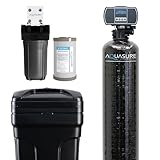
The 50,000-grain Harmony is the answer for a busy five-or-six-person household, a home with a large soaking tub and heavy laundry use, or water testing above roughly 15 grains per gallon. It also suits anyone who wants the regeneration interval stretched as far as practical so the unit is not cycling every few days. If you have the floor space and the hardness to justify it, this is the capacity class where a softener stops feeling like a compromise.
Key specs
- 50,000-grain capacity class, the largest in the Harmony lineup covered here
- High-performance automatic digital metered control head
- Two-tank design with a separate brine tank
- Demand-initiated regeneration based on measured water use
- Whole-house installation on the main line ahead of the water heater
Why it works
Capacity is the whole story with this model. A 50,000-grain class unit on a household that consumes 300 to 450 gallons a day at 12 grains per gallon is removing roughly 3,600 to 5,400 grains of hardness daily. That means a regeneration cycle every week or slightly longer, which is a comfortable rhythm: the resin gets a full, clean regeneration, the salt dose stays moderate, and you are not hauling bags into the house every five minutes.
It also matters for peak flow. A large household with multiple showers running, a washing machine filling, and a dishwasher going puts a lot of demand on the main line at once. A larger resin bed creates less pressure drop at high flow than a small one, so showers do not lose pressure when the laundry starts.
The practical caution is oversizing. If you put a 50,000-grain unit in a one-person household on 6-grain water, it may go three or four weeks between regenerations. Long intervals are not automatically better; the resin bed sits with hardness loaded on it for longer, and some manufacturers recommend more frequent cycling for resin health. Match capacity to your actual household rather than buying the biggest unit you can afford.
Pros
- Handles five-to-six-person households and very hard water without constant cycling
- Large resin bed limits pressure drop during simultaneous high-flow use
- Digital metered control head adjusts regeneration to actual consumption
- Large brine tank means fewer salt refills per year
- Mid-range price tier for the largest capacity class in this roundup
Cons
- Takes up the most floor space of the Aquasure models here
- Oversized and inefficient for one or two people
- Larger salt dose per regeneration than a smaller unit
- Still requires iron pretreatment if your well water carries dissolved iron
How it compares
Against the Aquasure Harmony Series 48,000, this is a modest step up in capacity for a modest step up in price tier. The 48,000 handles most families; the 50,000 is for the top end of normal residential demand. Against the AFWFilters 48K Grain Fleck 5600 SXT, you are choosing between more capacity on a proprietary control head and slightly less capacity on a Fleck valve with better parts support. If serviceability over fifteen years matters more to you than the extra 2,000 grains of rated capacity, the Fleck-based unit is the better pick.
4. Aquasure Harmony Series 32,000 Grains – Best Budget Pick for Small Households

The 32,000-grain Harmony is the right softener for one to three people, a small home, or water in the 5 to 10 grains-per-gallon range where a larger unit would sit mostly unused. It is also the sensible choice for a cabin or rental property where you want real softening without a large capital outlay. Despite the budget price tier, it keeps the same metered digital control approach as its larger siblings, which is the feature that separates it from the cheapest timer-based units on the market.
Key specs
- 32,000-grain capacity class, corresponding to roughly 1 cubic foot of resin in standard design
- High-performance automatic digital metered control head
- Two-tank configuration with separate brine tank
- Demand-initiated regeneration triggered by measured water volume
- Pre-filled resin tank and included bypass valve
Why it works
A 32,000-grain unit is the classic residential workhorse. For a two-person household using around 150 gallons a day on 10-grain water, the daily hardness load is about 1,500 grains, so a full regeneration cycle covers well over a week of use. That is an efficient, comfortable rhythm and it means the salt bill stays low.
The metered control head is what makes this a good buy rather than just a cheap one. Timer-based softeners regenerate on a fixed schedule whether or not you have used any water, which wastes salt on vacations, on low-use weeks, and in any household with an irregular pattern. Metered control removes that waste entirely, and over several years the salt savings are real money.
The trade-off is headroom. There is not much. If your household grows, if you add a large tub, or if you discover your hardness is higher than you thought, this unit will start regenerating every three or four days and the salt consumption will climb. Before buying, test your water rather than assuming. A $20 hardness test kit prevents a $600 mistake.
Pros
- Lowest price tier in this roundup while keeping metered regeneration
- Compact resin tank and brine tank suit smaller utility areas
- Efficient salt use for one-to-three-person households
- Pre-filled resin simplifies installation
- Same control platform as the larger Harmony models, so operation is familiar
Cons
- Limited headroom; struggles if household size or hardness increases
- Will cycle frequently on very hard water above about 20 grains per gallon
- Two tanks still require meaningful floor space
- Not suitable for high-iron water without pretreatment
How it compares
Against the Aquasure Harmony Series 40,000, the decision is straightforward: if you have three or more people or hardness above 10 grains per gallon, spend the small amount extra for the 40,000 and get a longer regeneration interval. Against the iSpring WCSTB45KG, this Aquasure has a smaller capacity but the same general metered-control approach, so the iSpring wins on capacity per dollar while the Aquasure wins on a slightly more established control platform. Against the Kenmore 350, both target the 1-to-4-person range, and the Aquasure generally sits at a lower price tier for similar capacity.
5. Aquasana SimplySoft Whole House Water Softener 40K Grain – Best for Compact Installations

The SimplySoft WH-SF40-BASE is aimed at homeowners who want a recognizable water treatment brand and a tidier installation than a traditional two-tank setup. A 40,000-grain class rating puts it squarely in the range for a three-to-four-person household on moderately hard water. It suits anyone whose utility area is tight, who wants fewer visible components, and who values Aquasana’s broader filtration ecosystem if they are already using other products from the brand.
Key specs
- 40,000-grain class rating per the model designation
- Single-unit design rather than a separate resin tank and brine tank pair
- SimplySoft whole-house platform from Aquasana, a long-established water filtration brand
- Base configuration, meaning the core softening unit without added filtration stages
Why it works
The primary advantage is footprint and simplicity. A single-unit design consolidates the components that normally occupy two separate tanks, which is a genuine benefit in a closet, a crawlspace access area, or a garage corner where every square foot is contested. Fewer connections also means fewer places for a slow leak to develop, and a cleaner look if the unit is visible.
The 40,000-grain rating is a good middle ground. It is large enough for a family of four on moderate hardness to regenerate on roughly a weekly cadence, and small enough to fit the kind of installation space where a 50,000-grain two-tank system would not go. Aquasana’s brand history in residential water treatment is a point in its favor for buyers who want a company with a track record and accessible customer support.
One thing to verify before ordering: Aquasana has marketed products under the SimplySoft name across more than one softening approach, and the technologies differ in an important way. Ion-exchange softening removes calcium and magnesium from the water and requires salt and a drain. Salt-free conditioning platforms do not remove hardness minerals; they alter them so they are less likely to form scale, and they need no salt, no electricity, and no drain. The 40K grain rating in this model’s name points to an ion-exchange capacity rating, but confirm the regeneration type on the specific listing you order, because it changes your plumbing, your salt budget, and your maintenance routine entirely.
Pros
- Single-unit design saves significant floor space compared with two-tank systems
- 40,000-grain class suits three-to-four-person households
- Fewer plumbing connections means fewer potential leak points
- Backed by an established water filtration brand with broad product support
- Base configuration keeps the price tier mid-range rather than premium
Cons
- Confirm the regeneration type on the listing before you buy; SimplySoft has covered more than one technology
- Consolidated designs can be harder to service than a standard two-tank system with a separate brine tank
- Less capacity headroom than the 48,000 and 50,000-grain Aquasure models
- Fewer aftermarket parts options than a Fleck-based system
How it compares
Against the iSpring WCS45KG one-tank design, both compete on footprint, and the iSpring carries a slightly higher capacity rating and a premium tier positioning. Against the Aquasure Harmony Series 40,000, the capacity is comparable, so the choice comes down to form factor: Aquasure gives you a conventional two-tank layout with an easily accessible brine tank, while Aquasana gives you a consolidated unit for tight spaces. If you have room for two tanks, the conventional layout is generally easier to live with over ten years of maintenance.
6. iSpring WCSTB45KG 45,000 Grains with Brine Tank – Best Budget System With a Separate Brine Tank
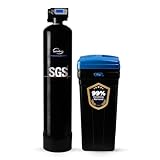
The iSpring WCSTB45KG is for the buyer who wants the capacity of a 45,000-grain class system and the serviceability of a conventional two-tank layout, but does not want to pay premium prices for it. It suits four-to-five-person households on hard water, and it is a good fit for anyone who has been put off by all-in-one cabinet softeners because they are difficult to repair. iSpring is a well-established name in residential water treatment, which helps with parts and support questions down the road.
Key specs
- 45,000-grain capacity class
- Separate brine tank included, which is the conventional and more serviceable configuration
- Digital metered control for demand-initiated regeneration
- Two-tank layout: resin tank plus brine tank
- Whole-house installation on the main supply line
Why it works
Capacity per dollar is the headline here. A 45,000-grain class system at a budget price tier is a lot of softening capability for the money, and it puts a four-person household on roughly a weekly regeneration cycle even on fairly hard water. That is the interval you want: long enough that salt consumption stays reasonable, short enough that the resin is not sitting loaded with hardness for weeks at a time.
The separate brine tank is a real advantage that buyers often overlook. Cabinet-style softeners hide the brine tank inside a single shell, which looks tidy but makes salt loading awkward, makes it harder to see and break up salt bridging, and makes cleaning the tank a chore. With a conventional brine tank, you can lift the lid, look at the salt level, break up a bridge with a broom handle in ten seconds, and empty and rinse the tank annually without dismantling anything.
Digital metered control keeps salt use tied to actual consumption, which matters more on a budget system than a premium one because the salt bill is a larger share of total ownership cost when the hardware is cheap. Expect standard maintenance: keep the brine tank at least a third full of salt, never let it run completely dry for long periods, and check for salt mushing if your household uses very little water.
Pros
- 45,000-grain class capacity at a budget price tier
- Separate brine tank is easier to fill, inspect, and clean than a cabinet design
- Digital metered control avoids wasted regeneration cycles
- Conventional two-tank layout is familiar to any plumber or technician
- Established brand with accessible customer support
Cons
- Two tanks require more floor space than a one-tank cabinet design
- Control head parts come from the manufacturer rather than a broad aftermarket
- Budget-tier valve components may not match a premium valve’s service life
- Oversized for one or two people
How it compares
Against the iSpring WCS45KG one-tank model, this is the same capacity in a more conventional and more serviceable package, at a lower price tier. The one-tank version wins only on footprint and appearance. Against the Aquasure Harmony Series 48,000, the iSpring offers slightly less rated capacity at a similar price tier, so the Aquasure edges ahead on headroom while the iSpring competes on brand support and its included brine tank. Against the Aquasure Harmony Series 40,000, the iSpring gives you more capacity for similar money, which makes it the stronger value if your household is at the larger end of the range.
7. DuraWater Fleck 5600 SXT 32,000 Grains – Best for Very Hard Water in Small Homes
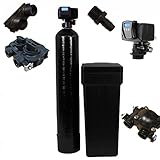
The DuraWater 32,000-grain system is built around the Fleck 5600 SXT metered valve, which makes it the premium choice for a small household that wants professional-grade hardware rather than a large resin bed. It suits one-to-three-person homes, apartments with a mechanical room, and any installation where floor space is tight but water quality is poor. If your water tests at 20 grains per gallon or above and you live alone or with one other person, this is a more sensible purchase than a giant two-tank system you cannot fit.
Key specs
- 32,000-grain capacity class
- Fleck 5600 SXT digital metered control valve with demand-initiated regeneration
- Two-tank configuration with separate brine tank
- Programmable controller for hardness, capacity, and regeneration timing
- Widely supported valve platform with readily available replacement parts
Why it works
Very hard water in a small household creates a specific problem. You need frequent regeneration because the daily hardness load is high relative to the resin volume, but you also do not have the space or the water demand to justify a 50,000-grain system. The answer is a compact resin tank paired with a valve that is precise about when it regenerates. The Fleck 5600 SXT does exactly that: it meters actual gallons, calculates when capacity is exhausted, and regenerates on that basis rather than on a fixed schedule.
At 25 grains per gallon, a two-person household using 150 gallons a day is removing about 3,750 grains daily. A 32,000-grain class unit regenerates roughly every seven or eight days in that scenario, which is still a healthy interval. The premium valve means that when the system eventually needs a piston, seal kit, or controller replacement, you can buy the part and fit it rather than replacing the whole softener.
The trade-off versus a larger system is peak flow. A 1-cubic-foot resin bed creates more pressure drop at high flow than a 1.5-cubic-foot bed. In a one-or-two-person home this rarely matters. In a household where three showers, a dishwasher, and a washing machine can run at once, it might.
Pros
- Premium Fleck 5600 SXT metered valve with strong parts availability
- Compact capacity suits small homes and tight utility spaces
- Programmable controller lets you tune for very hard water precisely
- Repairable rather than disposable; components can be replaced individually
- Demand-initiated regeneration controls salt use even on hard water
Cons
- Premium price tier for only 32,000 grains of capacity
- Not enough headroom for households larger than three people
- More pressure drop at high flow than a larger resin bed
- Requires manual programming during setup
How it compares
Against the AFWFilters Fleck 5600 SXT with 10% crosslink resin, the two share the same valve family, so the decision comes down to capacity and resin. AFWFilters offers more capacity and the chlorine-resistant crosslink resin; DuraWater offers a compact footprint and the same premium valve. On chlorinated city water, the crosslink resin is the better long-term choice. On well water with no chlorine, the difference in resin matters far less and this unit’s compact size becomes the deciding factor. Against the Aquasure Harmony Series 32,000, you are paying the premium for the Fleck valve and its serviceability, which is a reasonable trade if you plan to keep the house.
8. Kenmore 350 Whole House Water Softener System – Best for Straightforward 1-4 Person Replacements
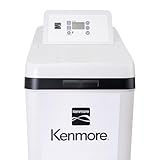
The Kenmore 350 is a 32,000-grain system explicitly rated for one to four people, which makes it one of the easiest units here to match to a household without doing much math. It suits homeowners replacing an existing Kenmore softener, buyers who want a recognizable appliance brand with a support line, and anyone who prefers a system with a clearly stated household rating over a raw grain number they have to interpret. It is also a reasonable choice for a mid-size home on moderately hard water where a 48,000-grain system would be overkill.
Key specs
- 32,000-grain capacity class
- Manufacturer rating of 1 to 4 people, which is unusual clarity in this category
- Demand-initiated regeneration rather than fixed-timer cycling
- Two-tank configuration with a separate brine tank
- Whole-house installation on the main line
Why it works
The household rating is the feature worth highlighting. Most softener listings give you a grain capacity and leave you to work out whether that fits your family, your hardness, and your water use. A stated 1-to-4-person rating removes most of that guesswork for the typical buyer, and it is generally calibrated for moderately hard water, which is what most municipal supplies in the United States fall into.
Demand-initiated regeneration is the second thing that matters. At this price tier, some competing units still use timer-based control, which regenerates on a calendar regardless of consumption. Demand initiation means the unit regenerates when the resin is actually exhausted, which saves salt on low-use weeks and keeps the system honest in a household with an irregular schedule.
The main limitation is the rating itself. A 1-to-4-person rating assumes moderate hardness. If your water tests at 20 grains per gallon, a four-person household will push this unit well past its comfortable range and it will regenerate every few days. Get a hardness number before you buy, and if it comes back high, size up to a 48,000 or 50,000-grain system instead.
Pros
- Clear 1-to-4-person household rating simplifies sizing decisions
- Demand-initiated regeneration keeps salt use tied to actual consumption
- Recognizable brand with established customer support channels
- 32,000-grain capacity is a good match for typical mid-size homes
- Mid-range price tier rather than premium
Cons
- The 1-to-4-person rating assumes moderate hardness and can mislead on very hard water
- Less capacity headroom than 40,000 or 48,000-grain alternatives
- Two-tank layout requires dedicated floor space
- Fewer aftermarket parts options than a Fleck-based valve platform
How it compares
Against the Aquasure Harmony Series 32,000, the capacity class is identical and both use metered regeneration, so the choice comes down to brand preference, price tier, and physical dimensions. Against the Aquasure Harmony Series 40,000, the Kenmore offers less capacity for a similar or higher price tier, which makes the Aquasure the better value if you have three or four people in the house. The Kenmore’s advantage is its explicit household rating, which is genuinely useful if you would rather not run the sizing math yourself.
9. AFWFilters 48K Grain Fleck 5600 SXT with Crosslink Resin – Best for High-Capacity Fleck Buyers

This is the larger sibling of the premium AFWFilters system: the same Fleck 5600 SXT metered valve and crosslink resin, scaled up to a 48,000-grain class. It suits four-to-five-person households on hard municipal water who want both capacity and long-term serviceability, and it is the natural pick for anyone who has already decided on a Fleck-based system but needs more resin volume than