Key takeaways
- A guard or feed chute that keeps fingers away from blades and rollers.
- An interlock that prevents operation when the blade or roller assembly is removed.
- Non-slip feet or a clampable base.
- A clearly accessible stop switch.
- A reverse function on powered roller units, useful for releasing a jam without reaching into the feed area.
- Removable parts that can be handled with a tool or designated grip rather than direct contact with sharp edges.
Best Meat Tenderizer Machine Options for Faster Prep
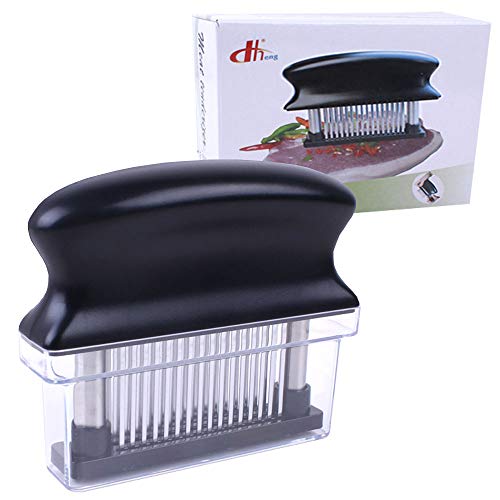
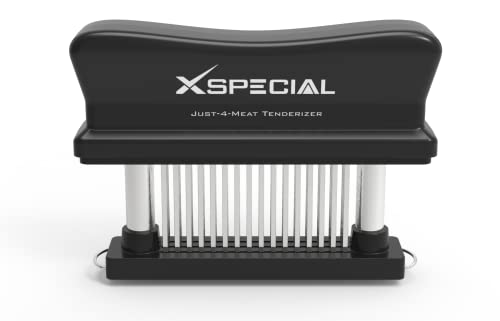
The best meat tenderizer machine for most home cooks is a compact stainless-steel blade tenderizer with removable parts; choose a roller tenderizer instead when you regularly process large batches of thin steaks, cutlets, or boneless poultry.
These machines are not interchangeable. Blade models make repeated vertical cuts through thicker pieces and are usually easier to store. Roller models pull meat through rotating shafts fitted with blades, delivering faster, more uniform coverage when throughput matters. The right choice depends less on the number of blades than on meat thickness, batch size, cleanup tolerance, and available counter space.
Our top picks


As an Amazon Associate we earn from qualifying purchases at no extra cost to you. Ratings are shown as listed on Amazon.
Roller vs. blade tenderizers at a glance
| Criterion | Blade-style machine | Roller-style machine |
|---|---|---|
| Best meat thickness | About 6–35 mm; better for thicker steaks and roasts cut into portions | About 3–15 mm; best for thin steaks, cutlets, and schnitzel-style portions |
| Typical working width | 100–180 mm | 150–250 mm |
| Small-batch speed | Approximately 10–25 kg per hour, depending on loading and model | Approximately 30–80 kg per hour |
| Construction to prioritize | 304 stainless-steel blades, shafts, guards, and removable food-contact parts | 304 stainless-steel rollers and frame; sealed drive components are preferable |
| Counter and storage footprint | Roughly 250–400 mm wide and 3–8 kg | Roughly 350–600 mm wide and 8–20 kg |
| Cleaning effort | Moderate: many narrow blades and slots require a brush | Moderate to high: rollers, combs, guards, and feed openings must be separated |
| Best setting | Home kitchen, occasional catering, and varied portion sizes | Restaurant prep, butcher counters, or frequent batch production |
The figures above are useful buying ranges rather than universal specifications. Actual capacity depends on motor power, blade spacing, operator loading, meat temperature, and whether the machine is designed for continuous commercial duty.
Best choices by situation
Best for most home kitchens: compact blade tenderizer
A countertop blade machine is the most practical option if you tenderize a few portions at a time. It can handle thicker beef steaks, pork chops, chicken breasts, and game cuts without requiring a long, straight feed path. Look for a removable blade cassette, a transparent or hinged safety guard, non-slip feet, and a power switch that cannot be activated accidentally while the guard is open.
Blade tenderizers also offer more flexibility. A thinner blade arrangement creates many shallow cuts, while a wider spacing is less aggressive on delicate poultry. The trade-off is cleaning: meat fibers can lodge between blades, so a quick rinse is not enough.
Best for high throughput: roller tenderizer
Choose a roller machine when you process several kilograms in one session or need consistent results across many similarly sized portions. The rollers draw meat through at a steady rate, reducing the repetitive handling associated with a blade unit. This is valuable for meal-prep businesses, small restaurants, and serious home cooks who regularly prepare large family or event batches.
Rollers are less forgiving of awkward shapes. A very thick steak may not enter correctly, and uneven pieces can fold or jam. For reliable feeding, trim excess fat, remove bone fragments, and keep portions within the specified width and thickness.
Best for limited storage: manual or attachment-style tenderizer
If you use a tenderizer only a few times per month, a manual roller or a mixer attachment may make more sense than a powered machine. These options usually cost less and occupy less space, but they demand more force and produce lower throughput. They are suitable for a handful of cutlets, not for processing a full case of meat.
How thickness changes the decision
Thickness is the most important selection factor. A blade machine can penetrate a thicker portion from above, making it suitable for steaks around 20–35 mm thick, provided the guard and blade depth accommodate that size. It does not necessarily tenderize the center of a very thick roast evenly; large cuts may need to be portioned first.
Roller machines work best when the meat is thin enough to pass between the shafts without excessive compression. For pieces around 6–12 mm, they can create an even pattern quickly. If the meat is much thicker than the manufacturer’s feed limit, forcing it through can strain the drive system, deform the portion, or create a dangerous jam.
Neither design replaces proper trimming. Silver skin, tough membrane, bone, and hard cartilage should be removed before tenderizing. Blades can snag these materials, while rollers can wrap them around the shafts.
Stainless steel: what matters beyond appearance
“Stainless steel” on a product description may refer only to the outer housing. For food-contact durability, check whether the blades, rollers, shafts, chute, guard, and removable trays are also stainless steel. Type 304 stainless steel is a useful benchmark for general kitchen use because it resists corrosion from moisture and ordinary food acids.
A polished finish is not automatically better than a brushed finish. More important features are smooth welds, rounded corners, minimal crevices, and fasteners that do not trap meat residue. Painted steel can be acceptable for a frame, but chipped paint near food-contact areas is a reason to stop using the machine until the part is replaced.
Drive gears and bearings deserve attention too. A stainless exterior cannot compensate for an exposed drive assembly that collects water during cleaning. Prefer machines with protected transmissions, replaceable drive components, and a stated duty cycle. A unit rated for intermittent operation should not be treated like a continuous-duty commercial tenderizer.
Cleaning and safety determine ownership effort
The machine is only useful if you will clean it after every session. Raw meat residue dries quickly in blade gaps and roller combs, and reheating or wiping alone is not an adequate cleaning method. Unplug the machine, remove the guard and food-contact assembly according to the manual, and wash those parts with hot water and detergent. Use a narrow nylon brush for slots; do not use your fingers to clear blades.
Dry every removable part before reassembly. Moisture left around shafts and fasteners promotes corrosion and can dilute food-safe lubricant. Do not immerse a motor housing, switch assembly, or power cord. If the manual permits dishwasher cleaning, verify whether repeated high-heat cycles dull blades or damage seals.
Safety features worth paying for include:
- A guard or feed chute that keeps fingers away from blades and rollers.
- An interlock that prevents operation when the blade or roller assembly is removed.
- Non-slip feet or a clampable base.
- A clearly accessible stop switch.
- A reverse function on powered roller units, useful for releasing a jam without reaching into the feed area.
- Removable parts that can be handled with a tool or designated grip rather than direct contact with sharp edges.
A practical ownership calculation
Suppose a compact blade machine costs $120–$250 and you use it twice each month for five years. That is 120 uses, making the equipment cost approximately $1.00–$2.08 per use before electricity, cleaning supplies, and replacement parts. A $500–$1,200 roller machine used four times weekly for five years provides about 1,040 sessions, or approximately $0.48–$1.15 per session.
The roller appears cheaper per use only when its higher capacity is actually used. For occasional family meals, the blade machine may have the lower total ownership cost because it needs less space and is less likely to sit unused. For frequent batch prep, the higher purchase price of a roller can be justified by reduced handling time.
What wears first and what to replace
Blades gradually lose sharpness, especially when they encounter bone fragments or frozen meat. Roller combs and scraper plates can bend if a portion jams. Plastic guards and feed trays may crack before the metal frame shows any damage. On powered units, drive belts, gears, and bearings are the likely long-term wear points.
Before buying, search the manufacturer’s parts documentation for blade cassettes, roller assemblies, combs, guards, belts, and lubricant requirements. A machine with a lower initial price but no replacement parts can be more expensive after one damaged component. Avoid running frozen or partially frozen meat unless the manufacturer specifically permits it; ice can damage blades and overload motors.
Final buying recommendation
Buy a compact stainless-steel blade tenderizer if you prepare fewer than about 5 kg per session, work with mixed thicknesses, or need equipment that can be stored in a cabinet. Choose a stainless-steel roller tenderizer if you process thin, uniform portions several times per week and can dedicate counter or prep-room space to it. For rare use, a manual model or attachment is the sensible alternative.
Whichever design you choose, prioritize removable food-contact parts, a real guard and interlock, published thickness limits, replacement-part availability, and a cleaning routine you will follow. Those details have more influence on speed, safety, and useful lifespan than an impressive blade count or motor wattage alone.