Key takeaways
- Lens count: 266 pieces, the standard full-range professional count.
- Rim construction: metal rims, which hold the lens edge and reduce the chipping that kills rimless lenses in busy handling.
- Case: aluminum, with a molded or slotted interior typical of this class.
- Aperture class: full-aperture lenses, generally around 36–38 mm overall diameter in 266-piece kits, giving a wider field than the reduced-aperture lenses found in compact sets.
- Sphere steps: 0.25 D through the low and mid range, widening to 0.50 D or 1.00 D at the extremes — the usual pattern at this count.
- Cylinder steps: 0.25 D through the low powers, then 0.50 D as the powers climb.
- Prisms and accessories: kits at this count normally include prism lenses, occluders, a pinhole, plano and frosted lenses, filters and cross-cylinders. Confirm the exact accessory list on the product page.
- Trial frame: not listed as part of this kit. Budget for one separately.
The best professional trial lens set for most optometrists is the UCanSee 266-piece metal-rim set in its aluminum case. It is the pick that balances a genuinely full working range — spheres and cylinders in 0.25 D steps through the range you use every day — with metal-rimmed lenses that survive handling and a case organized well enough to keep a busy lane moving. Buy it if you refract most working days, see a normal mix of low and high refractive errors, and want one kit that will not need replacing in three years. If money is tight, or you are equipping a second lane or finishing a qualification, the AISITESY 104-piece JS-104 is the sensible budget entry, and it arrives with a trial frame. If you want the widest coverage available and a second cylinder scale, the AISITESY 268-piece set is the premium choice. And if your lenses travel — satellite clinics, domiciliary visits, teaching — the WoopJeem 68-piece kit is the one that fits in a bag.
Top 3 Picks
Best overall: UCanSee 266-Piece Metal Rim Set
The 266-piece count is the professional sweet spot: it covers routine refraction plus the high myopes and hyperopes that smaller kits run out of range on, and the 0.25 D steps hold through the powers where a quarter diopter actually changes your endpoint. Metal rims protect the lens edges from the chips that quietly ruin a set, and the aluminum case gives you slots rather than a jumble. It does not include a trial frame, so budget for one separately — that is the only real gap.
Best budget: AISITESY 104-Piece JS-104 Set
A 104-piece set will handle the large majority of routine refractions in a general practice, and this one arrives with a trial frame included, which is unusual at its price tier. The trade-off is honest and predictable: the cylinder range stops earlier and the high-power spheres thin out, so high-cylinder and high-myopia work will occasionally send you reaching for something you do not have. For a first set, a second lane, or a student kit, that is a fair trade.
Best premium: AISITESY 268-Piece Set
The 268-piece count edges past the standard 266 by adding a few lenses at the margins — typically extra cross-cylinders, filters or prism steps — and the listing pairs that with an adjustable frame and an aluminum case. This is the set for a high-volume clinic or a teaching practice where two practitioners share one kit and nobody wants to hunt for a lens that is not there. You pay premium-tier money for coverage you may only need a few times a month, which is exactly the point of buying it once.
Quick Comparison
| Product | Best for | Key specs | Price tier |
|---|---|---|---|
| UCanSee 266-Piece Metal Rim Set | Best overall daily-driver kit | 266 lenses, metal rims, aluminum case, full-aperture class, 0.25 D steps low range; frame not included | Premium |
| UCanSee 104-Piece Set with Trial Frame | Best value full kit with frame | 104 lenses, metal rims, aluminum case, trial frame included, reduced range at the extremes | Mid-range |
| AISITESY 104-Piece JS-104 | Best budget first set | 104 lenses, metal rims, case, free trial frame, compact footprint | Budget |
| AISITESY 268-Piece Set | Best premium coverage | 268 lenses, metal edge, aluminum case, adjustable frame, widest range in this list | Premium |
| VV LIINNCXM 104-Piece TLS-104 | Best budget second lane | 104 lenses, metal rims, aluminum case, no frame in the kit | Budget |
| SongChaza 266-Piece Metal Rim Set | Best mid-budget full range | 266 lenses, metal rims, aluminum case, optometry accessories at this count | Mid-range |
| WoopJeem 68-Piece Trial Lens Set | Best for mobile and travel | 68 lenses, storage case, compact and light, reduced sphere and cylinder range | Budget |
How We Chose
Selection was driven by the specifications that actually change how a trial lens set performs in a lane, not by how large the number on the box is. The first filter was lens range and step logic: how far the spheres run, where the 0.25 D increments stop and coarser 0.50 D or 1.00 D steps take over, and whether the cylinder scale reaches the powers a general practice sees. The second was construction — metal rims versus rimless lenses, aperture size, and whether the listing describes any coating at all, because an uncoated lens behaves differently under the glare of a bright room than a coated one. The third was case organization and transport weight, which decides whether a set stays on the desk or gets shoved in a cupboard. Fourth was frame adjustability where a trial frame is included, since a frame that will not hold a PD or a temple angle turns a good lens set into a frustrating one. Finally, we weighed calibration expectations, replacement paths for individual lenses, and upgrade logic: whether a set is a sensible first purchase, a sensible second lane, or a lifetime buy. Every claim here is based on published specifications, category standards and the way trial lens sets are used clinically — no product was tested, handled or benchmarked for this article.
1. UCanSee 266-Piece Metal Rim Set – Best for Full-Scope Daily Refraction
As an Amazon Associate we earn from qualifying purchases at no extra cost to you.

This is the set to buy when you want one kit that covers almost everything a general optometric practice will throw at it, and you would rather not think about trial lenses again for several years. It suits a single-lane practice doing daily subjective refraction, a practitioner who sees a genuine spread of refractive errors rather than a narrow demographic, and anyone who has already owned a 104-piece set and grown tired of running out of range. It also suits a clinic that wants a spare set capable of standing in for a primary kit if the main case goes for service.
Key specifications
- Lens count: 266 pieces, the standard full-range professional count.
- Rim construction: metal rims, which hold the lens edge and reduce the chipping that kills rimless lenses in busy handling.
- Case: aluminum, with a molded or slotted interior typical of this class.
- Aperture class: full-aperture lenses, generally around 36–38 mm overall diameter in 266-piece kits, giving a wider field than the reduced-aperture lenses found in compact sets.
- Sphere steps: 0.25 D through the low and mid range, widening to 0.50 D or 1.00 D at the extremes — the usual pattern at this count.
- Cylinder steps: 0.25 D through the low powers, then 0.50 D as the powers climb.
- Prisms and accessories: kits at this count normally include prism lenses, occluders, a pinhole, plano and frosted lenses, filters and cross-cylinders. Confirm the exact accessory list on the product page.
- Trial frame: not listed as part of this kit. Budget for one separately.
The practical consequence of the 266 count is coverage. A 104-piece set is a deliberate compromise: the manufacturer drops lenses from the tails of the distribution to keep the kit affordable and portable. That is fine until you meet a −14.00 D myope or a patient with 3.50 D of cylinder at an oblique axis and discover the lens you need is simply not in the case. At 266 pieces those tails are filled in, and the accessories that make subjective refraction quicker — cross-cylinders, Maddox rod, filters — are present rather than improvised.
Metal rims matter more than buyers expect. Rimless trial lenses are lighter and cheaper to produce, but the exposed edge is where chips start, and a chipped edge scatters light in a way that can affect what the patient reports. A metal rim takes the knocks instead, and it also keeps a lens sitting flat if it gets slightly bent. On a set you will handle thousands of times, that difference compounds.
The aluminum case does three jobs: it protects the lenses, it organizes them so you can find a power by feel and by slot, and it makes the whole set movable. Organization is not a cosmetic detail. In a working lane, the difference between a case with numbered or shaped slots and a case with a foam cutout that has compressed is the difference between a fifteen-second lens swap and a thirty-second hunt. Ask yourself where each lens goes back — a case that makes the wrong slot obvious is a case that keeps its order for years.
The honest trade-offs are weight and price. A full 266-piece set in an aluminum case sits in the roughly 6–9 kg class, which is not something you carry between rooms casually, and it occupies real desk space. The premium tier also means you are paying for range you might use a few times a month. That is the correct calculation for a primary clinic kit and the wrong one for a spare.
Pros
- Full professional range in one purchase, including the high-power spheres smaller sets omit.
- Metal rims protect lens edges and keep lenses seated flat.
- Aluminum case with organized interior protects and orders the set.
- 0.25 D steps held through the range where quarter-diopter changes matter.
- Accessory lenses at this count let you run a full subjective routine without improvising.
- Strong upgrade path: it is the set you keep rather than the set you replace.
Cons
- No trial frame in the kit, which adds a separate purchase and a compatibility question.
- Heavy and bulky — poor for mobile or domiciliary work.
- Premium-tier price for coverage some low-volume practices rarely use.
- You must verify calibration yourself; a large set is harder to spot-check lens by lens.
- Case interiors at this tier vary, so organization quality is not guaranteed by the count alone.
Against the SongChaza 266-piece set, the choice comes down to budget and bundling: both offer the same class of coverage, and the SongChaza listing sits a tier lower and leans toward including optometry accessories, which can make it the better value if you already own a frame you like. Against the AISITESY 268-piece set, the UCanSee gives up two lenses and an adjustable frame in exchange for a lower premium-tier position. If your budget genuinely stops at this tier, the UCanSee is the safer primary kit; if you want the absolute widest coverage and a frame in the box, the AISITESY is the step up.
2. UCanSee 104-Piece Set with Trial Frame – Best for a Complete Kit on a Mid-Range Budget

This is the set for someone who wants to start refracting properly without assembling a kit piece by piece. It suits a new practice equipping its first lane, an established practice adding a second lane without duplicating premium spend, a student or recently qualified optometrist building a personal kit, and any clinic that wants a complete, self-contained case that includes the frame. If you have been borrowing a colleague’s lenses or working around gaps in a shared set, this is the point where you stop.
Key specifications
- Lens count: 104 pieces — the standard reduced-range professional count.
- Rim construction: metal rims, as stated in the listing.
- Case: aluminum, with an organized interior.
- Trial frame: included, which is the defining feature of this kit at this tier.
- Sphere coverage: typically to around ±12.00 to ±16.00 D in 104-piece kits, in 0.25 D steps through the low range.
- Cylinder coverage: typically to around ±4.00 to ±6.00 D, with 0.25 D steps at the low end.
- Prisms: usually a small set of prism lenses; kits at this count often stop short of the full prism ladder.
- Footprint: roughly half the volume of a 266-piece case, in the 3–4.5 kg class.
The arithmetic of a 104-piece set is worth understanding before you buy, because it explains every limitation you will hit. A full 266-piece set is built around filling in the tails: high spheres, high cylinders, more prism steps, more accessory lenses. A 104-piece set is built around the middle of the distribution — the powers that cover the majority of routine refractions in a general population. That is a rational design, not a cheap shortcut. What you lose is the ability to finish a refraction in one pass when a patient sits outside that middle band, and you lose some of the accessory lenses that speed up subjective work.
Including a trial frame changes the economics considerably. A frame on its own is a meaningful part of the cost of getting started, and a kit that arrives with one means you can begin refracting the day it lands. The caveat is that an included frame at this tier is usually a basic adjustable model: expect adjustable PD, adjustable temple length and a standard bridge, and check the PD range against the patients you actually see. If your patient population includes very narrow or very wide interpupillary distances, verify the frame’s adjustment range before committing — a frame that will not reach the extremes is the single most common frustration with bundled kits.
For workflow, this set sits in a genuinely useful middle position. It is light enough to move between two rooms without a trolley, it opens and closes quickly, and it is organized enough that a new user can learn the layout in a week. In a two-lane practice it makes an excellent second kit: the premium set stays in the primary lane for complex work, and this one handles the routine list without either practitioner waiting.
The main risk is that you outgrow it faster than you expect. Practices that refract high myopes regularly, or that do a lot of pediatric and binocular vision work requiring accessory lenses, tend to hit the 104-piece ceiling within a year or two. That is not a reason to avoid it — it is a reason to buy it as a deliberate first step and plan the upgrade rather than treating it as a lifetime purchase.
Pros
- Complete kit: lenses, case and a trial frame arrive together.
- Metal rims and an aluminum case at a mid-range tier.
- Covers the majority of routine refractions in a general practice.
- Roughly half the weight and bulk of a full set, so it moves easily.
- Fast to learn and fast to use — good for a second lane or a new clinician.
- Leaves budget for a better standalone frame later if the included one disappoints.
Cons
- Range stops short at the high sphere and cylinder extremes.
- The included trial frame is a basic model; check its PD and temple range against your patients.
- Fewer accessory lenses than a 266-piece kit, which slows some subjective routines.
- You will likely want to upgrade within a few years in a high-volume practice.
- Two purchases over time usually cost more than one 266-piece set bought up front.
Against the AISITESY 104-piece JS-104, this is a straight budget decision. Both are 104-piece kits with a frame included; the AISITESY sits a tier lower and the UCanSee sits a tier higher, so the question is whether the UCanSee’s case and rim quality justify the step. If the set is going into a busy lane and will be opened and closed fifty times a week, the higher tier usually pays for itself. Against the UCanSee 266-piece set, this is a coverage decision: same brand, same construction philosophy, half the lenses. Buy the 104 first if the budget is real; buy the 266 first if you would rather not buy twice.
3. AISITESY 104-Piece JS-104 Trial Lens Set – Best for a First Set on a Tight Budget

This is the set for the person who needs to start refracting now and cannot justify a premium-tier kit. It suits students and recently qualified optometrists building a first personal set, small or newly opened practices equipping a single lane on a controlled budget, and established clinics that want a spare kit that is genuinely usable rather than decorative. It also suits teaching environments where multiple sets are needed and the budget per set is the binding constraint.
Key specifications
- Lens count: 104 pieces, the standard reduced-range count.
- Rim construction: metal rims, as stated in the listing.
- Case: included, with the slotted or molded interior typical of the class.
- Trial frame: included free with the kit.
- Model designation: JS-104, which makes reordering and matching straightforward.
- Sphere coverage: typically to around ±12.00 to ±16.00 D at this count, in 0.25 D steps low down.
- Cylinder coverage: typically to around ±4.00 to ±6.00 D in 0.25 D steps at the low end.
- Weight class: roughly 3–4.5 kg including the case, so it moves between rooms easily.
What you are buying at the budget tier is the same lens count and the same basic architecture as more expensive 104-piece kits, with cost taken out of the margins: the case interior, the finish of the rims, the quality of the included frame, and the consistency of the lens coatings. For a first set those are acceptable places to economize, because the thing that actually determines whether you can refract is the presence of the right lens in the right step — and that is a function of the count, not the tier.
The included trial frame deserves a realistic expectation. At this tier, expect a functional adjustable frame with a workable PD range and temples that adjust, but do not expect the smooth, precise feel of a professional standalone frame. Check it on arrival: set the PD, tighten everything, and see whether it holds position under light handling. If the knobs drift, treat the frame as a stopgap and plan a better one, because a frame that shifts mid-refraction is worse than no frame at all — it will have you re-checking endpoints you already established.
Workflow fit is better than the price suggests. A 104-piece kit in a compact case is fast to open, fast to search and easy to keep ordered, and the JS-104 model number means that if you later add a second identical set for a second lane, the layouts match and your muscle memory transfers. That consistency is a real operational benefit in a multi-lane clinic and it is easy to overlook when comparing single units.
The limitations are the ones that come with 104 pieces, not with the tier. High myopes and high hyperopes will push you past the available range, high cylinders will thin out, and the accessory lens selection will be shorter than a 266-piece kit’s. You will also find that budget-tier coatings vary: some lenses may show more surface reflection than a premium set, which matters in a brightly lit room. If your practice sees a broad refractive spread, plan the upgrade path before you buy rather than after.
Pros
- Lowest realistic entry point into a complete, usable trial lens kit.
- Frame included, so you can start refracting immediately.
- Metal rims and a protective case at a budget tier.
- Model-numbered (JS-104), which makes reordering and multi-lane matching simple.
- Compact and light enough to move or store without effort.
- Good coverage of routine refractions for the money.
Cons
- Range stops short at the extremes of sphere and cylinder.
- Included frame is basic; verify that it holds PD and temple settings.
- Case interior and rim finish are where the cost savings show up.
- Coatings are less predictable than at higher tiers, which can matter in bright rooms.
- Shorter accessory lens selection than a full-range kit.
Against the VV LIINNCXM 104-piece TLS-104, the decision is simple: the AISITESY includes a trial frame and the VV LIINNCXM kit, as listed, does not. If you do not already own a frame, the AISITESY is the more complete purchase; if you already have a frame you trust, the VV LIINNCXM gives you the same lens count without paying for a frame you will not use. Against the UCanSee 104-piece set, this is the budget versus mid-range call — the same coverage, with the higher tier buying better finish and case quality.
4. AISITESY 268-Piece Trial Lens Set – Best for High-Volume and Teaching Clinics
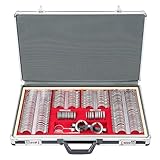
This is the set for a clinic where the lens case is opened constantly, more than one practitioner uses it, and running out of range is treated as a workflow failure rather than an inconvenience. It suits high-volume practices, hospital and teaching clinics where students rotate through the same equipment, and any practitioner who wants the widest coverage available in a single purchase and an adjustable frame in the same box. It also suits a practice that has decided to stop buying intermediate kits and go straight to the top.
Key specifications
- Lens count: 268 pieces — two beyond the standard full-range 266 count.
- Rim construction: metal edge, protecting the lens perimeter.
- Case: aluminum, with an organized interior.
- Trial frame: included, described as adjustable.
- Sphere coverage: full-range class, typically to around ±20.00 D with 0.25 D steps in the low and mid range.
- Cylinder coverage: full-range class, typically to around ±6.00 D with 0.25 D steps low down and 0.50 D steps higher up.
- Prisms and accessories: full-range kits at this count normally include a prism ladder, occluders, pinhole, plano and frosted lenses, filters and cross-cylinders.
- Weight class: roughly 6–9 kg with the case — a desk instrument, not a travelling one.
The extra two lenses above 266 are worth thinking about honestly. They are almost always at the margins of the range — an additional cross-cylinder, an extra filter, or one more prism step — and they are not what makes this set valuable. What makes it valuable is that it is a full-range kit with a frame included, which means the two most common gaps in a professional setup are both closed at the point of purchase. If you have ever run a refraction and found yourself one accessory lens short, you already know what that is worth.
The adjustable frame is the second differentiator. At premium tier, an included frame is usually a genuine instrument rather than a placeholder: expect a wider adjustment range on PD, temples that hold their position, and a mechanism that survives being reset between patients. In a teaching clinic that matters enormously, because a frame that drifts teaches students to accept imprecise endpoints. It also matters in a high-volume clinic where the frame is adjusted dozens of times a day and a stripped knob means downtime.
For workflow, a full-range set of this size is best understood as fixed equipment. It belongs on a desk with a defined place, opened at the start of the day and closed at the end, with a routine for returning lenses to their slots. Clinics that get this right find the set lasts for many years with only occasional lens replacement; clinics that treat it as portable find rims bent, lenses chipped and slots mixed within a year. If you need portability, this is not the set for you — that is what the 68-piece kit below is for.
The honest downside is cost and coverage overlap. If you already own a 104-piece kit, this set replaces rather than complements it, and the extra range will sit unused on most days. The value case is strongest for a practice that has decided this is its last lens set purchase for a decade, and weakest for a low-volume practitioner who sees a narrow refractive spread.
Pros
- Widest coverage in this list, with the full sphere and cylinder range a general practice needs.
- Adjustable trial frame included — no separate purchase to close the kit.
- Metal edge construction and an aluminum case for daily handling.
- Full accessory lens selection supports complete subjective routines.
- Suits multi-practitioner and teaching environments where the set is shared.
- Long ownership horizon: the coverage does not become the reason to upgrade.
Cons
- Premium-tier price for range many practices use only occasionally.
- Heavy and bulky; unsuitable for mobile or domiciliary work.
- Duplicates a 104-piece kit rather than complementing it.
- Verifying calibration across 268 lenses takes real time.
- The two extra lenses over 266 are marginal, so do not buy it for the count alone.
Against the UCanSee 266-piece set, this is very close on paper: the same full-range class, the same metal rims, the same aluminum case. The differences are the two extra lenses and the included adjustable frame on the AISITESY versus the lower premium-tier position of the UCanSee. If you already own a good frame, the UCanSee is the better value. If you want a complete kit in one purchase and the frame matters to you, the AISITESY is the cleaner answer. Against the SongChaza 266-piece set, the AISITESY buys you a frame and a marginally wider count; the SongChaza buys you a lower tier.
5. VV LIINNCXM 104-Piece TLS-104 Trial Lens Set – Best for a Second Lane With a Frame You Already Own

This is the set for someone who already has a trial frame and does not want to pay for another one. It suits a practice adding a second lane where the practitioners prefer their own frames, a clinic replacing a lost or damaged 104-piece set where the frame survived, and a practitioner who has strong opinions about frames and would rather spend the budget on lenses. It also suits a teaching or training room where frames are supplied separately and only the lens case needs to be duplicated.
Key specifications
- Lens count: 104 pieces, the standard reduced-range count.
- Rim construction: metal rims, as stated in the listing.
- Case: aluminum, with an organized interior.
- Trial frame: not included in the kit as listed.
- Model designation: TLS-104, which makes matching a second unit straightforward.
- Sphere coverage: typically to around ±12.00 to ±16.00 D at this count, with 0.25 D steps low down.
- Cylinder coverage: typically to around ±4.00 to ±6.00 D, with 0.25 D steps at the low end.
- Weight class: roughly 3–4.5 kg with the case.
The logic of buying lenses without a frame is stronger than it first appears. Frames are the part of a trial kit that gets adjusted, dropped and worn; lenses are the part that determines what you can measure. If your frame is good and your lens set is thin, spending the whole budget on lenses is the right allocation. And because the TLS-104 carries a model number, adding a second identical unit for a second lane keeps the layouts consistent, which matters more than most buyers expect when two practitioners share a room.
The aluminum case is the feature to scrutinize at this tier. With no frame bundled, more of the price can go into the case and the rims, and a well-organized aluminum case is what keeps a 104-piece set usable over years. Look for a case where each lens has a defined home and where the closure is robust enough for daily opening and closing. A budget case with a loose foam insert will compress, and once lenses start sliding into neighbouring slots you will spend part of every refraction sorting the set back out.
Workflow fit is straightforward: this is a second-lane or backup kit. It is light enough to move between rooms, fast to open, and covers the routine middle of the refractive distribution. In a two-lane practice it means neither practitioner waits for the shared premium set, and the premium set stays where the complex cases are. In a single-lane practice with an existing frame, it is a direct replacement purchase with no redundant parts.
The limitations are the 104-piece limitations plus one of your own making: without a frame in the box, you cannot start refracting until you have one, and a poor frame will cap the quality of everything the lenses can do. Budget for a decent frame in the same purchase, or accept that the kit is only as good as what you already own. Also expect the usual shortfall at the high sphere and cylinder extremes, and a shorter accessory lens selection than a full-range kit.
Pros
- No cost tied up in a frame you may not need or want.
- Metal rims and an aluminum case at a budget tier.
- Model-numbered (TLS-104) for easy multi-lane matching and reordering.
- Light and compact enough to move between rooms.
- Covers routine refractions well for the money.
- Lets you put the whole budget into the part that determines measurement quality.
Cons
- No trial frame — you cannot refract until you supply one.
- Range stops short at the high sphere and cylinder extremes.
- Case and rim finish vary at the budget tier; inspect on arrival.
- Shorter accessory lens selection than a full-range kit.
- If you do need to buy a frame, the total often lands above a bundled kit.
Against the AISITESY 104-piece JS-104, this is the frame question and nothing else: the AISITESY bundles one, this does not. Buy the AISITESY if you need a frame; buy this if you do not. Against the WoopJeem 68-piece set, the choice is coverage versus portability — this kit carries roughly a third more lenses and stays usable as a lane kit, while the WoopJeem is the one you carry. If the set is going to live on a desk, this is the better buy; if it is going in a bag, it is not.
6. SongChaza 266-Piece Metal Rim Trial Lens Set – Best for Full-Range Coverage at a Mid-Range Price
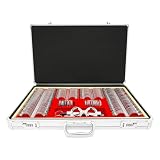
This is the set for the practitioner who wants full-range coverage without paying the top tier, and who values a kit that comes with the optometry accessories that make a complete routine possible. It suits a mid-volume practice upgrading from a 104-piece set, a clinic equipping a primary lane on a defined budget, and anyone who has decided that the 266 count is the right target and is now shopping purely on price within that class.
Key specifications
- Lens count: 266 pieces, the standard full-range professional count.
- Rim construction: metal rims, protecting the lens perimeter.
- Case: aluminum, with an organized interior.
- Accessories: the listing describes optometry accessories alongside the lenses — the occluders, pinhole, filters and cross-cylinders that full-range kits typically carry.
- Sphere coverage: full-range class, typically to around ±20.00 D in 0.25 D steps through the low and mid range.
- Cylinder coverage: full-range class, typically to around ±6.00 D with 0.25 D steps low down and 0.50 D steps higher up.
- Prisms: full-range kits normally include a prism ladder; check the exact steps listed.
- Weight class: roughly 6–9 kg with the case.
The value proposition here is straightforward: you are buying the coverage of a 266-piece set at a tier below the premium picks. In this class the differences between brands are mostly in the margins — case interior quality, rim finish, coating consistency, and the exact accessory list — rather than in what the lenses can measure. If your priority is range per unit of budget, this is the set that scores highest in this list.
The accessory question is the one to check carefully. At 266 pieces, some of the count is made up of accessory lenses rather than refractive powers, and the split varies between listings. A set with a generous prism ladder and a full accessory set is more clinically useful than one that pads the count with powers you will rarely use. Read the included-lens list before buying, and count how many prism steps and accessory lenses you are actually getting.
On construction, metal rims and an aluminum case are the right baseline for a set that will be opened daily. The rims protect edges, and the case protects everything else. At this tier, expect the case to be functional rather than luxurious: a molded insert, a decent latch, and slots that hold lenses in place. That is enough. What you are watching for is whether the insert stays put and whether the closure stays firm after a year of use.
Workflow fit is the same as any full-range kit: it belongs on a desk in a primary lane, opened in the morning and closed at night, with a return-to-slot habit that keeps it ordered. Because it costs less than the premium picks, it is also a more comfortable choice for a practice that wants a full-range backup set rather than a premium one — if the primary kit goes away for servicing, this can stand in without leaving you short of range.
The trade-offs are the usual mid-range ones. You are not getting the very best case interior or the most consistent coatings, and there is no included frame in the listing as given, so budget for one. There is also less information available about the brand’s long-term support and individual lens replacement than you would get from a larger, more established name — worth weighing if you plan to keep the set for a decade.
Pros
- Full 266-piece range at a mid-range price tier.
- Metal rims and an aluminum case for daily handling.
- Optometry accessories included, supporting a complete subjective routine.
- Good value if range per unit of budget is your main criterion.
- Works well as a full-range backup to a premium primary kit.
- Sensible upgrade target from a 104-piece starter set.
Cons
- No trial frame listed, so add one to your budget.
- Case interior and coatings are mid-range rather than premium.
- The accessory-to-power split varies, so check the included list closely.
- Heavy and bulky — not a portable kit.
- Less brand track record for long-term parts and support than the bigger names.
Against the UCanSee 266-piece set, this is a tier decision with nearly identical coverage: the UCanSee sits a tier higher and typically brings a better case and more consistent finish, while the SongChaza leaves budget for a frame and accessories. If you are buying one set and keeping it for years, the higher tier is usually worth it; if you are equipping a lane to a fixed budget, this is the smarter allocation. Against the AISITESY 268-piece set, you give up two lenses and an included adjustable frame in exchange for a lower tier — a fair trade unless the frame is the deciding factor.
7. WoopJeem 68-Piece Trial Lens Set – Best for Mobile, Domiciliary and Backup Use

This is the set for lenses that travel. It suits domiciliary and community optometry where you carry everything to the patient, satellite or outreach clinics where equipment is packed and unpacked regularly, teaching settings where a compact demonstration set is more useful than a full case, and any practice that wants a genuinely portable backup rather than a second heavy kit.
Key specifications
- Lens count: 68 pieces — a compact, portable class.
- Case: a storage case is included; at this count it is typically smaller and lighter than the aluminum cases on full-range kits.
- Lens type: described as precise optical lenses in an optometry kit.
- Sphere coverage: compact sets typically cover a reduced range, often to around ±6.00 to ±10.00 D in 0.25 D steps, with coarser steps at the edges.
- Cylinder coverage: typically to around ±2.00 to ±3.00 D in 0.25 D steps at this count.
- Prisms and accessories: usually limited; compact kits often include only a few accessory lenses.
- Weight class: roughly 1.5–2.5 kg with the case — genuinely carryable.
The design logic of a 68-piece set is different from a 104 or 266. It is not trying to cover everything; it is trying to cover enough to be useful while remaining light enough that you will actually take it with you. That means the high-power spheres and the upper cylinder range are the first things sacrificed, followed by the accessory lenses that a full routine uses. Understanding that trade in advance is what separates a satisfied owner from a frustrated one.
For domiciliary work, the case matters more than the count. You want a case that closes securely in a bag, does not shed lenses when it is carried at an angle, and is small enough to sit on a patient’s table without dominating it. Compact sets are usually good at this because they are built for it, but check the closure and the insert before committing — a case that spills a third of its lenses in transit is worse than no case at all.
The lens steps are the second thing to check. Some compact kits keep 0.25 D steps through their whole (shorter) range, which preserves the precision you need for fine subjective work even though the range is narrow. Others use 0.25 D steps at the bottom and coarser steps higher up, which means you may be able to reach a power but not fine-tune it. If your mobile work involves careful endpoint refinement, the step structure matters more than the total count.
Workflow fit is where this set earns its place even in a practice that already owns a full kit. It is the set you take to a satellite clinic, the set a colleague borrows for a home visit, the set that lives in a bag by the door. Used that way, it never has to cover everything, and its limitations stop being limitations. Used as a primary lane kit, it will frustrate you within a week.
The trade-offs are coverage and construction. You will not be able to refract high myopes or high hyperopes reliably, high cylinders are out of reach, and the accessory lens selection is thin. At the budget tier, expect the case to be functional rather than protective in the way an aluminum case is, and expect to replace lenses more often if the set is packed and unpacked daily.
Pros
- Genuinely portable — light enough to carry routinely.
- Covers routine low-to-moderate refractions in a compact footprint.
- Small case that works on a patient’s table during home visits.
- Budget tier, so a second or third set is affordable for outreach work.
- Useful as a backup when a full-range kit is unavailable or
Affiliate disclosure. As an Amazon Associate we earn from qualifying purchases at no extra cost to you. Prices accurate as of the date shown.Best Professional Trial Lens Sets for OptometristsCheck price on Amazon