Key takeaways
- Gaskets: Flattening, cracking, and loss of elasticity cause leaks and pressure loss.
- Valve assemblies: Residue or incorrect cleaning can make the lever stick or dispense unevenly.
- Nozzles: Fine tips clog or become damaged if cleaned with unsuitable tools.
- Threads and charger holders: Cross-threading can occur when the head is forced or tightened at an angle.
- Body finish: Aluminum coatings and painted surfaces show commercial wear sooner than stainless steel.
The best professional whipped cream dispenser for most kitchens is a 0.5-liter stainless-steel model that accepts standard 8-gram N2O chargers, offers several stainless or plastic nozzles, and has replaceable seals and a serviceable head.
A half-liter dispenser is large enough for routine pastry, café, and catering work without becoming awkward to chill, clean, or store. Choose a 1-liter model when you regularly prepare multiple batches, and choose aluminum only when low weight and lower purchase cost matter more than maximum commercial durability.
Our top picks


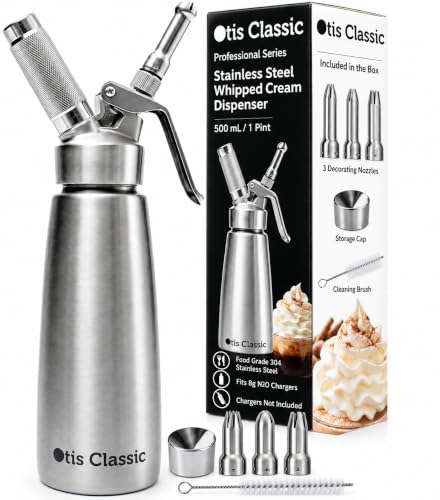

As an Amazon Associate we earn from qualifying purchases at no extra cost to you. Ratings are shown as listed on Amazon.
Best professional whipped cream dispensers by situation
| Kitchen situation | Best format | Why it fits | Typical market range |
|---|---|---|---|
| Frequent pastry or café service | 0.5 L stainless-steel professional dispenser | Durable, easy to chill, manageable between batches | $70–$130 |
| High-volume prep | 1 L stainless-steel dispenser | Fewer refills and better workflow for repeated service | $90–$170 |
| Occasional home use | 0.5 L aluminum dispenser | Lightweight and usually less expensive | $25–$60 |
| Hot and cold kitchen applications | Thermally rated stainless-steel model | Better resistance to temperature changes; verify the maker’s limits | $100–$190 |
| Small refrigerator or limited storage | 0.25–0.5 L model | Uses less space and is easier to keep upright | $30–$100 |
The strongest professional choices
iSi Gourmet Whip
The iSi Gourmet Whip is a sensible all-round professional choice for kitchens that mainly dispense cold whipped cream, foams, sauces, and similar preparations. It is commonly available in 0.25-liter, 0.5-liter, and 1-liter capacities, with a stainless-steel body and an established supply of replacement parts and chargers.
Its main advantage is ownership confidence rather than an unusual feature. The head, gasket, valve, and decorating tips are familiar to food-service users, and the 0.5-liter size is easy to refrigerate. A stainless-steel head and body are preferable for frequent use because they tolerate repeated washing, knocks, and commercial handling better than thin aluminum.
iSi Profi Whip
The iSi Profi Whip is aimed more directly at professional kitchens. It is a stainless-steel dispenser available in common 0.5-liter and 1-liter formats, and it is a better fit when the tool will be used throughout a service rather than occasionally at home.
Choose it over a basic dispenser when replacement parts, consistent sealing, and long-term commercial use are priorities. The additional cost is easier to justify when a failed gasket or damaged nozzle would interrupt paid service. It is still important to confirm the exact model’s permitted preparations; not every dispenser is designed for hot mixtures or heated holding.
Aluminum professional-style dispensers
Aluminum models remain attractive because they are light, commonly sold in 0.5-liter sizes, and often cost substantially less than stainless-steel equipment. They can perform well for occasional whipped cream, provided the head seals properly and the user follows the manufacturer’s cleaning instructions.
The trade-off is wear. Aluminum can show dents and scratches more easily, and the finish may become less attractive after years of commercial washing. Do not assume that an aluminum dispenser is suitable for hot preparations, acidic mixtures, or a dishwasher. Check its temperature and cleaning instructions before use.
Stainless steel versus aluminum
| Criterion | Stainless steel | Aluminum |
|---|---|---|
| Typical empty weight | Approximately 0.7–1.1 kg for a 0.5 L unit | Approximately 0.4–0.8 kg for a 0.5 L unit |
| Impact resistance | Usually better for busy kitchens | More prone to dents and finish damage |
| Corrosion and staining | Generally strong, depending on grade and care | Finish and coating require more attention |
| Temperature flexibility | Some models support hot and cold use | Often limited to cold preparations |
| Long-term serviceability | Usually the better commercial investment | Good for lighter duty and lower budgets |
For a professional kitchen, stainless steel is normally the safer default. Aluminum makes sense when the dispenser is used a few times per month, weight matters, or replacing the entire unit later is acceptable.
Capacity, pressure, and charger compatibility
A dispenser’s stated capacity is the maximum liquid volume, not the amount of finished cream it can safely hold. Leave headspace as directed by the manufacturer; overfilling reduces expansion room and can produce weak dispensing or an obstructed valve. A 0.5-liter dispenser should therefore not be filled to the rim.
Most professional whippers use food-grade nitrous oxide, or N2O, chargers. Standard chargers commonly contain 8 grams of gas, but compatibility depends on the dispenser’s charger holder and instructions. Some high-capacity systems use larger chargers or a different charging arrangement. Never substitute carbon-dioxide chargers: CO2 produces a different result and can create an unpleasantly acidic flavor in dairy mixtures.
Pressure consistency depends on more than the charger. Cold cream, a clean valve, the correct fill level, and adequate shaking all matter. A 0.5-liter dispenser commonly uses one 8-gram charger for a normal cream preparation, but the exact charger quantity should come from the manual. Adding extra gas does not reliably improve texture and can make the mixture difficult to control.
Nozzles: decoration versus reliability
Look for at least two decorating tips: a star tip for ridged rosettes and a plain or tulip-style tip for smooth portions. Stainless-steel tips last longer and resist cracking, while plastic tips are lighter and often easier to replace. A narrow nozzle creates fine detail but clogs more easily when the mixture contains cocoa, fruit purée, herbs, or poorly dissolved sugar.
For a café or bakery, the useful feature is not the largest tip collection. It is a secure nozzle connection, a valve that dispenses cleanly, and inexpensive replacement tips. If the dispenser will handle savory foams, choose tips that can be fully disassembled or brushed clean.
Cleaning and maintenance that protect performance
- Release all pressure first. Hold the dispenser upright and dispense until no pressure remains. Unscrewing a charged head can be unsafe and can spray contents.
- Disassemble the head, gasket, valve, and nozzle. Small dairy residues commonly collect around the valve and gasket, where they can cause leaks or inconsistent portions.
- Rinse promptly. Dried cream is harder to remove and may block the narrow gas path. Use warm water and a mild detergent unless the manufacturer specifies another method.
- Clean the nozzle opening with the correct brush. Avoid sharp metal objects that can enlarge or scratch the opening.
- Dry every component completely. Reassemble only after drying, especially around threads and seals.
- Inspect the gasket and valve regularly. Replace them when they flatten, crack, feel sticky, or allow gas to escape.
A common mistake is putting the entire assembled dispenser in a dishwasher without checking the manual. Even when the body is dishwasher-safe, the head, coating, gasket, or decorative tips may not be. Another mistake is storing a loaded dispenser overnight without following the maker’s refrigeration guidance; prepared cream should be handled according to the recipe and food-safety requirements for the kitchen.
Worked capacity and cost calculation
Suppose a café uses 300 milliliters of cream per service and buys a 0.5-liter dispenser. Filling it to a safe working level of about 400 milliliters gives roughly one full service with some reserve, but not two 300-milliliter services. A 1-liter dispenser filled to approximately 800 milliliters can cover two such services, assuming the preparation remains suitable for the entire holding period.
If an 8-gram charger costs about $0.50–$1.00 in a multipack, gas costs roughly $0.50–$1.00 per charged batch before counting cream, labor, and cleaning. A more expensive stainless-steel dispenser can therefore pay for itself through durability and reduced replacement risk, not through lower charger consumption. Both aluminum and stainless models generally use comparable charger quantities when their capacities and mixtures are the same.
What wears out first
- Gaskets: Flattening, cracking, and loss of elasticity cause leaks and pressure loss.
- Valve assemblies: Residue or incorrect cleaning can make the lever stick or dispense unevenly.
- Nozzles: Fine tips clog or become damaged if cleaned with unsuitable tools.
- Threads and charger holders: Cross-threading can occur when the head is forced or tightened at an angle.
- Body finish: Aluminum coatings and painted surfaces show commercial wear sooner than stainless steel.
Before buying, check whether the brand lists replacement gaskets, valves, charger holders, and tips separately. A dispenser with a lower initial price but no available service parts is rarely the best professional value.
Final buying recommendation
Choose a 0.5-liter stainless-steel dispenser such as the iSi Gourmet Whip for general professional use, or step up to the iSi Profi Whip when frequent service and parts availability justify the higher price. Select a 1-liter stainless model for batch volume, not because it creates more pressure or better cream. Choose aluminum only for lighter, occasional-duty use.
Before ordering, verify four details: the permitted charger type, whether the model accepts the preparation you intend to make, which nozzles are included, and whether seals and valves are sold as replacement parts. Those details have more impact on daily reliability than the number of decorative tips in the box.