Key takeaways
- Load capacity. Add up camera body, battery grip, lens, and any cage or mic. Then multiply by 1.5–2 and buy at or above that. A 900 g camera plus a 600 g lens is 1.5 kg of gear, so look for a stated 3 kg payload, not a 1.5 kg one.
- Folded length. Under 35 cm rides in a daypack; 40–50 cm needs a side pocket or a strap. If a tripod does not fit the bag you already own, the odds you leave it at home rise sharply.
- Maximum height. Subtract the head height — usually 8–12 cm — from the stated maximum, then compare to your eye level minus 15 cm. If the number is below your chin, you will stoop.
- Travel weight. Under 1 kg feels like nothing on a hike; 1.5 kg is noticeable over 5 km; 2 kg and up is a car tripod.
- Head movement. Ball heads pack smaller and level faster; three-way pan-and-tilt heads pan more smoothly for video and are easier to lock on one axis at a time. Check that the head is removable — a 3/8-inch stud under it means you can upgrade the head later without replacing the legs.
- Leg locks. Flip levers are faster; twist collars snag less on straps and pack flatter. Both are fine — but on budget tripods the locks are the first part to loosen, so buy the type you will actually tighten.
Quick Answer
The best tripod under $100 for most people is the Manfrotto Compact Advanced (aluminum, roughly $70–$90) if you shoot a mirrorless or entry DSLR kit under 3 kg and want a real ball head with a quick-release plate. If your priority is phone or compact-camera travel, the Joby GorillaPod 3K Kit (about $50–$70) folds to roughly 25 cm and wraps around railings; if you need maximum height on a tight budget, the K&F Concept 70″ (TM2324-ish class) aluminum tripod is typically $60–$90 and reaches about 1.7 m. Nothing under $100 matches a $250+ carbon tripod for vibration damping — the trade you are making is weight and stiffness, not features.
Quick Comparison: Best Tripods Under $100
| Pick | Best for | Key specs (manufacturer figures) | Typical price |
|---|---|---|---|
| Manfrotto Compact Advanced | Best overall for mirrorless / small DSLR | Aluminum; ~1.5 kg weight; ~2.5–3 kg payload; max height ~165 cm; folded ~44 cm; ball head with QR plate | $70–$90 |
| K&F Concept 70″ aluminum (TM2324 class) | Best tall option for the money | Aluminum; ~1.4–1.6 kg; ~8–10 kg stated payload; max height ~170–175 cm; folded ~42–48 cm; ball head | $60–$90 |
| Joby GorillaPod 3K Kit | Best for travel, phones, compact cameras | Flexible ABS/rubber legs with aluminum core; ~0.7 kg; 3 kg payload; max height ~75 cm with ball head; folded ~25 cm | $50–$70 |
| Benro Slim (aluminum series) | Best low-profile build quality | Aluminum; ~1.2–1.4 kg; ~4 kg payload; max height ~150 cm; folded ~40 cm; ball head | $80–$100 |
| SmallRig / Ulanzi phone tripod class | Best for phones and vlogging | Aluminum legs + plastic head; ~0.5–0.9 kg; 1–2 kg payload; max height ~130–160 cm; folded ~35–45 cm; often includes phone clamp | $30–$60 |
Payload figures are the manufacturer’s stated maximum with the head centered; assume you should stay at roughly 60–70% of that number in real use, because stated ratings assume a balanced load and no wind.
Our top picks


As an Amazon Associate we earn from qualifying purchases at no extra cost to you.
Best Overall: Manfrotto Compact Advanced
This is the tripod to buy if you own a mirrorless body or a small DSLR with a kit lens and you want something that behaves like a “real” tripod rather than an accessory. The head is a proper ball head with a panning base and a quick-release plate, which matters more than most shoppers expect: a pan-and-tilt head with a long handle is easier for video, but a ball head sets up faster and packs smaller.
Reach is about 165 cm at full extension, and folded length is around 44 cm, so it rides diagonally in a daypack or bungees to the outside. At roughly 1.5 kg it is not light — that is the trade-off. You are buying stability in a budget aluminum package, and aluminum transmits vibration more readily than carbon fiber.
Who it suits: hobbyist photographers, landscape and city shooters, anyone who wants a brand with service and parts. Main trade-off: heavier than travel tripods at the same price, and the center column is short, so hunching is a real risk for taller shooters.
Best for Tall Shooters and Video: K&F Concept 70″ Class
If you are over about 175 cm and shoot upright, a 150 cm tripod forces you to stoop, which is the single most common reason people stop carrying a tripod. The K&F Concept 70-inch aluminum class reaches roughly 170–175 cm with the column up, and it usually ships with a ball head, a carry bag, and spiked or rubber feet in the box.
These tripods advertise payload ratings of 8–10 kg, which sounds enormous for a $60–$90 product. Treat that number as a survival limit, not a working limit. The weak points are the leg-lock collars and the head clamp, not the legs. A 2 kg camera is fine; a 4 kg telephoto combo on a 1.4 kg tripod will sag and will ring after you touch it.
Who it suits: tall shooters, vloggers locking off a camera, anyone who wants height and a bag included. Main trade-off: more plastic in the locks and head than on the Manfrotto, so long-term wear shows up there first.
Best for Travel and Phones: Joby GorillaPod 3K Kit
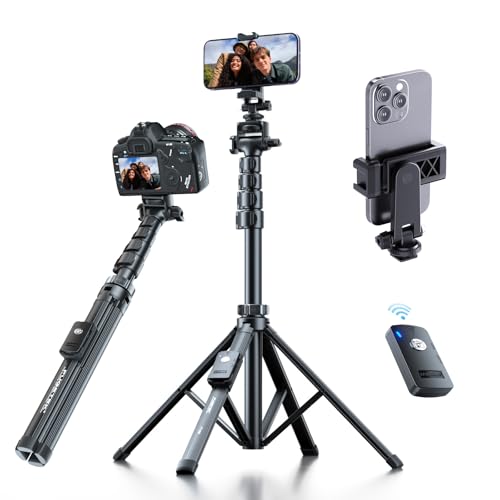
Flexible-leg tripods are the wrong answer for long exposures on a windy beach and the right answer for everything else in a carry-on. The GorillaPod 3K Kit supports up to 3 kg, folds to roughly 25 cm, and includes a ball head with a quick-release plate plus a phone mount in most kit configurations.
Its real trick is the leg joints: you can wrap it around a fence rail, a branch, or a chair back, which no conventional tripod can do. Used as a normal tripod it stands about 75 cm tall with the head, so it is a waist-height support, not a full-height one. On a hard, flat surface it is stable; on grass or gravel the jointed legs need care.
Who it suits: phone shooters, travelers, anyone filming themselves. Main trade-off: height and stiffness; a 3 kg payload on flexible legs is not the same as 3 kg on three aluminum tubes.
Best Build Quality at the Ceiling: Benro Slim Series
Benro’s Slim aluminum tripods sit at the top of the under-$100 band and show it in the details: smoother collar action, less flex in the center column, and a head that holds position without creeping. Payload is realistically around 4 kg, weight around 1.2–1.4 kg, and it folds near 40 cm.
You are paying for consistency rather than headline specs. If you shoot weekly and want the tripod to feel the same in year three as in month one, this is the category to stretch for. Main trade-off: no 170 cm of height, and at the top of the budget there is little room left for a bag or spare plate.
How to Choose: Six Numbers That Decide It
Ignore marketing copy and compare these six figures side by side. They determine whether you actually carry the thing.
- Load capacity. Add up camera body, battery grip, lens, and any cage or mic. Then multiply by 1.5–2 and buy at or above that. A 900 g camera plus a 600 g lens is 1.5 kg of gear, so look for a stated 3 kg payload, not a 1.5 kg one.
- Folded length. Under 35 cm rides in a daypack; 40–50 cm needs a side pocket or a strap. If a tripod does not fit the bag you already own, the odds you leave it at home rise sharply.
- Maximum height. Subtract the head height — usually 8–12 cm — from the stated maximum, then compare to your eye level minus 15 cm. If the number is below your chin, you will stoop.
- Travel weight. Under 1 kg feels like nothing on a hike; 1.5 kg is noticeable over 5 km; 2 kg and up is a car tripod.
- Head movement. Ball heads pack smaller and level faster; three-way pan-and-tilt heads pan more smoothly for video and are easier to lock on one axis at a time. Check that the head is removable — a 3/8-inch stud under it means you can upgrade the head later without replacing the legs.
- Leg locks. Flip levers are faster; twist collars snag less on straps and pack flatter. Both are fine — but on budget tripods the locks are the first part to loosen, so buy the type you will actually tighten.
A Worked Example: Cost Per Shoot
Say you buy an $80 tripod and shoot twice a month for three years — 72 sessions. That is about $1.11 per session. A $400 carbon tripod over the same period is $5.56 per session. The budget tripod is not the compromise people describe it as; the compromise is that it weighs 300–600 g more and rings a little longer after you press the shutter. If you shoot long exposures in wind or carry gear far, that difference is worth real money. If you shoot a few times a month near the car, it is not.
Stability by Camera Weight: What Actually Changes
| Camera rig | Rough weight | Minimum stated payload to look for | Practical notes |
|---|---|---|---|
| Phone + clamp | 250–400 g | 1 kg | Any rigid tripod works; flexibility and portability matter more than payload |
| Compact camera | 300–600 g | 1.5 kg | Flexible-leg tripods are fine; watch for tipping when the head is angled |
| Mirrorless + kit zoom | 700–1,200 g | 3 kg | Where budget aluminum tripods earn their keep; use a 2-second timer or remote |
| DSLR + fast prime | 1,200–1,800 g | 4–5 kg | Hang a bag from the center hook to add mass and lower the center of gravity |
| DSLR + telephoto zoom | 2,500 g+ | 6 kg+ | Under $100 you are at the limit; budget for a better head before a better leg set |
Ownership Realities: What Wears Out, and What to Do About It
Budget tripods fail in a predictable order, and knowing the sequence changes how you buy.
- First: the head clamp and plate. The cork or rubber pad on the quick-release plate compresses and the camera starts to twist. Fix: replace the pad or the plate, or swap the head entirely if it has a standard 3/8-inch thread.
- Second: leg-lock friction. Flip levers lose tension and twist collars lose grip. Many flip levers have a small screw to re-tension; twist collars can sometimes be cleaned and re-greased with a silicone grease, never a petroleum one, which attacks plastic.
- Third: the center column joint. This is the flex point that causes blur. Shooting with the column down is the single cheapest stability upgrade available.
- Fourth: the feet. Rubber feet harden and go missing. Spiked feet grip grass and gravel better but scratch floors — keep both sets if your tripod includes them.
Two common mistakes cost more than the tripod. First, extending the thin bottom leg sections first and the thick top sections last: do it the other way around. The bottom sections are the least stiff, so use them only when you need the height. Second, hanging a heavy bag from the center hook without it touching the ground — a swinging bag makes vibration worse, not better. Let it rest lightly or skip it.
Cleaning is simple: after sand or saltwater exposure, wipe the leg sections with a damp cloth, dry them, extend and retract each section twice, then leave the tripod extended to dry fully before packing. Sand inside a collar is what grinds the anodizing off and starts the wobble.
Frequently Asked Questions
Is a $80 tripod good enough for a mirrorless camera?
Yes, for a mirrorless body and a kit or moderate zoom, provided you pick one with a stated payload of at least 3 kg and keep the center column down. The limitation you will notice is damping, not support: budget aluminum holds the camera fine but vibrates longer after you touch it, so use a 2-second timer or a remote release. It becomes a real problem only with long lenses or in wind.
What is the difference between load capacity and real usable weight?
Stated payload is a maximum, usually measured with a balanced load and a locked head, and it often reflects what the legs will hold before collapsing rather than what they hold steadily. A practical rule is to stay at 60–70% of the stated figure. A 4 kg rating then means about 2.5–3 kg of real working gear.
Ball head or pan-and-tilt head under $100?
Ball heads pack smaller, level faster, and are easier to use one-handed, which makes them the better default for photography. Pan-and-tilt heads pan and tilt on separate axes with a long handle, which is smoother for video and easier to lock on one axis. Under $100 you usually get one or the other, not both, unless the head is removable and you buy a second one later.
Do I need a carbon fiber tripod if I am on a budget?
Not under $100 — carbon fiber in this price band is rare and usually compromised, and the weight saving over good aluminum is typically only 200–400 g. Spend the money on a stiffer head and a tripod you will actually carry. Carbon fiber becomes the better buy once you are regularly hiking or flying with the tripod.
How tall should a tripod be for standing eye level?
Take the stated maximum height, subtract the head height (about 8–12 cm), and aim for that figure to be within roughly 15 cm of your eye level. If you are 180 cm tall, that means a maximum height near 170 cm with the column down. Buying shorter than this is the most common cause of neck and back strain when shooting.
Can I use one tripod for both a phone and a camera?
Yes, if the head is removable or the tripod accepts standard quick-release plates. Most phone clamps mount on a 1/4-inch screw, which every camera tripod head provides, so a single tripod plus a phone clamp covers both. Check the clamp’s width range against your phone plus case before buying.