Key takeaways
- Aerated Stream: The default for filling and normal washing. It mixes air into the water to reduce splashing while maintaining volume. Look for a non-aerated, laminar option if you fill clear containers often and want less bubbling.
- Shower / Spray: A wider, more forceful cone for rinsing produce or clearing food residue. Strong shower modes feel effective even at 1.5 GPM because they concentrate flow into smaller nozzles.
- Shielded Sweep / Blade Spray: Found on newer Delta, Kohler, and Moen pull-downs, this creates a powerful, flat blade of water. It is the most effective for blasting stuck-on food off plates before the dishwasher and typically uses the full flow rate to maintain velocity. It is not ideal for delicate rinsing.
- Pause / Trickle Function: Some models reduce flow to a trickle instead of stopping it completely, which saves water while you scrub without shutting off the mixing temperature. It is not a replacement for the main valve.
What's inside
- Pull-Down vs. Pull-Out: Which Sprayer Style Fits Your Sink
- Spray Modes and Real-World Water Pressure
- Hose Reach, Spout Height, and Sink Coverage
- Installation Fit: Single-Hole vs. 3-Hole Sinks
- Spec Comparison: Common Pull-Down and Pull-Out Types
- Which Kitchen Faucet With Sprayer Should You Choose
- Durability and Ownership Realities
- Frequently Asked Questions
The best kitchen sink faucets with sprayer for most kitchens are pull-down models with at least two spray modes, a 20 to 24-inch hose reach, and a 1.8 GPM flow rate, while pull-out models are better for compact sinks and low-clearance cabinets where spout height is limited.
- Pull-Down vs. Pull-Out: Which Sprayer Style Fits Your Sink
- Spray Modes and Real-World Water Pressure
- Hose Reach, Spout Height, and Sink Coverage
- Installation Fit: Single-Hole vs. 3-Hole Sinks
- Spec Comparison: Common Pull-Down and Pull-Out Types
- Which Kitchen Faucet With Sprayer Should You Choose
- Durability and Ownership Realities
- Frequently Asked Questions
As an Amazon Associate we earn from qualifying purchases at no extra cost to you.
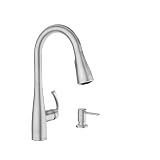


Pull-Down vs. Pull-Out: Which Sprayer Style Fits Your Sink
Both types integrate the sprayer into the spout, but they behave differently during daily use. Understanding the trade-off helps you avoid buying a faucet that overwhelms a small sink or under-reaches a large one.
Pull-Down Faucets
Pull-down faucets have a tall, high-arc spout, typically 15 to 17 inches high. The spray head pulls straight down into the sink basin. This design gives you more clearance for filling tall pots, washing sheet pans vertically, and cleaning the sink itself. The spray head is usually larger, which allows for broader spray patterns like a wide shower or a blade-like sweep.
Best for: standard and deep single-bowl sinks (27 inches and wider), farmhouse sinks, and anyone who regularly fills large stockpots or handles bulky cookware.
Watch out for: Low-hanging upper cabinets or shallow sinks. A high arc can cause splashing in sinks less than 7 inches deep, and the tall body may not fit under cabinets that sit less than 15 inches above the counter.
Pull-Out Faucets
Pull-out faucets have a lower, more compact spout profile, often 12 to 14 inches high. The spray head pulls outward toward you, not just straight down. That outward angle makes it easier to direct the hose outside the sink footprint, such as filling a pot sitting on the adjacent counter.
Best for: Small kitchens, double-bowl sinks where you need to reach both basins, islands with low pendant lighting, and rental-friendly updates where you want less spray height.
Watch out for: Hose management. Because you pull at an angle, cheaper pull-out designs can experience more friction at the hose guide and may not dock as smoothly over time.
Spray Modes and Real-World Water Pressure
Most kitchen sink faucets with sprayer offer two or three modes, toggled by a button or rocker on the head. The number of modes matters less than how useful each mode is under normal household pressure of 45 to 60 psi.
- Aerated Stream: The default for filling and normal washing. It mixes air into the water to reduce splashing while maintaining volume. Look for a non-aerated, laminar option if you fill clear containers often and want less bubbling.
- Shower / Spray: A wider, more forceful cone for rinsing produce or clearing food residue. Strong shower modes feel effective even at 1.5 GPM because they concentrate flow into smaller nozzles.
- Shielded Sweep / Blade Spray: Found on newer Delta, Kohler, and Moen pull-downs, this creates a powerful, flat blade of water. It is the most effective for blasting stuck-on food off plates before the dishwasher and typically uses the full flow rate to maintain velocity. It is not ideal for delicate rinsing.
- Pause / Trickle Function: Some models reduce flow to a trickle instead of stopping it completely, which saves water while you scrub without shutting off the mixing temperature. It is not a replacement for the main valve.
Water pressure note: All kitchen faucets sold in the US since 2022 are limited to a maximum of 1.8 gallons per minute (GPM) at 60 psi, with many WaterSense-labeled models at 1.5 GPM. If your home has low static pressure (below 40 psi), a 1.8 GPM model with a well-designed shower mode will feel stronger than a 1.5 GPM model with a diffuse spray. If you have very high pressure above 80 psi, any modern sprayer will feel strong, and a pressure regulator at the main line will protect the retractable hose and cartridge more than the choice of faucet.
Hose Reach, Spout Height, and Sink Coverage
Hose reach determines whether you can actually rinse the corners of your sink without moving the dish. Measured from the docked position, usable hose extension is the length you can pull and maneuver before the counterweight stops you.
For a standard 30-inch single-bowl sink, you need at least 20 inches of usable hose to reach the far corners. For a double-bowl sink, 21 to 24 inches lets you comfortably direct spray from one bowl to the other. Anything under 18 inches feels restrictive in sinks wider than 25 inches.
Spout reach, the horizontal distance from the center of the base to the center of the aerator, also matters. An 8 to 9-inch spout reach centers water in a 30-inch sink. If your sink is offset from the faucet hole or you have a thick countertop ledge, a 7-inch reach can cause water to fall too close to the back wall, increasing splashing.
How to Measure Before You Buy
Measure two distances: A) vertical clearance from counter to the lowest point of your upper cabinet or window trim, and B) horizontal distance from your existing faucet hole center to the center of the sink drain. Choose a spout height at least 2 inches less than measurement A to allow for handle lift, and choose a spout reach that aligns within 1 inch of measurement B. This prevents overshoot and ensures the spray head naturally docks over the drain, not the divider.
Installation Fit: Single-Hole vs. 3-Hole Sinks
Nearly every modern kitchen faucet with sprayer is designed for single-hole installation, since the sprayer is integrated. The 3-hole question is about what to do with sinks or countertops that already have three holes on an 8-inch spread.
- Single-Hole Sink or Counter (1 hole, ~1-3/8 inch diameter): Every pull-down and pull-out will fit directly. No extra parts are needed beyond the included mounting hardware and deck gasket.
- 3-Hole Sink with Existing Faucet (3 holes on 4-inch or 8-inch centers): You have two clean options. Use the included deck plate, also called an escutcheon, to cover the two unused holes, or install a single-hole faucet and add separate accessories like a soap dispenser or air gap in the extra holes. A deck plate is typically 10 to 10.5 inches long and adds about 1/4 inch to the base height.
- Counter Depth and Weight: Most kits include bolts for counters up to 1-3/4 inches thick, which covers quartz, granite, and quartzite. For thicker butcher block over 2 inches, check the maximum deck thickness in the spec sheet. The counterweight for the retraction hose needs at least 3 inches of clear space under the sink and should not catch on cleaning supplies or disposal wiring.
Connection type is universal in the US: 1/2-inch IPS supply lines with included 24-inch braided connectors that attach to standard 3/8-inch compression shut-off valves. Touchless models add a battery pack or AC adapter and a control box that needs 6 to 8 inches of side clearance on the cabinet wall.
Spec Comparison: Common Pull-Down and Pull-Out Types
Use this table to set expectations for dimensions and performance before comparing specific brands like Delta, Moen, Kohler, Kraus, and Pfister.
| Feature | Compact Pull-Out | Standard Pull-Down | High-Arc Pro-Style Pull-Down | Touchless Pull-Down |
|---|---|---|---|---|
| Spout Height | 12.5 – 14.0 inches | 15.0 – 16.5 inches | 17.0 – 20.5 inches | 15.5 – 17.0 inches |
| Spout Reach | 7.5 – 8.0 inches | 8.2 – 9.0 inches | 8.8 – 10.2 inches | 8.2 – 9.0 inches |
| Usable Hose Extension | 18 – 20 inches | 20 – 24 inches | 22 – 26 inches | 20 – 24 inches |
| Flow Rate (at 60 psi) | 1.5 – 1.8 GPM | 1.5 – 1.8 GPM | 1.8 GPM | 1.5 GPM (WaterSense) |
| Spray Modes | 2 (Stream + Spray) | 2 to 3 (Stream, Spray, Sweep/Blade) | 2 to 3 (Stream, Spray, Sweep) | 2 to 3 + touchless activation |
| Mounting Options | 1-hole or 3-hole with 10-inch deck plate | 1-hole or 3-hole with 10.5-inch deck plate | 1-hole only on most models | 1-hole or 3-hole with deck plate |
| Body Material | Zinc alloy body, stainless steel hose | Brass / zinc mix, braided nylon hose | Solid brass, coiled spring + braided hose | Brass / zinc mix, braided hose, plastic control box |
| Docking Type | Friction + magnet | Magnetic docking | Magnetic + spring assist | Magnetic docking |
| Power Requirement | None | None | None | 4 AA or 6 AA batteries (12-18 months) or AC adapter |
Which Kitchen Faucet With Sprayer Should You Choose
Match your situation to the type that solves the biggest daily friction, not just the look you prefer.
| Your Situation | Best Fit | Why It Works |
|---|---|---|
| Small sink, under 25 inches wide, or shallow basin under 7 inches deep | Compact Pull-Out | Lower arc reduces splashing; shorter reach still covers the basin |
| Large single-bowl or farmhouse sink, you hand-wash pots daily | Standard or Pro-Style Pull-Down (20+ inch hose) | Long hose and high arc let you rinse corners and fill tall pots vertically |
| Double-bowl sink and you switch bowls constantly | Standard Pull-Down with 21+ inch extension | Mid-height arc and sweep mode clear food from both bowls without moving dishes |
| 3-hole sink, want to keep existing holes covered | Any 1-hole faucet that includes a deck plate | Plate covers unused holes cleanly; extra holes can be kept for soap dispenser |
| Low water pressure at 30-40 psi | 1.8 GPM Pull-Down with concentrated shower mode | Higher flow ceiling and focused nozzles feel stronger at low pressure than diffuse 1.5 GPM designs |
| Hands often full or messy, want hygiene upgrade | Touchless Pull-Down | Wave or tap sensor avoids touching handle; pause feature saves water while scrubbing |
| Tight under-sink storage or garbage disposal crowding | Manual Pull-Down without control box | Avoids batteries and control box that compete for space with disposal and filter |
Durability and Ownership Realities
A kitchen faucet lasts 8 to 15 years, but certain parts wear much sooner. Knowing what fails first helps you pick for longevity and maintain it correctly.
- Cartridge and Handle: The ceramic disc cartridge controls temperature and flow. It is rated for 500,000+ cycles on quality brands. If the handle feels gritty or drips when off, the cartridge is the culprit. Look for models with a standard 1225 or 1255-style cartridge that plumbers stock locally.
- Hose and Retraction System: Braided nylon hoses resist kinking better than older rubber, but the retraction counterweight is what fails most. If the head no longer retracts, the weight is caught on pipes or the hose weight position slipped. Keep a 4-inch clearance path for the hose and re-secure the weight 8 to 10 inches above the hose loop midpoint.
- Spray Head and O-Rings: Mineral buildup clogs the spray nozzles first, especially on the shower mode. Rub the silicone nozzles monthly with a fingertip. Soak the head in a 50/50 white vinegar and warm water solution for 20 minutes if spray becomes uneven. Hard water shortens O-ring life, leading to leaks at the hose connection.
- Finish and Cleaning Mistakes: Spot-resist or brushed nickel hides water spots, while matte black and polished chrome show them differently. Avoid acidic cleaners, bleach, and abrasive pads. Wipe with mild dish soap and water; strong descalers can strip the protective coating and void finish warranties. Never use a Scotch-Brite style pad on stainless spot-shield finishes.
- What to Check at Installation: Flush the supply lines for 30 seconds before connecting the faucet to prevent debris from scoring the cartridge. Hand-tighten plus a quarter-turn on braided lines; over-tightening cracks the gasket. Verify the deck gasket seats fully to prevent water creeping under the base, which corrodes the mounting nut.
General market range: basic pull-out models start at the budget tier, standard pull-downs occupy the mid-range, and pro-style or touchless pull-downs sit at the premium tier. Price generally tracks material, brass content, hose system design, and added electronics rather than just finish. Most major brands offer a limited lifetime warranty on function and finish to the original purchaser, with 5-year coverage on electronic parts for touchless models.
Frequently Asked Questions
Can I replace a 3-hole faucet with a single-hole faucet with sprayer?
Yes. Use the deck plate included with most single-hole faucets to cover the two outer holes. If you prefer not to use a plate, you can leave the outer holes for a soap dispenser, filtered water tap, or cap them with 1-3/8 inch hole covers.
Why does my new faucet with sprayer feel weaker than my old one?
Two common reasons: the new faucet is a 1.5 GPM WaterSense model replacing an older 2.2 GPM faucet, or the aerator and supply-line screens still have installation debris. Remove the spray head and flush the hose for one minute, then clean the inlet screens at the shut-off valves.
Do I need a plumber to install a kitchen sink faucet with sprayer?
A confident DIYer can install a manual pull-down or pull-out in 45 to 90 minutes with a basin wrench and adjustable wrench. Touchless models take longer because you must mount the control box and manage battery or AC power. Call a plumber if your shut-off valves are frozen or if your counter is unusually thick.
How long is the hose supposed to be?
Most hoses are 60 to 68 inches total, which translates to 18 to 26 inches of usable pull once routed through the spout and weighted under the sink. Spec sheets often list total hose length, not usable extension, so check both numbers to judge true reach.