Key takeaways
- Motorized cellular (honeycomb) shade, cordless headrail, remote control
- Rechargeable battery operation — no mains run to the skylight required
- Intelligent control integration per the listing, so it can join a broader smart-home routine rather than living on its own handset
- Custom widths to fit the skylight reveal; fabric available in light-filtering and room-darkening classes
- Mounts inside the reveal, leaving glazing, frame and flashing untouched
The best premium motorized skylight system for most buyers is a complete custom electric venting skylight with a double-tempered glazing unit, an aluminum frame and a factory-matched rain-sensor operator — in this roundup that role goes to the NEHCFO Custom Electric Skylight Venting Window, because it bundles glazing, frame and motor instead of asking you to marry parts from three suppliers. If you already own a roof window and only want automation, the HUIYEETEX 600 N rain-sensor actuator is the cheapest legitimate way in, and it costs a fraction of a new window. If you want a fully integrated, large-format electric roof hatch with double glazing and remote control, the generic Electric Remote Control Skylight Window is the premium pick. Everyone else in this list is either a glazing unit you motorize later, or a rechargeable blind that upgrades an existing skylight without touching the roof.
Top 3 Picks
Best overall: NEHCFO Custom Electric Skylight Venting Window
It is the only product here that arrives as a complete motorized assembly: double tempered glass, aluminum frame and electric venting in one custom-sized unit. That removes the two hardest parts of a skylight project — matching an operator to a sash, and getting the flashing and frame geometry right — because the manufacturer has already done it. It suits a planned renovation or new build where the roof is open and a wiring run is easy.
Best budget: HUIYEETEX Electric Skylight Opener with Rain Sensor
A 600 N, 300 mm-stroke chain actuator that runs on 110–240 V and closes itself when rain hits the sensor. If your existing vent window is sound and simply unreachable, this converts it into a self-managing motorized window for the price of a mid-range power tool. It is also the cheapest way to add genuine rain protection to any skylight in this list.
Best premium: Electric Remote Control Skylight Window, Double Glass Roof Hatch
For buyers who want the finished article — a double-glazed roof hatch with an integrated electric operator and remote control — this is the premium end of the category. It is aimed at pitched roofs on homes where the skylight is meant to be a design feature rather than a utility opening, and it pairs naturally with a rechargeable motorized blind for daylight control.
Quick Comparison
Every product below is compared on the same four axes: what it is actually best for, the specs that drive that verdict, and the market band it sits in. Price tiers are bands, not figures, because listing prices move daily.
| Product | Best for | Key specs | Price tier |
|---|---|---|---|
| Keego Motorized Cordless Skylight Cellular Shades | Motorized shading retrofit on an existing skylight | Cordless cellular (honeycomb) shade, rechargeable motor, remote, intelligent control integration, custom widths | Budget |
| Valdoza Manual Vented Roof Window | Cheapest route to a venting roof window | Double-glazed tempered glass, manual vent, customizable sizes, pitched-roof mount | Budget |
| HUIYEETEX Electric Skylight Opener with Rain Sensor | Automating an existing vent window | 600 N force, 300 mm stroke, chain actuator, 110–240 V, integrated rain sensor | Budget |
| NEHCFO Custom Electric Skylight Venting Window | All-in-one motorized venting skylight | Double tempered glass, aluminum frame, electric venting, custom sizes, roof mount | Mid-range |
| Generic Square/Rectangle Roof Skylight Window | Large-format premium glazing and partition light wells | Square or rectangular formats, manual ventilation, partition or roof mounting | Premium |
| Gene 14″ x 22″ Inner Dome with Clear Window | Low-cost second glazing layer under a skylight | 14 x 22 in inner dome, clear glazing, white frame, ceiling-side mounting | Budget |
| 24V Motorized Window Opener with Remote | Quiet multi-window vent automation | 24 V DC chain drive, remote control, quiet operation, roof-vent duty | Mid-range |
| Electric Remote Control Skylight Window, Double Glass Roof Hatch | Fully integrated premium electric roof hatch | Double glass, integrated electric operator, remote control, residential roof hatch format | Premium |
| Valdoza Custom 19.7–47.2 in Roof Skylight Window | Wide-span custom openings | 19.7–47.2 in width range, tempered glass, gas strut lift, custom sizing | Premium |
| Valdoza Sun Room Roof Skylight | Sunroom and conservatory roofs | Double-glazed tempered glass, gas strut lift, customizable, sunroom roof mounting | Mid-range |
| Upgraded Smart Motorized Skylight Blind (Light Grey) | Premium smart blind retrofit | Rechargeable battery, motorized roller blind, remote control, light grey fabric | Premium |
| Smart Rechargeable Motorized Skylight Blind (Blue) | Fast, low-cost blind retrofit | Rechargeable battery, remote control, motorized roller blind, easy install, blue fabric | Mid-range |
How We Chose
This roundup is assembled from published product specifications, standard glazing and actuator engineering conventions, and the practical constraints that decide whether a skylight project succeeds or fails on a roof. We did not test, benchmark or install any of these products; every judgement here is based on documented specs and how they map to real situations.
Four criteria did the filtering. First, specification honesty: products that state a force rating, a stroke length, a voltage, a glazing build-up or a size range score higher than listings that only promise “premium quality”. Second, category fit: a blind, an actuator and a complete venting window solve different problems, so each was judged against its own job rather than against the others. Third, use case: pitched residential roof, sunroom, light well, or retrofit onto an existing window. Fourth, upgrade path — whether the purchase can be motorized later, paired with a rain sensor, or brought into a smart-home routine without replacing the whole assembly. That last criterion is why several manual glazing units appear alongside fully motorized systems: they are the sensible first half of a two-stage project.
1. Keego Motorized Cordless Skylight Cellular Shades – Best for Motorized Shading Retrofit
As an Amazon Associate we earn from qualifying purchases at no extra cost to you.

These shades suit the homeowner who already has a skylight, likes it, and wants motorized control of light and heat without touching the roof. Because the unit is a cellular honeycomb blind rather than a flat roller fabric, it works as both a dimmer and a thin insulating layer on what is usually the weakest thermal point in a ceiling. It is the least expensive way in this roundup to get motorized operation on a skylight, and the cordless headrail means nothing dangles into the room on a sloped ceiling.
The cellular construction is the whole point. A single-cell honeycomb adds roughly R-2 to the assembly and a double-cell roughly R-3 to R-4, which is meaningful on glass. In summer the same air cells, plus the reflective backing used on many cellular fabrics, cut solar gain and glare — the two complaints that push most people to look at skylight shades in the first place. In winter the trapped air reduces the cold-radiation effect you feel standing under a skylight. Because the motor and battery live in the headrail, installation is a bracket-and-clip job inside the reveal: no mains wiring, no roofer, no flashing work.
Key specs
- Motorized cellular (honeycomb) shade, cordless headrail, remote control
- Rechargeable battery operation — no mains run to the skylight required
- Intelligent control integration per the listing, so it can join a broader smart-home routine rather than living on its own handset
- Custom widths to fit the skylight reveal; fabric available in light-filtering and room-darkening classes
- Mounts inside the reveal, leaving glazing, frame and flashing untouched
Pros
- Cellular fabric insulates as well as it shades, which flat roller blinds do not
- No wiring, no roof work and no trades — a genuine DIY retrofit
- Works on almost any skylight brand because it mounts to the reveal, not the window
- Budget tier pricing makes it the cheapest motorized upgrade in this list
- Rechargeable design avoids the cost of an electrician and the risk of a bad cable run through a hot roof void
Cons
- It does not open the window; ventilation is a separate system entirely
- Battery models need periodic recharging, and the interval shortens with heavy daily cycling
- Cellular fabric collects dust and is harder to deep-clean than flat roller fabric
- Custom sizing means measuring the reveal precisely — a wrong measurement is not returnable in most cases
- Smart-home integration is less predictable than a hardwired 24 V actuator on a relay
Compared with the two rechargeable blinds further down this list — the premium light grey unit and the mid-range blue unit — the Keego wins on insulation and price and loses on nothing that matters for shading, because honeycomb fabric outperforms flat roller fabric thermally. The blinds win if you prefer a flatter, more minimal look or need a specific fabric colour. Choose Keego if heat and light control are the goal; choose a roller blind if aesthetics are.
2. Valdoza Manual Vented Roof Window – Best for Budget Ventilation

This is the sensible starting point for anyone who needs a venting roof window and has not yet decided whether to motorize. It is a customizable manual vented skylight with double-glazed tempered glass, sized to your opening and mounted in a pitched house roof. Buyers who fit this profile are usually replacing a failed or fogged unit, adding ventilation to a loft conversion on a tight budget, or building the first stage of a two-stage project in which a chain actuator gets added later.
The value proposition is straightforward: you get a real glazing unit with two panes and a tempered outer sheet, which is the safety baseline for anything overhead, at the lowest tier in this category. The manual vent gives you the full opening without paying for a motor, and the customizable sizing means the window can match an existing rough opening instead of forcing a reframe. Double glazing on a skylight typically delivers a centre-of-glass U-value somewhere in the 1.1–1.6 W/m²K band depending on the cavity and coating, which is a large improvement over single glazing and a small step behind triple-glazed units. Because the frame is a standard profile, adding a chain actuator later is a known quantity rather than an experiment.
Key specs
- Manual vented roof window, customizable to the opening
- Double-glazed tempered glass construction
- Designed for pitched house roofs with conventional flashing
- Manual operator handle; no electrical connection required
Pros
- Lowest entry price for a genuinely double-glazed venting skylight
- No wiring, no motor and therefore nothing electrical to fail
- Custom sizing lets it drop into an existing opening
- Tempered glass meets the safety expectation for overhead glazing
- Straightforward upgrade path: a 600 N chain actuator can be added later
Cons
- You must be able to reach it, or it stays closed through every warm spell
- No rain sensor, so an open window and a sudden shower are a real risk
- Manual vent hardware — handles, hinges and seals — wears faster than motorized operators in heavy use
- No smart-home path without adding an actuator
- Double glazing without a specified coating will not match the thermal performance of premium units
Its nearest alternative in this list is the NEHCFO Custom Electric Skylight Venting Window. Both are custom-sized double-glazed venting units for pitched roofs, but the NEHCFO arrives with the operator built in and the Valdoza arrives with a handle. If the window is above a stairwell, over a bed, or anywhere you cannot reach with a pole, the manual unit is a false economy — you will pay for the actuator anyway, plus a second round of labour. If you can reach it, the manual version saves money and removes a failure point.
3. HUIYEETEX Electric Skylight Opener with Rain Sensor – Best for Automating an Existing Window

This actuator is for the person who already has a vent window, hatch or roof vent that works fine but is either out of reach or left open when it rains. Rather than replacing the window, you bolt a chain actuator to the frame and let the rain sensor decide when to close. It is the cheapest way in this roundup to get genuine automatic rain protection, and it is also the most common first step for anyone who plans to motorize several openings over time.
The headline numbers are useful and specific: 600 N of force and a 300 mm stroke, running on 110–240 V. Force is the number that matters most. A vent sash weighing 25 kg presents roughly 245 N of load before you account for hinge geometry, friction, seal compression and wind pressure on an open sash — all of which multiply the effective requirement. A 600 N actuator therefore has real headroom on a typical residential sash and will still be working comfortably when the seals stiffen in cold weather. The 300 mm stroke suits most standard vent sashes; measure your opening travel before ordering, because a sash that needs 400 mm will only open three-quarters of the way. The 110–240 V input means it runs directly from mains through a switch or the supplied rain sensor, with no separate power supply to hide in the roof void — convenient, but also the reason it is less smart-home friendly than a 24 V unit.
Key specs
- 600 N opening force, 300 mm stroke
- Chain-drive actuator for skylights and roof vents
- 110–240 V AC input; direct mains operation
- Integrated rain sensor that triggers automatic closing
- Automatic operation with manual override
Pros
- Converts an existing window into a self-closing motorized one for very little money
- 600 N is generous for a residential sash, so it tolerates stiff seals and cold weather
- Rain sensor solves the single biggest practical problem with roof windows
- Mains voltage means no transformer, no low-voltage wiring and no battery to charge
- Reversible: if you move or sell, the window is still a window
Cons
- Mains-voltage wiring should be done by a qualified electrician, which adds cost
- No native smart-home protocol; automating it requires a relay or switch module
- 300 mm stroke will not fully open unusually large sashes
- Chain drives are visible when open and the chain needs occasional cleaning and light lubrication
- No wind sensor, so a gust on an open sash is not automatically handled
The nearest alternative is the 24 V Motorized Window Opener with Remote. That unit trades raw convenience for control: low-voltage DC is safer to wire, easier to integrate with building automation, and typically quieter, but it usually needs a separate power supply and often a separate rain sensor. If you want the simplest possible rain-safe retrofit, take the 600 N unit. If you are planning scenes, schedules and multiple windows, take the 24 V unit.
4. NEHCFO Custom Electric Skylight Venting Window – Best Overall Motorized Skylight

This is the product to buy when you want one supplier, one delivery and one warranty covering the whole assembly. It is a custom-sized electric venting skylight built from double tempered glass in an aluminum frame, mounted in the roof and operated electrically. It suits a planned renovation or new build where the roof structure is already open, where a power run can be made properly, and where you would rather not coordinate a glazing supplier, an actuator supplier and a roofer who each blame the other when something leaks.
The engineering logic behind buying a complete unit is worth spelling out. When you pair a third-party actuator with a third-party window, you own the interface: the mounting brackets, the stroke geometry, the seal compression at the closed position and the rain-sensor placement. Get any of those wrong and you get a window that does not quite close, or a motor that strains. A factory-matched assembly removes that risk. Aluminum framing with a thermal break also handles condensation better than an unbroken metal frame, and tempered glass on both panes is the safety baseline for overhead glazing — an inner pane that shatters into large shards over a bed or stairwell is not a compromise worth making.
Key specs
| Glazing | Double tempered glass |
| Frame | Aluminum, roof-mount profile |
| Operation | Electric venting, remote or switch controlled |
| Sizing | Custom to the rough opening |
| Mounting | Pitched roof with standard flashing |
Pros
- One integrated assembly: glazing, frame and operator arrive matched
- Double tempered glass on both panes is the correct safety specification for overhead use
- Aluminum frame is dimensionally stable and resists rot, unlike timber alternatives
- Custom sizing means no compromise between the opening and the window
- Electric operation makes high or unreachable skylights genuinely usable, which is the entire point of the category
Cons
- Mid-range to upper-mid pricing once custom sizing, flashing and installation labour are included
- Requires a power run into the roof space, which is disruptive if the ceiling is already finished
- Rain sensing is not guaranteed as standard — confirm before ordering, or budget for a separate sensor
- Custom lead times are longer than buying an off-the-shelf unit
- More parts means more to go wrong than a fixed, manual window
Against the Valdoza Manual Vented Roof Window, the NEHCFO is the more expensive but more complete answer: same double-glazed, tempered, custom-sized concept, plus an operator and minus the handle. Against the premium Electric Remote Control Skylight Window further down, the NEHCFO is the more workmanlike choice — better suited to a utility opening over a stairwell or bathroom, where the premium hatch is aimed at spaces where the skylight is meant to be seen.
5. Generic Square/Rectangle Roof Skylight Window – Best for Large-Format Premium Glazing

This unit suits a specific buyer: someone designing a large square or rectangular light well, a partition-mounted glazed panel, or a roof opening where the geometry is the feature and the ventilation is secondary. It is a manual-ventilation glazing unit in square or rectangular formats, suitable for partition as well as roof mounting, and it sits in the premium band because of the sizes and framing involved rather than because of any electronics. If you are planning a statement ceiling or a light well over a landing, this is the shape of product you are shopping for.
The reason a manual unit belongs in an article about motorized systems is that large glazing and motorization are separable purchases. A big fixed or manually vented panel can be motorized afterwards with a suitably rated actuator, and in many premium builds that is exactly what happens — the glazier sets the unit, then the electrician and the actuator supplier come in behind. What you are paying for at this tier is the frame engineering: large panes need stiffer profiles and more careful structural support, and partition-mounted panels need to satisfy fire and safety glazing expectations that a small roof window never touches. Square and rectangular formats also give the designer far more freedom than the standard roof-window proportions, which is why light wells so often end up here.
Key specs
- Square or rectangular glazing formats
- Manual ventilation operation
- Suitable for roof mounting and partition mounting
- Premium framing and sizing tier
Pros
- Format freedom: squares and rectangles in sizes standard roof windows do not offer
- Partition mounting opens up interior light wells, not just roof openings
- Premium framing handles larger spans with less visible deflection
- Manual operation keeps the unit simple and serviceable
- Straightforward to motorize later with a correctly rated actuator
Cons
- Premium pricing, and large panes mean larger flashing and structural costs
- Manual ventilation on a large panel is genuinely awkward to reach
- Heavier sashes need a much stronger actuator than the 600 N budget unit
- Partition installations bring additional code considerations
- No motor, no sensor, no remote as supplied
The nearest alternative is the Valdoza Custom 19.7–47.2 in Roof Skylight Window, which is also a premium, custom-sized glazing unit. The Valdoza is narrower and roof-specific with a gas strut lift; this square/rectangle unit is wider in format and can also be mounted as a partition. If your opening is a roof and you want a defined size range, take the Valdoza. If you are building a light well or a glazed internal panel, take this one.
6. Gene 14″ x 22″ Inner Dome with Clear Window – Best for a Low-Cost Second Glazing Layer

This inner dome suits the pragmatic fixer: someone with a skylight that condenses, drips, or loses heat, who wants an improvement without a full replacement. It is a 14 x 22 inch inner dome with clear glazing in a white frame, mounted on the room side of a ceiling opening. It is not a motorized system and it does not open — it is a second layer of glazing, and that is precisely its value.
Two glazing layers separated by an air space is the oldest insulation trick in the book, and an inner dome is the cheapest way to apply it to a skylight that was installed with a single layer, or to an older unit whose seals have failed. The trapped air space reduces heat loss and, more importantly for many owners, raises the inner surface temperature of the assembly above the dew point, which is what stops the winter dripping that ruins ceilings and paint. Because the dome is a fixed, unpowered component, there is nothing to wire, nothing to charge and nothing to service beyond wiping it clean. It also softens the harsh light quality of a bare skylight, which is a small but real comfort gain in bedrooms and home offices.
Key specs
- 14 x 22 inch inner dome
- Clear glazing, white frame
- Ceiling-side mounting beneath an existing skylight or opening
- Passive, unpowered component
Pros
- Very low cost relative to any other change you can make to a skylight
- Reduces condensation on the room-side surface, the most common skylight complaint
- Adds a second glazing layer and therefore a measurable insulation improvement
- Nothing electrical, nothing to maintain, nothing to fail
- Simple enough for a competent DIY installation
Cons
- Fixed size — it only fits openings that accept a 14 x 22 inch dome
- It does not vent, so it cannot replace an opening window
- Adds visual bulk to the ceiling and slightly reduces headroom at the opening
- If the outer skylight leaks, this does nothing about the water coming from above
- Cannot be motorized or integrated into smart-home control
Its nearest counterpart in this list is the Keego motorized cellular shade, and the two solve different halves of the same problem. The Keego controls light and adds insulation but leaves the glass cold; the Gene dome warms the assembly and cuts condensation but does nothing about glare. Owners of older single-glazed skylights frequently end up buying both, and the combined cost is still far below replacing the unit.
7. 24V Motorized Window Opener with Remote – Best for Quiet Multi-Window Vent Control
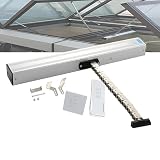
This actuator suits the buyer who is motorizing more than one opening and wants them to behave as a group. It is a 24 V DC chain-driven window opener with remote control, intended for skylights and roof vents, and described as quiet in operation. It is the natural choice for a loft with three or four roof windows, a sunroom with a row of vents, or any installation where a hardwired control scheme is preferable to a mains switch.
Low-voltage DC is the reason building automation standardized on 24 V. It is safer to run through a roof void, it pairs directly with relay modules, and it allows several actuators to share one power supply and one control bus rather than each needing its own mains feed. Chain drive is also the right mechanism for roof vents: it pushes a sash open along a straight line, it holds position against wind when the motor stops, and it does not need the counterweighting that rack-and-pinion systems sometimes require. Quiet operation matters more than it sounds — a vent that grinds every time it opens is a vent that gets disabled within a month.
Key specs
- 24 V DC chain-drive actuator
- Remote control included
- Designed for skylights and roof vent duty
- Quiet operation
- Low-voltage wiring suitable for multi-unit installations
Pros
- 24 V DC is the safest and most automation-friendly wiring standard in this category
- Multiple actuators can share a supply and be grouped on one remote
- Chain drive holds position and handles roof vent geometry well
- Quiet enough to run on a schedule without becoming an annoyance
- Good middle ground on price between a bare mains actuator and a full integrated window
Cons
- Needs a 24 V power supply, which is an extra component to house
- Rain and wind sensors are typically separate purchases
- Remote handsets are easy to lose; a wall switch is a worthwhile addition
- Stroke and force ratings must be checked against your sash before ordering
- No built-in smart-home protocol without a bridge or relay module
Its closest alternative is the HUIYEETEX 600 N mains actuator. That unit is simpler and includes a rain sensor, which makes it the better single-window retrofit. This 24 V unit is the better multi-window choice, because grouping several mains actuators under one control scheme is awkward while grouping several 24 V actuators is routine. If you are fitting one window, buy the mains unit; if you are fitting four, buy this one.
8. Electric Remote Control Skylight Window, Double Glass Roof Hatch – Best for a Premium Integrated Electric Hatch
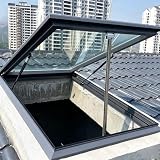
This is the premium integrated option: a double-glazed roof hatch with an electric operator and remote control, designed for homes where the skylight is part of the architecture rather than a service opening. It suits a buyer who wants the finished product with no assembly required, is willing to pay for the premium tier, and cares about how the unit looks from inside the room as much as how it performs.
The integrated approach pays off in three places. First, the operator is matched to the sash at the factory, so stroke, force and closed-position seal compression are all correct by design. Second, the frame and glazing are engineered as one unit, which matters for thermal performance: a double-glazed hatch with a proper thermal break will not grow condensation on the inner frame the way a poorly detailed assembly does. Third, the remote control and electric operation make a high or steeply pitched opening genuinely usable, which is the difference between a hatch you open twice a year and one you open twice a week. In practice, the value of motorization is not convenience — it is frequency of use, and frequency of use is what delivers the ventilation benefit you paid for.
Key specs
- Double glass glazing
- Integrated electric operator
- Remote control operation
- Roof hatch format for residential roofs
- Premium tier construction and finish
Pros
- Factory-matched operator removes the interface risk of mixing brands
- Double glazing with a finished frame suits visible interior spaces
- Remote control makes high openings usable
- Premium construction typically means better seals and a longer service life
- Clean, uncluttered appearance compared with a bolt-on actuator
Cons
- Premium pricing, and installation and flashing costs sit on top
- Proprietary control means fewer options for smart-home integration
- Repairing an integrated operator usually means a manufacturer part, not an off-the-shelf one
- Requires a mains supply in the roof space
- Overkill for a utility opening in a bathroom or above a stairwell
Its nearest alternative is the NEHCFO Custom Electric Skylight Venting Window. Both are complete motorized glazing units. The NEHCFO is the value-led choice, custom-sized and workmanlike; this hatch is the finish-led choice, better suited to a living space where the frame is on show. If you are specifying for a room people look at, take the hatch. If you are specifying for a room people walk through, take the NEHCFO and put the savings into a blind.
9. Valdoza Custom 19.7-47.2 in Roof Skylight Window – Best for Wide-Span Custom Openings

This one suits a buyer with a specific dimensional problem: an opening that is wider than standard roof-window sizes allow. It is a custom roof skylight window with a stated width range of 19.7 to 47.2 inches, tempered glass glazing and a gas strut lift, in the premium tier. That width range is unusually generous, and it is the reason to consider this unit — most competing products stop well short of 47 inches.
Gas strut lift is a manual-assist mechanism, and it is worth understanding what it does. A strut holds a heavy sash open against its own weight, so you can open a large panel and let go of it. That makes wide glazing practical without a motor, which is the trade-off here: you get size and a premium glazing specification, but you operate it yourself. A panel at the top of that range is genuinely heavy, and reaching the centre of a 47-inch-wide sash from inside the room is not always comfortable. The practical answer for most buyers at this size is to add a chain actuator later — but a sash that wide needs a properly rated operator and a check on the hinge geometry, so plan that from the start rather than as an afterthought.
Key specs
- Custom width range: 19.7 to 47.2 inches
- Tempered glass glazing
- Gas strut lift assist
- Roof mounting, custom sizing
- Premium tier
Pros
- Wide size range covers openings most roof windows cannot
- Gas strut lift makes a heavy sash manageable by hand
- Tempered glass is the correct safety specification overhead
- Custom sizing avoids compromises and infill framing
- Good daylight delivery per unit, which reduces the number of openings needed
Cons
- Manual operation — no motor, no remote, no rain sensor
- Large sashes are awkward to reach and to close by hand
- Premium pricing, plus heavier flashing and structural support costs
- Adding a motor later requires a correctly rated actuator and careful geometry
- Struts are a wear item and lose force over the years
Its nearest alternative is the Valdoza Sun Room Roof Skylight, from the same brand at mid-range. Both use gas strut lift and double or tempered glazing; the difference is sizing and intended application. This unit is the wide-span roof window for a general pitched roof. The sunroom unit is sized and specified for conservatory-style roofs. If you need the extra width, this is the one; if you are glazing a sunroom, the other is the better match.
10. Valdoza Sun Room Roof Skylight – Best for Sunroom and Conservatory Roofs

This unit suits the sunroom, conservatory or glazed-extension owner. It is a customizable roof skylight window with gas strut lift, double-glazed tempered glass and sunroom roof mounting, at mid-range pricing. Conservatory roofs are their own category: pitches are often shallower than a house roof, the structure is usually lighter, and overheating is the dominant problem rather than heat loss.
That last point changes what matters. In a sunroom, the glazing’s solar control matters more than its U-value, because the room is already a solar collector. Double-glazed tempered glass with gas strut lift gives you an opening panel that dumps the hot air layer that builds at the ridge — the single most effective passive cooling move available in a conservatory, and far cheaper than air conditioning. The gas strut means a decent-sized panel can be opened and left open without a prop. Mid-range pricing keeps the per-panel cost sane, which matters because sunroom roofs often want several panels rather than one. And because the unit is customizable, it can follow the rake and pitch of a conservatory roof rather than fighting it.
Key specs
- Customizable sizing
- Double-glazed tempered glass
- Gas strut lift assist
- Sunroom and conservatory roof mounting
- Mid-range tier
Pros
- Purpose-suited to conservatory geometry and pitch
- Double glazing with tempered glass balances safety and thermal performance
- Opening panels vent the hot air layer at the ridge, which is the main overheating fix
- Mid-range pricing makes a multi-panel installation realistic
- Custom sizing follows the roof rather than requiring infill
Cons
- Manual operation only; no motor or remote
- Reaching ridge panels in a conservatory usually needs a pole or a platform
- Double glazing without specified solar control may still admit significant heat gain
- No rain sensor, which matters more in a room with a lot of glazing
- Gas struts are consumable and will need replacement eventually
Its nearest alternative is the premium Valdoza Custom 19.7–47.2 in unit. The premium window is wider and aimed at general pitched roofs; this one is aimed squarely at sunroom roofs and is cheaper per panel. For a conservatory with four or five openings, the mid-range unit is usually the sensible specification, and the money saved is better spent on motorizing the two panels you actually cannot reach.
11. Upgraded Smart Motorized Skylight Blind – Light Grey – Best for Premium Smart Blind Retrofit

This blind suits the buyer who wants motorized daylight control on an existing skylight, prefers a flat roller fabric to a cellular shade, and is willing to pay premium pricing for a more capable motor and control package. It is a rechargeable motorized window covering with remote control in a light grey fabric, marketed as energy efficient and simple to install. Light grey is the practical choice for a skylight: it reflects some solar gain back out while still letting a soft, diffused light through, which is a better balance than a dark fabric in a room that depends on the skylight for daylight.
The rechargeable format is what makes these blinds a genuine retrofit. Running mains power to a skylight reveal usually means cutting into a finished ceiling and a roof void, which is why so many skylights go without shading. A battery headrail sidesteps all of it. The trade-off is a consumable: the battery. Expect to charge a blind in this class a few times a year under normal use, more often if it cycles twice a day. Batteries also lose capacity over time, so budget for a replacement every few years. Roller fabric has one clear advantage over cellular fabric — it wipes clean easily and collects less dust — and one clear disadvantage: it insulates far less.
Key specs
- Motorized roller blind for skylights
- Rechargeable battery headrail
- Remote control operation
- Light grey fabric
- Easy retrofit installation in the skylight reveal
Pros
- No mains wiring, so it works in a finished room with no disruption
- Light grey fabric controls glare without blacking the room out
- Flat roller fabric is easy to dust and wipe
- Premium tier motor package is typically smoother and quieter than budget equivalents
- Remote control solves the reach problem that stops most people using skylight blinds
Cons
- Premium pricing for what is fundamentally a roller blind
- Battery is a consumable — charging and eventual replacement are ongoing costs
- Minimal insulation value compared with a cellular shade
- Roller fabric can develop creases if left half-open for long periods
- Custom sizing means measurement errors are expensive
Its nearest alternative is the Smart Rechargeable Motorized Skylight Blind in blue, at mid-range. Both are rechargeable motorized roller blinds. This one carries premium tier pricing, which generally buys a better motor and headrail; the blue unit is the value option for the same job. If you are fitting one blind in a room you use daily, the premium unit is defensible. If you are fitting four across a loft, the mid-range blind is the smarter buy.
12. Smart Rechargeable Motorized Skylight Blind – Blue – Best for a Fast, Low-Cost Blind Retrofit
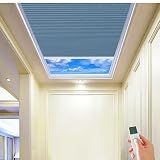
This is the entry point for motorized shading on a skylight. It is a rechargeable motorized window covering with remote control, easy installation and a blue fabric, at mid-range pricing. It suits the buyer who wants the convenience of a remote-controlled blind without premium spend, and who is shading a room where deep darkness is not the goal.
Blue is a deliberate choice rather than a novelty: it filters warm light and reduces glare while keeping a cool cast in the room, which many people find pleasant under a skylight in summer. The rechargeable headrail is the same retrofit logic as its premium sibling — no wiring, no ceiling surgery — and easy installation means the mounting is designed for the reveal rather than the window frame, so it will fit most existing skylights regardless of brand. The honest limitation of any blind at this tier is the fabric: a flat roller weave does not insulate meaningfully, so it is a light and glare control product, not a thermal upgrade. If you want the blind to reduce heat loss as well as