Key takeaways
- Using a heavy cleaver or rocking a thin Japanese nakiri aggressively – the board will win, the edge will lose. Use a softer German stainless chef knife on titanium.
- Cutting directly on the board without a damp paper towel or silicone mat underneath if your model lacks feet – it can slide and scratch countertops.
- Assuming double-sided use is always hygienic – if one side has a juice groove, that side will collect bacteria in the groove if not scrubbed with a brush.
- Putting a wood board in the dishwasher to match titanium convenience – this will cause splitting within a few cycles.
What's inside
- Who Titanium Boards Are Actually Good For
- What Buyers Love Most About Titanium Cutting Boards
- The Most Common Complaints
- Titanium vs. Wood vs. Plastic: Spec Comparison
- Decision Matrix: Which Board Fits Your Situation
- Cost Per Use: Is Titanium Actually Cheaper Long-Term?
- Durability and Ownership Realities
- How to Reduce the Downsides If You Buy Titanium
- Bottom Line From Reviews
Titanium cutting board reviews and complaints show a clear split: buyers love the hygiene and near-indestructible durability, but consistently complain about knife dulling, loud chopping noise, and food slipping on the slick metal surface.
- Who Titanium Boards Are Actually Good For
- What Buyers Love Most About Titanium Cutting Boards
- The Most Common Complaints
- Titanium vs. Wood vs. Plastic: Spec Comparison
- Decision Matrix: Which Board Fits Your Situation
- Cost Per Use: Is Titanium Actually Cheaper Long-Term?
- Durability and Ownership Realities
- How to Reduce the Downsides If You Buy Titanium
- Bottom Line From Reviews
As an Amazon Associate we earn from qualifying purchases at no extra cost to you.
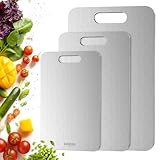


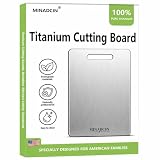
Who Titanium Boards Are Actually Good For
If your top priority is a non-porous, odor-free board that will never crack, warp, stain, or need oiling and can go in the dishwasher, titanium delivers. If your top priority is protecting expensive Japanese knives, quiet prep, and a stable cutting surface that grips food, wood remains the better choice. Most satisfied titanium owners use it for raw meat, fish, and pungent foods and keep a wood board for vegetables and fine knife work.
What Buyers Love Most About Titanium Cutting Boards
1. Hygiene and Odor Resistance
This is the number one praise in verified reviews. Because solid titanium is non-porous, it does not absorb juices from raw chicken, fish, garlic, or onions. Buyers report that unlike wood and plastic, it does not retain odors or stain after handling berries or turmeric, and it rinses clean with just soap and water. For households focused on cross-contamination, the ability to sanitize with boiling water or a dishwasher cycle without damage is a major advantage.
2. Durability and Low Maintenance
Reviewers who switched from wood or plastic after dealing with warping, deep grooves, or mold note that titanium boards show almost no wear over months of use. There are no knife scars to trap bacteria, no oiling or conditioning, no cracking from the dishwasher, and no need to replace the board every 1-2 years. The board stays flat and will not dull from warping-related rocking.
3. Stability for Heavy-Duty Tasks
Buyers who use the board for breaking down poultry, chopping frozen-adjacent meats, or pounding cutlets appreciate that the board does not flex or slide as much as thin plastic, provided it has silicone edge bumpers or feet. The weight gives a planted feel on the counter.
The Most Common Complaints
1. Knife Dulling Is Real
The single most frequent complaint is accelerated edge dulling. Titanium has a hardness of around 6 on the Mohs scale, far harder than maple or HDPE plastic. While titanium will not chip a quality German or Japanese knife as quickly as glass or ceramic would, reviewers consistently report needing to hone or sharpen more often, especially with harder Japanese steel (60+ HRC). Buyers who do a lot of rocking chops or push-cuts notice the difference within weeks. Using a softer steel utility knife or keeping a separate wood board for precision slicing mitigates this.
2. Loud Noise and Harsh Feel
Nearly every negative review mentions sound. Chopping on titanium produces a loud, metallic clack compared to the dull thud of wood. For apartment living or early-morning prep, buyers describe it as unpleasant. The feel is also unforgiving – there is no give under the blade, which creates more hand fatigue and a sensation of the blade skidding rather than biting into the board.
3. Food Slips and Slides
The smooth, non-porous surface that makes cleaning easy also makes it poor at gripping. Reviews frequently note that round items like onions, tomatoes, and lemons slide around, and juices pool and run off instead of staying in a groove. Most titanium boards now include a shallow juice groove and etched texture or brushed finish to add friction, but they still offer less grip than end-grain wood or textured plastic. Silicone feet help the board stay put, but they do not solve food movement on top.
4. Not Ideal as an All-Purpose Board
Buyers who tried to replace their primary wood board entirely often regret it. The combination of knife wear, noise, and slipperiness makes titanium frustrating for high-volume vegetable prep. The most satisfied owners treat it as a secondary board specifically for raw proteins and strong odors.
Titanium vs. Wood vs. Plastic: Spec Comparison
Marketing often presents titanium as superior in every category, but the trade-offs are clearer with concrete specs.
| Feature | Titanium (Pure Grade 1) | Wood (Maple / Teak, End-Grain) | Plastic (HDPE) |
|---|---|---|---|
| Common Sizes | 13.5 x 9.5 in / 15.7 x 11 in | 15 x 11 in / 18 x 12 in / 20 x 15 in | 13 x 9 in / 15 x 11 in / 18 x 12 in |
| Thickness | 1.5 – 3.0 mm (solid sheet) | 1.25 – 2.0 in | 0.375 – 0.5 in |
| Weight | 1.4 – 2.6 lbs (650 – 1,180g) | 5.5 – 12 lbs (2.5 – 5.4kg) | 1.2 – 3.0 lbs (550 – 1,360g) |
| Surface Hardness | ~120 Vickers (~6 Mohs) | ~60-70 Vickers (Janka 1,450 lbf for maple) | ~8-10 Vickers (Shore D 60-70) |
| Porosity | Non-porous, will not absorb | Porous, requires sealing | Semi-porous, scores trap bacteria |
| Dishwasher Safe | Yes | No – will crack/warp | Yes (top rack) |
| Maintenance | Soap and water only | Oil monthly, hand wash, sand as needed | Replace when deeply grooved |
| General Market Price Range (2026) | $40 – $90 | $60 – $180 | $15 – $40 |
| Expected Lifespan | 10+ years | 5-10 years with care | 1-3 years |
The table explains the complaint pattern: wood and plastic are much softer than blade steel and cushion the edge, while titanium is harder than many knife steels and offers no cushioning. That hardness is exactly what makes it durable and sanitary, and exactly what dulls edges.
Decision Matrix: Which Board Fits Your Situation
| Your Situation | Best Choice | Why |
|---|---|---|
| You cook raw meat/fish 3+ times per week and worry about sanitation | Titanium as a dedicated protein board | Non-porous, dishwasher-safe, zero odor transfer between chicken and produce |
| You own high-end Japanese knives (SG2, VG-10, Blue Steel) and prioritize edge retention | Wood (walnut, maple, or teak end-grain) | Softest on edges, self-heals slightly, grips food and reduces micro-chipping |
| You want one low-effort, low-cost board for an apartment or small kitchen | Plastic HDPE with juice groove | Lightweight, quiet enough, dishwasher-safe, cheap to replace |
| You want a lifetime board and don’t mind touching up knives more often | Titanium | Will not warp, crack, or need oiling; lifetime cost is lowest if you maintain knives |
| You prep large volumes of vegetables and herbs daily | Wood primary + titanium secondary | Wood gives grip and quiet chopping; titanium handles meat without cross-contamination |
Cost Per Use: Is Titanium Actually Cheaper Long-Term?
Durability is only a value if you keep the board. A worked example helps:
A titanium board at a general market price of $65 with a 10-year lifespan, used 4 times per week: 4 uses x 52 weeks x 10 years = 2,080 uses. $65 / 2,080 = $0.031 per use.
A plastic HDPE board at $25 replaced every 2 years over the same period (5 boards): $125 / 2,080 = $0.06 per use.
A mid-range wood board at $120 with conditioning oil ($12 per year) over 10 years: ($120 + $120) / 2,080 = $0.115 per use.
Titanium is the cheapest per use on paper, but that calculation assumes you do not add extra sharpening costs. If you pay for professional sharpening twice more per year at $15 per service because of faster dulling, that adds $300 over 10 years, erasing the savings. Home honing with a ceramic rod largely avoids that extra cost.
Durability and Ownership Realities
What wears first is not the titanium itself but the add-ons. Silicone bumpers, edge guards, and non-slip feet loosen or discolor over time, especially with repeated dishwasher heat. Food-grade silicone feet can be replaced, but check if the manufacturer sells spares.
Common mistakes that shorten satisfaction:
- Using a heavy cleaver or rocking a thin Japanese nakiri aggressively – the board will win, the edge will lose. Use a softer German stainless chef knife on titanium.
- Cutting directly on the board without a damp paper towel or silicone mat underneath if your model lacks feet – it can slide and scratch countertops.
- Assuming double-sided use is always hygienic – if one side has a juice groove, that side will collect bacteria in the groove if not scrubbed with a brush.
- Putting a wood board in the dishwasher to match titanium convenience – this will cause splitting within a few cycles.
Cleaning titanium is simple, but requires a different technique than wood. Wash immediately after raw protein with hot soapy water, use a soft sponge rather than steel wool to preserve the brushed finish, and occasionally deodorize with a baking soda paste rather than soaking. Avoid cutting on the board while it is still hot from the dishwasher, as heat plus pressure can accelerate dulling.
How to Reduce the Downsides If You Buy Titanium
If you decide titanium fits your kitchen as a second board, these setup steps address the top complaints:
- Choose a board at least 15 x 11 inches and 2mm+ thick with integrated silicone feet and a juice groove. Thinner, smaller boards slide more and offer less knuckle clearance.
- Dedicate knives: use a Victorinox-style stainless or other softer 56-58 HRC knife for titanium, reserve hard-steel Japanese knives for wood.
- Place a thin, damp kitchen towel under the board if it has no feet to stop movement and dampen sound.
- Use a pinch grip and light draw-cuts rather than heavy downward chops to reduce noise and edge impact.
- Hone with a ceramic rod weekly if you use titanium daily, rather than waiting until the knife feels blunt.
For general information only, not medical advice. If you have concerns about food safety, sanitation, or handling raw meat and seafood at home, consult a food safety professional or local health authority guidance.
Bottom Line From Reviews
Buyers love titanium cutting boards for staying odor-free, never warping, and handling raw meat with easy dishwasher cleanup. They complain most about faster knife dulling, loud clacking, and a slippery surface that makes it a poor standalone replacement for wood. The highest satisfaction comes from owners who use a two-board system: titanium for proteins and pungent foods, wood for everything else.