Key takeaways
- Wood: Naturally contains antimicrobial compounds, but its end-grain structure is porous. It must be hand-washed immediately, dried upright, and oiled regularly with food-grade mineral oil to prevent cracking, warping, and moisture absorption that can harbor bacteria in joints and cracks.
- Plastic (HDPE/PP): Starts non-porous and easy to sanitize, but knife cuts create grooves. Over 6-12 months of daily use, those grooves trap residue and discolor, and the board itself becomes stained and needs replacement. This is why many food safety guidelines recommend replacing heavily scarred plastic boards.
- Titanium: Can be washed with hot soapy water, wiped with diluted vinegar or hydrogen peroxide, or placed in the dishwasher. It will not stain, swell, or develop odor, even without oiling or special treatment.
What's inside
- Titanium vs Wood vs Plastic: The Core Trade-Off
- Hygiene and Odor Resistance: Where Titanium Wins Clearly
- Knife Edge Retention: Where Titanium Loses
- Slip Resistance, Noise, and Usability in Busy Kitchens
- Cleaning, Maintenance, and Long-Term Durability
- Decision Matrix: Which Should You Pick?
- What to Look for If You Buy Titanium
- Common Mistakes to Avoid
- Final Verdict
- Frequently Asked Questions
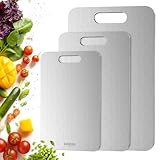
Titanium chopping boards for kitchens are worth it only for specific situations where long-term hygiene and zero-maintenance durability matter more than knife protection, as they are non-porous and odor-proof but will dull knife edges faster than wood or high-quality plastic.
- Titanium vs Wood vs Plastic: The Core Trade-Off
- Hygiene and Odor Resistance: Where Titanium Wins Clearly
- Knife Edge Retention: Where Titanium Loses
- Slip Resistance, Noise, and Usability in Busy Kitchens
- Cleaning, Maintenance, and Long-Term Durability
- Decision Matrix: Which Should You Pick?
- What to Look for If You Buy Titanium
- Common Mistakes to Avoid
- Final Verdict
- Frequently Asked Questions
As an Amazon Associate we earn from qualifying purchases at no extra cost to you.


Titanium vs Wood vs Plastic: The Core Trade-Off
The choice comes down to what you are willing to sacrifice. No board excels at everything. Titanium prioritizes sanitation and longevity, wood balances knife care and aesthetics, and plastic offers affordable, dishwasher-safe convenience.
| Feature | Titanium (Grade 1 Pure Titanium) | End-Grain Wood (Maple / Walnut) | Plastic (HDPE / PP) |
|---|---|---|---|
| Typical Size Range | 33 x 23 cm to 40 x 28 cm (13″ x 9″ to 15.5″ x 11″) | 38 x 28 cm to 50 x 35 cm (15″ x 11″ to 20″ x 14″) | 36 x 24 cm to 45 x 30 cm (14″ x 9.5″ to 18″ x 12″) |
| Weight | 900g – 1,400g (2.0 – 3.1 lbs) | 1,500g – 4,000g (3.3 – 8.8 lbs) | 400g – 900g (0.9 – 2.0 lbs) |
| Thickness | 1.0mm – 2.5mm solid sheet + silicone rim | 25mm – 50mm (1″ – 2″) | 8mm – 15mm (0.3″ – 0.6″) |
| Hardness (Relative) | Very High (approx. 6 Mohs) | Low-Moderate (Janka 950-1450 lbf) | Low |
| Porosity | Non-porous, does not absorb liquids | Porous, requires oiling to seal | Non-porous when new, micro-scarring over time |
| General Market Price Range (2026) | $60 – $150 | $40 – $180 | $12 – $45 |
| Dishwasher Safe | Yes | No | Yes |
Hygiene and Odor Resistance: Where Titanium Wins Clearly
Titanium’s main advantage is that it is biologically inert and completely non-porous. Unlike wood and plastic, it does not absorb raw meat juices, garlic oils, or beetroot pigments. Bacteria have no pores or deep knife scars to colonize, and the surface does not retain odors even after cutting fish or onions.
That does not make wood or plastic unhygienic, but they require more work to stay that way:
- Wood: Naturally contains antimicrobial compounds, but its end-grain structure is porous. It must be hand-washed immediately, dried upright, and oiled regularly with food-grade mineral oil to prevent cracking, warping, and moisture absorption that can harbor bacteria in joints and cracks.
- Plastic (HDPE/PP): Starts non-porous and easy to sanitize, but knife cuts create grooves. Over 6-12 months of daily use, those grooves trap residue and discolor, and the board itself becomes stained and needs replacement. This is why many food safety guidelines recommend replacing heavily scarred plastic boards.
- Titanium: Can be washed with hot soapy water, wiped with diluted vinegar or hydrogen peroxide, or placed in the dishwasher. It will not stain, swell, or develop odor, even without oiling or special treatment.
For households handling a lot of raw meat, fish, or allergens and wanting the lowest-maintenance sanitation, titanium is objectively easier to keep hygienic long-term.
Knife Edge Retention: Where Titanium Loses
This is the most important downside and the reason many chefs avoid titanium. Hardness protects the board but punishes the knife.
Kitchen knives are made of steel with a hardness of roughly 58-62 HRC. Wood and quality plastic are significantly softer than the blade, so the edge sinks slightly into the board and stays sharp longer. Titanium is harder than the steel. Every chop lands on an unyielding metal surface, which rolls and blunts the delicate apex of the edge much faster.
Practical impact:
- With a wood end-grain board, a well-maintained chef’s knife may need honing weekly and sharpening every 2-4 months with daily home use.
- With a titanium board used as the primary daily board, you can expect to hone twice as often and sharpen 2 to 3 times more frequently to maintain the same sharpness. For high-hardness Japanese knives (60+ HRC), the dulling effect and risk of micro-chipping is even greater.
If you have invested in expensive knives or prioritize effortless slicing, wood is the superior surface for edge retention. If you use mid-range Western stainless steel knives and are comfortable with more frequent honing, the trade-off may be acceptable. Consider using titanium as a secondary board for proteins and pungent foods, and wood for vegetables and precision knife work.
Slip Resistance, Noise, and Usability in Busy Kitchens
Early pure titanium sheets had a reputation for being slippery and loud. Modern 2026 designs address this with a full-perimeter silicone or TPU frame, non-slip feet, and a brushed or etched surface texture. The silicone rim also contains juices, which a flat titanium sheet alone would not.
- Slip resistance: A bare metal sheet on a stone countertop is unstable. Look for models with at least 4 silicone feet and a raised edge frame. Without them, place a damp kitchen towel underneath any board.
- Noise: Chopping on titanium produces a distinct metallic clack, noticeably louder than the thud on wood or plastic. In open-plan kitchens or late-night cooking, this can be intrusive.
- Stability and weight: At 900g-1,400g, titanium is heavier than plastic but much thinner and lighter than a thick end-grain butcher block. It will not slide as easily as lightweight plastic, but it does not have the anchored feel of a 3kg+ wood block that stays put under heavy cleaving.
- Juice groove: Most titanium boards now include a shallow milled groove inside the silicone rim. Wood boards often have a deeper routed juice groove; cheap plastic boards often have none.
Cleaning, Maintenance, and Long-Term Durability
Ownership reality is where the materials diverge most after the first year.
Titanium: Almost zero consumable maintenance. No oiling, no waxing, no sanding. It will not crack, warp, or split from water exposure. What wears first is not the titanium itself, which resists corrosion and deformation, but the silicone components. The rim and feet can loosen, stain, or retain odor after 2-3 years and may need replacement if the manufacturer sells parts. The brushed surface will develop fine scratch patterns from knives, which is cosmetic. Do not use abrasive steel wool, which can leave its own residues.
Wood: Requires the most care. Wash by hand, never soak or put in the dishwasher. Oil monthly (or when the board looks pale and dry) and apply board wax occasionally. Store flat and dry to prevent warping. Can last decades if maintained, but neglect leads to cracks that are difficult to repair hygienically. Can be sanded and refinished to restore the surface.
Plastic: Lowest initial care – dishwasher safe and lightweight. However, it is consumable. Deep cut lines, warping from high dishwasher heat, and retained stains mean most busy kitchens replace plastic boards every 12-18 months.
Cost Per Use: A Worked Calculation
Price alone is misleading. Consider lifespan:
Scenario: A household cooks 5 days a week and needs one primary board.
- Plastic: $25 average price, replaced every 1.5 years. Over 5 years: 3.3 boards = ~$83. Plus zero maintenance cost, but more plastic waste.
- Wood (mid-range maple): $90 one-time + $12 mineral oil per year ($60 over 5 years) = ~$150 over 5 years, assuming no cracking or refinishing costs. If well-cared for, it can exceed 10 years and cost drops further.
- Titanium: $95 one-time + $0 maintenance = ~$95 over 5 years, and it will likely last well beyond 5 years. The hidden cost is knife sharpening: if you pay $15 per professional sharpening and need 2 extra sessions per year due to faster dulling, add $150 over 5 years, making the total $245.
Titanium is cheapest for the board itself long-term, but becomes the most expensive if you factor in professional knife maintenance. If you sharpen at home, that extra cost disappears.
Decision Matrix: Which Should You Pick?
| Your Situation / Priority | Best Choice | Why |
|---|---|---|
| You want the most hygienic, lowest-maintenance board for raw meat/fish and have basic knives | Titanium | Non-porous, odor-free, dishwasher safe, never needs oiling |
| You own expensive Japanese or high-carbon knives and care about sharpness | End-Grain Wood | Softest on edges, preserves sharpness longest |
| You need a quiet, heavy, stable board for large prep and dough work | End-Grain Wood | Weight and thickness absorb chopping force and dampen sound |
| You cook occasionally, want cheap and convenient, or need a board for kids | Plastic (HDPE) | Lightweight, inexpensive, dishwasher safe, easy to replace |
| You want a two-board system for optimal hygiene + edge care | Titanium + Wood Combo | Use titanium for proteins/strong odors, wood for vegetables/bread |
| You rent, have limited storage, or need a thin board that travels | Titanium | 1-2.5mm thin, lighter than wood block, easy to store vertically |
What to Look for If You Buy Titanium
Not all titanium boards are equal. Check these specs before buying:
- Material: Look for Grade 1 pure titanium or explicitly stated food-grade pure titanium. Avoid boards labeled only as “titanium-coated” stainless steel, which is a different product.
- Construction: Pure titanium sheet bonded to or framed by food-grade silicone (not plain rubber). The metal should be at least 1.2mm thick to avoid flexing under pressure.
- Surface finish: Brushed or micro-etched finish provides better grip for food than a mirror polish.
- Size: For daily family cooking, 35 x 25 cm is the minimum usable area. Smaller boards look sleek but leave no room for transfer and increase the chance of slipping off the edge.
- Care instructions: Titanium itself tolerates acidic foods, but prolonged contact with highly acidic ingredients can discolor the silicone rim. Wash promptly after use.
Avoid using a cleaver or heavy bone-chopping on any titanium board. The board will survive, but the knife edge will not, and the thin sheet can dent a softer countertop underneath if struck with extreme force. Reserve heavy cleaving for a thick wood block.
Common Mistakes to Avoid
- Cutting frozen food on titanium: The hard surface offers no give; the knife is more likely to slip or chip.
- Using glass-cleaner or bleach concentrate: Unnecessary and can degrade silicone. Warm water, dish soap, and a soft sponge are sufficient.
- Storing wood boards wet or upright against heat: Causes warping regardless of material quality.
- Treating plastic as permanent: If the surface is heavily furrowed and discolored, it is no longer easy to fully clean and should be recycled and replaced.
Final Verdict
Titanium chopping boards for kitchens are not a universal upgrade. Choose titanium if your top priorities are hygiene, resistance to stains and smells, and a board that will not crack or need oiling for years, and you accept louder chopping and more frequent knife honing. Choose end-grain wood if you value knife longevity, quieter prep, and a traditional work surface and you are willing to hand-wash and oil it. Choose HDPE plastic if you want low cost, dishwasher convenience, and are comfortable replacing the board as it wears. For many busy home kitchens in 2026, the most practical setup is a hybrid: titanium for proteins and aromatics, wood for everything else.
Frequently Asked Questions
Are titanium cutting boards safe for food contact?
Yes. Pure titanium is non-reactive, non-toxic, and widely used in medical and food applications. It does not leach particles or alter food flavor. As with any board, clean it thoroughly between raw and cooked foods to prevent cross-contamination. For specific health concerns, consult a qualified professional.
Will a titanium board damage my knives?
It will not damage the steel itself but will dull the cutting edge faster than wood or plastic because the surface is harder than the blade. Regular honing and proper sharpening will maintain performance, but expect to sharpen more often than with a wood board.
Can you put a titanium chopping board in the dishwasher?
Most models with a pure titanium sheet and silicone frame are dishwasher safe. Place it on the top rack and avoid high-heat sanitizing cycles that can accelerate silicone aging. Wood boards should never go in the dishwasher.