Key takeaways
- Anchor tall hutches, shelves and bookcases to the wall as the instructions direct, since tip-over is a recognized risk with children’s furniture.
- Look for rounded corners and smooth edges on desks for younger children.
- Follow the weight limit; a desk top is not a climbing surface.
- Wipe laminate with a damp cloth and avoid harsh solvents; unfinished wood needs the care method the maker lists.
- Re-tighten bolts every few months, since screws can loosen with daily use.
- Position the desk to reduce glare on a screen, and place it where an adult can see the child’s work area.
For most families, a height-adjustable kids desk with a tilting top is the best long-term buy, a fixed-height desk with a deep surface suits a tight budget and a single young child, and a compact folding or wall-mounted desk suits small bedrooms. The right choice depends on your child’s age, the room, and how much homework, drawing and screen work the desk has to handle. This guide compares the main desk types, what makers typically state about them, and how to match one to a child.
Our top picks
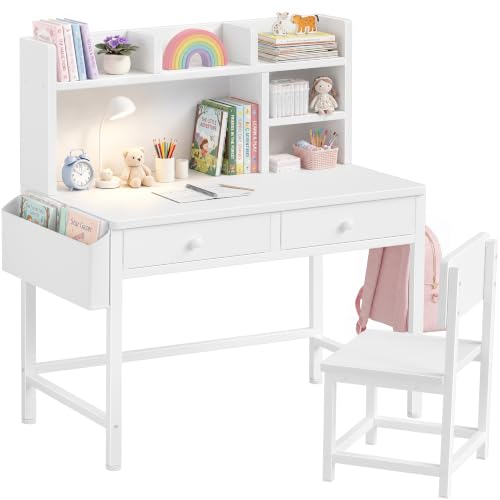


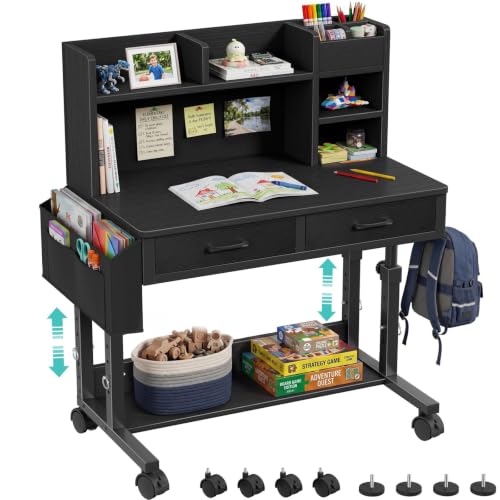
As an Amazon Associate we earn from qualifying purchases at no extra cost to you.
At a Glance: Kids Desk Types Compared
| Desk type | Best for | Typical stated features | Limits |
|---|---|---|---|
| Height-adjustable desk with tilting top | Ages roughly 5 to 15, one desk for many years | Makers list a height range, a tilt angle for drawing and reading, and a weight rating | Mid-range to premium tier; heavier to move; adjustment instructions must be followed exactly |
| Fixed-height desk and chair set | Preschool and early primary children | One height, often with a storage drawer or shelf | Outgrown quickly |
| Standard small writing desk | Teens, shared study spaces | Adult-style proportions, drawers, cable holes | Needs a footrest and adjustable chair for shorter children |
| Corner or L-shaped desk | Two children or heavy computer use | Larger surface, monitor shelf, cable management | Takes up wall space; assembly takes longer |
| Wall-mounted fold-down desk | Small rooms and shared bedrooms | Folds flat when not in use | Needs solid wall fixing; lower weight capacity |
| Activity table | Toddlers and crafts | Wipe-clean top, small chairs | Not suited to homework |
How to Choose the Right Kids Desk
Start with the child’s height, not their age
Ergonomics guidance commonly cited by furniture makers and school-furniture suppliers is that the child’s feet should rest flat on the floor or a footrest, knees and hips sit at about right angles, and the forearms rest on the desk surface with relaxed shoulders. Because children of the same age vary a lot in height, an adjustable desk and chair removes the guesswork. If you buy a fixed desk, measure the child seated and compare it to the maker’s stated desktop height, and add a footrest if the feet dangle.
Surface size
A surface that is too shallow forces a child to sit close to a screen or crowd a book against the edge. Reviewers generally favour a surface deep enough to hold a laptop or monitor at arm’s length with space left for a notebook. Compare the maker’s stated width and depth against the wall space available, and leave room for the chair to slide back.
Tilting tops
Many adjustable models include a top that tilts to a slope for drawing, reading and handwriting. A sloped surface can be more comfortable for reading than a flat one, and a retaining lip stops pencils sliding off. A flat position is still needed for computers. Look for a locking mechanism and a stated maximum load at the tilted angle, as this is often lower than the flat rating.
Storage
Drawers keep supplies off the surface, while open shelves are easier for younger children to use. Under-desk drawers reduce knee room on smaller desks, so compare the stated clearance under the desk with your child’s seated knee height.
Adjustable Kids Desks
Adjustable models are the most popular answer to the question of how to avoid replacing a desk every two years. Several office-furniture brands, including FlexiSpot, list kids desks with manual height adjustment and tilting tops, and many school-furniture makers sell similar designs. Reviewers who look at this category usually point out three things: the crank or lever should be smooth enough for a child to use under supervision, the frame should not wobble at the top of its range, and a pinch-point warning in the manual should be taken seriously. Always keep hands, fingers and pets clear of the frame while adjusting, and follow the maker’s instructions.
Adjustable desks suit families who want one purchase to last from primary school into the early teens, and they also work for siblings of different ages in turn. The trade-off is cost tier and weight. Expect these to sit in the mid-range or premium tier, and expect a longer assembly.
Matching chair
A desk is only half the setup. A chair with an adjustable seat height and a supportive back matters as much, and a footrest is useful where the desk is fixed. Makers of paired desk and chair sets list matching height ranges, which removes one compatibility question.
Fixed-Height Desks and Sets
For preschool and early primary children, a fixed desk and chair set is simple, sturdy and budget-friendly. Compact children’s tables from retailers such as IKEA (the Mammut range is one long-running example) are light, easy to wipe clean and designed with rounded corners. They suit drawing, puzzles and early reading. They are not designed for long computer sessions, and children will outgrow them within a few years, so treat them as a short-term, budget-tier solution.
Standard Writing Desks for Older Kids and Teens
Once a child is close to adult height, a standard desk is a perfectly reasonable option. Look for a surface wide enough for a laptop plus books, a cable grommet, and a sturdy frame. These are available in budget, mid-range and premium tiers, with the difference typically showing up in material (particleboard with laminate versus solid wood or a metal frame), drawer quality and finish. If indoor air quality matters to you, read the maker’s page for low-emission claims; any certification marks are the maker’s to substantiate.
Small-Space Solutions
Wall-mounted fold-down desks and slim console-style desks free floor space. Wall fixing must suit your wall type (solid masonry, stud, or plasterboard), and the maker’s stated load rating should be followed. If unsure, use a qualified installer. A desk that is bolted to the wall also avoids tipping hazards. Corner desks make use of otherwise empty space and suit two children working at the same time.
Safety and Care Notes
- Anchor tall hutches, shelves and bookcases to the wall as the instructions direct, since tip-over is a recognized risk with children’s furniture.
- Look for rounded corners and smooth edges on desks for younger children.
- Follow the weight limit; a desk top is not a climbing surface.
- Wipe laminate with a damp cloth and avoid harsh solvents; unfinished wood needs the care method the maker lists.
- Re-tighten bolts every few months, since screws can loosen with daily use.
- Position the desk to reduce glare on a screen, and place it where an adult can see the child’s work area.
Pick X If… Decision Table
| Pick this | If… |
|---|---|
| Adjustable desk with tilt top | You want one desk for many years or have siblings sharing it |
| Fixed desk and chair set | The child is under about six and budget is the priority |
| Standard writing desk | The child is a teen near adult height |
| Corner desk | Two children study together or a monitor and printer are involved |
| Wall-mounted fold-down | The room is small and the walls are solid |
| Activity table | The child is a toddler who mainly draws and plays |
Alternatives to Consider
- Lap desk or tray: a budget option for occasional homework on a bed or sofa, though posture is less supportive for long periods.
- Dining table with a booster seat: works for short-term use with young children, but heights rarely match.
- Adjustable adult standing desk: some families choose an electric sit-stand frame, which handles a wide height range. Electric models should be used per the maker’s manual, with attention to cable and pinch hazards around small children.
Frequently Asked Questions
What size desk does a child need?
The right size is one that lets the child sit with feet supported and forearms resting comfortably on the surface. Because ages and heights vary, compare the maker’s stated height range to the child’s seated measurements. For homework a surface that holds a laptop plus a notebook is a sensible minimum.
Is an adjustable desk worth it for a child?
For many families it is, because it can follow the child’s growth for several years. The extra cost sits in the mid-range or premium tier, so it makes most sense if the desk will be used daily. If your child is young and you expect to change rooms, a simple fixed set may be enough.
At what age should a child get a proper desk?
There is no fixed rule. Many families move from a play table to a small desk when regular homework starts, often around primary school age. A desk with an adjustable chair helps from that point on.
Should a kids desk have a tilting top?
A tilting top is helpful for drawing, handwriting and reading, as the slope can reduce neck bending. It is not essential, and a flat surface is still needed for a computer. If you choose one, look for a secure lock and a clearly stated load rating at the angled position.
How do I keep a kids desk stable and safe?
Assemble it exactly as the instructions say, tighten bolts periodically, and anchor any tall hutch or shelf to the wall. Avoid letting children stand or climb on the desk. If the frame wobbles, stop using it until the cause is found.
Can a standing desk work for a child?
Some families use sit-stand desks, and makers offer models with lower minimum heights. Children should still sit for most work and shift positions, and a parent should read the manual on safe operation. If you have posture or health concerns, ask a pediatrician or physical therapist for guidance.