Key takeaways
- Over-sink racks: Rest on the sink walls or span across. No counter footprint, drains directly into the sink. Limited by sink width and faucet height. Best for apartments, galley kitchens, and anyone with less than 18 inches of counter beside the sink.
- In-sink racks: Sit inside the basin on feet or a tray. Keep counters completely clear and work well for rinsing produce too. Reduce usable sink space while in place and usually hold fewer items.
- Countertop racks: Sit beside the sink with a sloped drainboard. Hold the most plates, bowls, and glasses per load, but require 15 to 24 inches of counter depth. Look for models with a directed spout and angled base so water does not pool.
What's inside
The best dish drainers for kitchen sink setups depend on your sink width and counter space: over-sink roll-up racks save the most counter space for small kitchens, 2-tier countertop racks hold the most dishes for families, and compact in-sink racks fit single-bowl sinks under 24 inches wide without blocking the faucet.
As an Amazon Associate we earn from qualifying purchases at no extra cost to you.


Which Type of Dish Drainer Actually Saves Space?
Space-saving is not one-size-fits-all. The right choice comes down to where the water drains and how much clearance you have.
- Over-sink racks: Rest on the sink walls or span across. No counter footprint, drains directly into the sink. Limited by sink width and faucet height. Best for apartments, galley kitchens, and anyone with less than 18 inches of counter beside the sink.
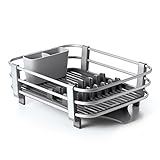
- In-sink racks: Sit inside the basin on feet or a tray. Keep counters completely clear and work well for rinsing produce too. Reduce usable sink space while in place and usually hold fewer items.
- Countertop racks: Sit beside the sink with a sloped drainboard. Hold the most plates, bowls, and glasses per load, but require 15 to 24 inches of counter depth. Look for models with a directed spout and angled base so water does not pool.
For rust resistance, prioritize 304 stainless steel, powder-coated steel with sealed welds, or BPA-free polypropylene. Chrome-plated steel without a full coating tends to rust first at joints and wire ends within 12-18 months in hard-water areas. For drainage slope, a 3 to 5 degree angle with a dedicated spout drains fully; flat trays leave standing water and require manual emptying.
10 Space-Saving Dish Drainers Compared: Specs and Fit
This comparison focuses on dimensions, material, capacity, and drainage design — the details that determine whether a rack fits and lasts.
| Model / Type | Footprint (L x W x H) | Material | Stated Capacity | Weight | Drainage |
|---|---|---|---|---|---|
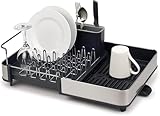
| Simplehuman Steel Frame Dishrack (Countertop) | 20.6 x 15.2 x 6.5 in | 304 stainless + coated steel, plastic tray | 10 plates, 6 glasses | 5.8 lbs | Sloped tray with spout into sink |
| OXO Good Grips FoldFlat (Countertop) | 19.5 x 14.3 x 5.3 in (folds to 3.1 in high) | Stainless + polypropylene | 8 plates, 4 glasses | 3.9 lbs | Angled drain cup, removable tray |
| Joseph Joseph Extend Expandable (Countertop) | 12.6-20.9 x 14.4 x 6.4 in | Polypropylene + coated steel prongs | 9-13 plates (expandable) | 4.2 lbs | Integrated spout, movable cutlery drain |
| Yamazaki Tower Small Dish Rack (Countertop) | 12.6 x 10.2 x 8.1 in | Powder-coated steel + wood handle | 5 plates, 3 glasses | 2.9 lbs | Removable tray, no spout (lift to empty) |
| KitchenAid Full Size Dish Rack (Countertop) | 20.5 x 15 x 6 in | Satin-coated stainless, plastic board | 10 plates | 5.1 lbs | Angled board drains to sink |
| Surpahs Over-Sink 2-Tier Rack (Over-sink) | 33.5 x 12.6 x 20.5 in (adjustable length) | Coated stainless steel | 14 plates, 8 bowls | 7.3 lbs | Vertical, drips directly into sink |
| KOHLER Multipurpose Over-Sink Rack (Over-sink) | 16.5 x 11.8 x 3.2 in | Stainless steel + silicone feet | 4 plates / doubles as prep rack | 2.1 lbs | Open wire, drains into sink |
| Generic Roll-Up Dish Drying Rack (Over-sink, e.g., Neat-O style) | 20.5 x 13.5 x 0.3 in (rolls to 3 in dia) | 304 stainless rods + silicone edges | 8 plates or 10 lbs produce | 1.8 lbs | Between rods, drains straight down |
| mDesign Compact Plastic Rack (In-sink / Countertop) | 14.2 x 12.1 x 5.1 in | Polypropylene | 6 plates | 1.4 lbs | Slotted tray, manual empty |
| Polder Advantage Single-Side Rack (Countertop slim) | 15.5 x 7.5 x 6.2 in | Coated steel + plastic tray | 5 plates | 2.3 lbs | Side spout tray |
1. Simplehuman Steel Frame Dishrack
A full-size countertop benchmark for families. The solid stainless frame resists flexing under cast iron or stoneware, and the extra-deep tray with a swivel spout handles high-volume draining without overflow. At over 20 inches long, it needs a standard 24-inch base cabinet run and benefits from being placed with the spout over the sink edge.
2. OXO Good Grips FoldFlat
Designed for small kitchens that need the counter back. The tine walls fold inward and the dish rack collapses to about 3 inches high for drawer or cabinet storage. Drain cup is smaller than a full tray, so it is better for 1-2 person households than for batch drying.
3. Joseph Joseph Extend
The only easily expandable option here, extending from 12.6 to 20.9 inches. Useful if your dish volume changes between weekdays and weekends. The polypropylene base will not rust and the movable spout lets you switch drain direction without moving the whole rack.
4. Yamazaki Tower Small
A minimal-footprint steel rack for studio kitchens or bar sinks. Holds just enough for two place settings and looks tidy left out. Trade-off is no directed drainage — you lift the tray to empty it — and the coated steel needs prompt drying to avoid chips at the welds.
5. KitchenAid Full Size Dish Rack
Similar capacity to Simplehuman but with a lighter satin finish and softer-tipped tines that are gentler on glassware. The angled drain board is effective, but the overall length means it overhangs shallow counters under 23 inches deep.
6. Surpahs 2-Tier Over-Sink Rack
Frees 100% of counter space by building upward. Fits double-bowl sinks 28 to 33.5 inches wide with adjustable feet, and the second tier adds space for mugs and cutting boards. Check faucet clearance: you need at least 18 inches from sink rim to cabinet bottom and enough setback for a tall gooseneck faucet.
7. KOHLER Multipurpose Over-Sink Rack
A low-profile stainless grid that sits across a single bowl, useful as both a drainer and a colander for washing produce. Very stable due to silicone-capped feet, but capacity is intentionally small — it is a complement to a main rack, not a replacement for a family.
8. Roll-Up Over-Sink Drying Rack
The most space-saving design. A series of 304 stainless rods joined by silicone that rolls out over the sink and rolls up for storage. Heat-safe to about 400F, so it can also serve as a trivet. Not ideal for stemware or small utensils that can slip through 0.6-inch rod gaps.
9. mDesign Compact Plastic Rack
All-plastic construction means zero rust risk and easy cleaning. Light enough to move between sink and counter. The slotted insert does not separate small bowls well, and the low walls let larger plates lean precariously if overloaded.
10. Polder Advantage Slim Rack
A narrow 7.5-inch-wide rack for kitchens with only a sliver of counter beside the sink. Holds plates in a single row, which improves air circulation and drying speed, but cannot handle pots or wide bowls.
Decision Matrix: Pick by Your Situation
Use your sink size, household size, and how often you hand-wash to narrow the field quickly.
| Your Situation | Best Fit | Why |
|---|---|---|
| Counter < 14 in beside sink, sink ≥ 20 in wide | Roll-up over-sink or KOHLER style | Zero counter needed, drains straight into basin |
| Single-bowl sink 24-30 in wide, family of 3-5 | Surpahs 2-tier over-sink | Vertical capacity without using counter; holds pots on lower tier |
| Standard counter 24+ in deep, daily hand-washing | Simplehuman, KitchenAid, or Joseph Joseph | Highest plate capacity and reliable sloped drainage |
| Tiny kitchen, washing for 1-2 people | OXO FoldFlat or Yamazaki Tower | Compact or foldable; store away to reclaim prep space |
| Hard water or no desire to manage rust | Joseph Joseph Extend or mDesign plastic | Polypropylene trays and prongs eliminate exposed steel |
| Rental / need to protect sink finish | Any model with silicone feet + stainless rods | Silicone prevents scratching on stainless or fireclay sinks |
Fit and Sizing Calculation: Will It Drain Into Your Sink?
Many countertop racks fail because the drain spout does not reach the sink. Do this 30-second check before buying:
- Measure A: distance from the wall to the outer edge of your sink basin (typically 22-26 inches).
- Measure B: depth of the rack you are considering (from table above, e.g., 15.2 inches for Simplehuman).
- Measure C: overhang needed. The spout tip should extend at least 1 inch past the sink rim inside the basin.
Worked example: Your counter is 25 inches deep and sink rim is 1.5 inches from the wall-side counter edge. A 15.2-inch-deep rack placed against the backsplash will have its front edge at 15.2 inches from the wall. The sink basin starts at 23.5 inches from the wall (25 – 1.5). Gap = 23.5 – 15.2 = 8.3 inches — too far for the 2-inch spout to bridge. Solution: place the rack perpendicular to the sink or choose an over-sink roll-up that needs no spout distance.
For over-sink racks, measure sink interior width at the top and faucet height. A roll-up needs sink side walls less than 13.5 inches apart to rest securely, while a 2-tier adjustable rack like Surpahs needs at least 28 inches of total sink width to span without blocking the faucet handle.
Durability and Ownership Realities
What wears first is rarely the frame. On coated steel racks, the vinyl or powder coating cracks at the wire intersections where dishes slide in and out. Once the coating chips, exposed steel rusts quickly, especially with citrus or salt water. Rinse and towel-dry the rack weekly, and touch up chips with appliance epoxy to extend life by a year or more.
On stainless models, check for 304 or 18/8 stamping. 201 stainless is cheaper but pits faster in salty or acidic environments. Silicone end caps and feet harden and split after 2-3 years; replacements are inexpensive and worth keeping on hand if you have a roll-up.
Plastic trays discolor and develop biofilm in the drain channel if not cleaned. The common mistake is leaving standing water in a flat tray. Clean the tray every 3-4 days with warm soapy water and a bottle brush in the spout channel, and descaling with a 1:3 white vinegar soak for 10 minutes if you have hard water. Avoid abrasive pads on coated wires — they accelerate coating loss.
For drain slope, if water pools instead of flowing, shim the back feet 1/8 inch with adhesive felt pads. That adds about 4 degrees of slope, enough to move water to the spout without making dishes unstable.
How to Set Up for Fastest Drying
- Place heaviest items on the outer or lower tier to lower the center of gravity and improve airflow around glasses.
- Angle plates so they do not touch — 0.75 to 1 inch of gap cuts drying time by nearly half versus nesting.
- Position the rack where kitchen airflow crosses it, not in a corner. A window or vent within 3 feet helps evaporation.
- Empty the drain tray or ensure the spout path is clear before each wash; a blocked spout leaves the bottom of cups sitting in water.
Frequently Asked Questions
Do over-sink drainers block the faucet?
Roll-up rods and low-profile grids sit below most faucet spouts and can be pushed aside in one motion. Full 2-tier racks need 15 to 20 inches of vertical clearance and a faucet set back at least 2 inches from the sink centerline to allow the rack frame to sit behind the spout.
Are dish drainers better with or without a drainboard?
With a sloped drainboard and spout is better for daily use because water returns to the sink automatically. Without a board is acceptable only if you are willing to lift and empty a tray daily or you are using an over-sink design that drains directly.
How do I prevent rust on a steel rack?
Choose 304 stainless or fully sealed powder coating, avoid soaking the rack, dry it after emptying, and keep it out of prolonged contact with cast iron residue and salt. Replace silicone caps when cracked, since exposed tube ends trap water inside the frame.