Key takeaways
- Vacuum around the machine regularly, especially near the front roller and side rails.
- Inspect belt alignment every few sessions during the first month, when a new belt may settle.
- Lubricate only according to the manual; excess lubricant can attract dirt and cause slipping.
- Unplug the treadmill before cleaning and keep liquids away from the motor housing.
- Do not store heavy objects on a folded deck or lean it against a wall where it can fall.
- Stop using it if the belt catches, the frame flexes unusually, or the motor emits a burning smell.
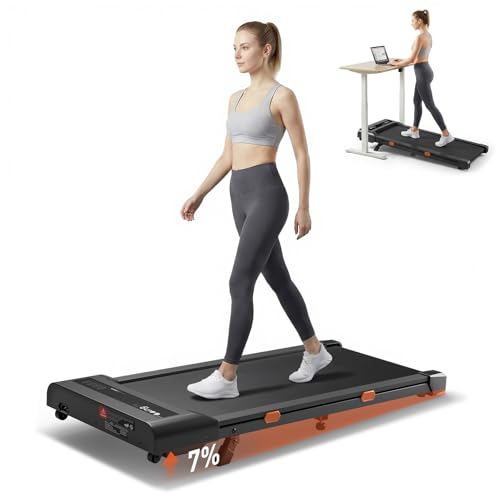
The best under desk treadmills for small spaces are the WalkingPad A1 Pro for the thinnest, simplest setup, the WalkingPad C2 for folding storage, the UREVO 2-in-1 under-desk treadmill for a lower-cost speed upgrade, and the LifeSpan TR1000-Classic for frequent office use.
Before choosing, measure the space under your desk and behind your chair, then compare the walking deck—not the machine’s total footprint—with your stride. A compact treadmill can fit neatly under a desk yet still feel cramped if its belt is narrow or short.
Our top picks



As an Amazon Associate we earn from qualifying purchases at no extra cost to you. Ratings are shown as listed on Amazon.
Best under desk treadmills at a glance
| Model | Walking speed | Deck dimensions | Approx. weight | Weight limit | Storage profile | Best for |
|---|---|---|---|---|---|---|
| WalkingPad A1 Pro | 0.5–3.7 mph | 47.2 × 16.5 in | About 55 lb | 220 lb | About 5.5 in high | Very small offices and flat storage |
| WalkingPad C2 | 0.5–3.7 mph | 47.2 × 15.7 in | About 55 lb | 220 lb | Folds across the deck; about 5.5 in high when flat | Closet or sofa storage |
| UREVO 2-in-1 under-desk treadmill | About 0.5–4.0 mph | Roughly 42–45 × 16 in | About 50–60 lb | About 265 lb, model dependent | Usually 5–6 in high | Value buyers wanting occasional faster walking |
| LifeSpan TR1000-Classic | Up to about 4.0 mph | Approx. 50 × 20 in | About 119 lb | 350 lb | About 6.5 in high; not a carry-upstairs product | Frequent use and a steadier, wider platform |
| Egofit Walker Pro M1 | Up to about 2.4 mph | About 38.5 × 16 in | About 53 lb | About 242 lb | Very short deck; approximately 6 in high | Short users and exceptionally tight spaces |
Specifications can vary by generation and region, particularly for UREVO models. Confirm the exact model number, belt size, and warranty before ordering. The dimensions above are practical comparison figures rather than a substitute for the manufacturer’s current manual.
Which model fits your situation?
| Your situation | Most suitable choice | Why | What to compromise on |
|---|---|---|---|
| Desk in a bedroom or small apartment | WalkingPad A1 Pro | Low profile, moderate weight, and no bulky upright console | It is intended for walking, not running |
| You must put it in a closet after every session | WalkingPad C2 | The folding deck reduces its stored length | The center fold adds a seam and does not make it light |
| You want occasional brisk walking on a limited budget | UREVO 2-in-1 model | Many versions offer around 4 mph and competitive pricing | Noise, belt feel, and quality control vary more by model |
| Several hours of use most workdays | LifeSpan TR1000-Classic | Wider deck, higher capacity, and a heavier commercial-oriented frame | It is difficult to move and needs a desk with generous clearance |
| You are short and have almost no floor depth | Egofit Walker Pro M1 | Its short chassis uses less room in front of the desk | The short belt is less forgiving for taller users or long strides |
Head-to-head: the features that matter in a home office
Walking speed
For typing, reading, and video meetings, 1.0–2.0 mph is usually the practical range. At higher speeds, your upper body moves more and precise mouse work becomes harder. A treadmill rated at 3.7 or 4.0 mph gives useful headroom for walking away from the desk, but it does not automatically make the machine suitable for running.
The A1 Pro and C2 are desk-walking specialists. UREVO’s 2-in-1 units are more versatile when you want a faster walking setting, although the exact speed depends on the version. The LifeSpan has the most convincing fit for regular, sustained office walking because its deck is wider and its frame is heavier.
Deck size and stride comfort
A 16-inch-wide belt is compact, but it leaves less room for lateral movement than a conventional treadmill. A deck around 47–50 inches long suits many users at walking speed. Taller users, people with long strides, or anyone who tends to drift while working should favor the LifeSpan’s approximately 20-inch width and 50-inch length.
Do not measure only your available floor space. Leave at least 2 inches of clearance on each side for airflow and to prevent the belt from rubbing nearby furniture. Keep a clear area in front and behind the treadmill so stepping off does not mean backing into a chair or wall.
Motor noise and office compatibility
Compact walking treadmills are usually quiet enough for ordinary keyboard work, but “quiet” does not mean silent. The motor produces a low mechanical hum, while footsteps create impact noise transmitted through the floor. Hard floors can make this sound noticeably louder for people in the room below.
A rubber equipment mat helps reduce vibration and protects flooring. It also makes the treadmill easier to reposition. Do not place it on a thick, soft carpet unless the manufacturer permits it: carpet can restrict ventilation, destabilize the machine, and make belt alignment harder to judge.
The quietest practical setup is a well-lubricated belt, a firm floor, moderate speed, and shoes with flexible soles. A treadmill under a height-adjustable desk is better than one under a fixed desk because you can raise the work surface enough to keep your elbows near 90 degrees while walking.
Weight limits and portability
Use the rated capacity as a ceiling, not as an ideal operating target. If the user is close to the limit, a heavier-duty frame such as the LifeSpan generally offers more reserve, though it sacrifices portability. Lightweight models around 50–60 pounds can be moved by one person, but carrying them repeatedly up stairs is still inconvenient.
Wheels help with repositioning, but they do not eliminate the need to lift one end over thresholds. Check whether the wheels roll in the direction you need. Some compact treadmills are easy to slide out from under a desk but awkward to turn sideways into a closet.
Desk compatibility: measure before buying
- Measure the desk’s lowest usable height from the floor to the underside of the desktop.
- Add the treadmill deck height—typically about 5.5–6.5 inches—to the height of your shoes.
- Stand at the desk and check whether your elbows remain comfortably bent when the keyboard is on the desktop.
- Measure the distance from the front edge of the desk to the nearest wall or furniture, including the treadmill’s full length.
- Confirm that the treadmill’s control remote, safety key, and power cord will not collide with the desk frame.
For example, if your desk is 28 inches high and the treadmill adds 6 inches, your working surface is effectively 34 inches above the floor. That may suit a tall person but be too high for a shorter user. A sit-stand desk with a broad height range is usually more important than a treadmill with an extra 0.5 mph of speed.
Ownership realities: what wears first
The belt and deck surface usually need attention before the motor. Dust, carpet fibers, and small debris increase friction. A belt that starts drifting, squeaking, or feeling hot may need cleaning, alignment, or manufacturer-approved lubricant—not simply a faster speed setting.
- Vacuum around the machine regularly, especially near the front roller and side rails.
- Inspect belt alignment every few sessions during the first month, when a new belt may settle.
- Lubricate only according to the manual; excess lubricant can attract dirt and cause slipping.
- Unplug the treadmill before cleaning and keep liquids away from the motor housing.
- Do not store heavy objects on a folded deck or lean it against a wall where it can fall.
- Stop using it if the belt catches, the frame flexes unusually, or the motor emits a burning smell.
For occasional use, a compact WalkingPad or UREVO can be the sensible choice. For daily, multi-hour use, paying more for a wider deck, stronger capacity, and better service support may cost less than replacing a budget machine. General product guidance cannot determine whether treadmill walking is appropriate for a particular health condition; consult a qualified professional if that is a concern.
Final recommendation
Choose the WalkingPad A1 Pro when minimum visual and storage impact matters most. Choose the C2 when folding storage is worth a slightly more complex deck. Choose a UREVO 2-in-1 model when price and a higher walking speed matter, but verify the exact version’s dimensions and noise expectations. Choose the LifeSpan TR1000-Classic for a permanent home-office station and frequent use. If your available depth is exceptionally limited and you have a short stride, the Egofit Walker Pro M1 is a specialized alternative—not the safest universal recommendation.