Key takeaways
- Driver size: 10 inches
- Impedance: 4 ohm, single voice coil
- Application: designed around the Bazooka marine tube and enclosure family, and usable in a small sealed box
- Power class: a mid-power 10-inch driver — plan on an amplifier in the 150W–300W RMS class at 4 ohm
- Construction class: marine-line driver with moisture-resistant cone and surround treatment
Best overall: the KICKER 51MWF104. It is a 10-inch, 4-ohm marine subwoofer built for free-air (infinite-baffle) mounting, which means it needs no box at all — you cut a hole in a rigid panel, seal the front wave from the back wave, and the boat’s own structure becomes the enclosure. That makes it the right first pick for 16- to 22-foot runabouts, bowriders, and center consoles, where a 1-cubic-foot box would swallow an entire storage locker. If your budget is the hard constraint, the BELVA BMSS10RW delivers 400W RMS from a shallow 10-inch frame with multi-color LED lighting at a budget price. If you want the most bass and the most finished look, the KICKER KMF124 is a 12-inch 4-ohm marine driver with an illuminated white grille. Readers in very small cockpits — tenders, skiffs, jon boats, and side consoles under 16 feet — should skip all three and go straight to the Polk Audio MM1 8-inch DVC, which trades cone area for a footprint that actually fits.
Top 3 Picks
Best overall: KICKER 51MWF104
A 10-inch, 4-ohm marine subwoofer explicitly rated for free-air applications, so it installs into a seat base, console side, or bulkhead without an enclosure. It suits boats where a box is impossible or where you want the least possible installation complexity, and it pairs cleanly with a single 4-ohm-stable Class D marine amplifier.
Best budget: BELVA BMSS10RW
An 800W peak / 400W RMS shallow-mount 10-inch marine subwoofer with multi-color LED lighting. The shallow frame makes it one of the few budget 10s that fits behind a gunwale or under a bench seat, and the RMS figure is published rather than buried, which makes amplifier matching straightforward.
Best premium: KICKER KMF124
A 12-inch, 4-ohm marine subwoofer with a white LED-illuminated grille. It is the pick for 20-foot-and-up boats with the mounting depth, the panel rigidity, and the electrical capacity to feed a large cone properly. Expect to need a real enclosure or a heavily braced free-air baffle, plus an amplifier in the 300W-plus RMS class.
Quick Comparison
| Product | Best for | Key specs | Price tier |
|---|---|---|---|
| Bazooka MBT1014 | Tube-style bass on center consoles and pontoons | 10 in, 4-ohm SVC, marine-rated, designed around Bazooka tube/enclosure family | Premium |
| Pyle 10-Inch Outdoor Marine Subwoofer (500W) | Budget 10-inch cone area | 10 in, 500W peak, 4-ohm, white, waterproof-rated single driver | Budget |
| Polk Audio MM1 8″ DVC | Small cockpits needing tight, accurate bass | 8 in, dual voice coil (2 or 8 ohm wiring), 900W peak, marine-rated | Mid-range |
| BELVA BMSS10RW | Shallow-mount budget installs with LED | 10 in, 800W peak / 400W RMS, shallow frame, multi-color LED, marine-rated | Budget |
| Pyle 8-Inch Low-Profile Amplified System | Installations with no room for a separate amp | 8 in active enclosed sub, 600W peak, built-in amplifier, low-profile footprint | Mid-range |
| KICKER 51MWF104 | Free-air mounting with no enclosure | 10 in, 4-ohm SVC, free-air / infinite-baffle rated, marine-built | Premium |
| Lanzar 8″ Marine Subwoofer System | One-box installs with remote level control | 8 in slim amplified woofer, 1000W peak, RCA low-level input, remote control | Mid-range |
| Pyle PLMRW8 | Lowest-cost waterproof 8-inch | 8 in, 400W peak, 4-ohm, white, waterproof-rated single driver | Budget |
| Polk Audio DB1242 SVC | Maximum cone area on a budget | 12 in, single voice coil, shallow-mount, rated for marine and car use | Budget |
| Pyle 10-Inch Low-Profile Amplified System | Under-seat and console-cavity bass | 10 in active enclosed sub, 900W peak, built-in amplifier, low-profile cabinet | Mid-range |
| KICKER KMF124 | Premium 12-inch output with LED grille | 12 in, 4-ohm, marine subwoofer, white LED-illuminated grille | Premium |
| JBL 10″ Marine Multi-Element Subwoofer | Efficient bass on modest amplifier power | 10 in, 200W rated, multi-element motor design, white finish, marine-rated | Premium |
How We Chose
This roundup was assembled from published manufacturer specifications, product documentation, and established marine-audio installation practice — not from physical testing of the units. Every product below appears in its current listing with a stated size, impedance, and power rating, and each one is sold as marine-rated or explicitly described as suitable for boats. We filtered for four things. First, category fit: a driver had to be sold as a marine or outdoor-rated subwoofer, not a car subwoofer that a seller has relabeled. Second, published specs: impedance, voice-coil configuration, peak versus RMS power, and whether an enclosure is required are the numbers that determine whether a sub will actually work in a given boat, so products that publish them clearly rank higher than products that do not. Third, installation reality: mounting depth, enclosure requirement, and whether the unit is active or passive decide whether a sub fits a 15-foot skiff or a 24-foot bowrider, and that matters more than any single wattage figure. Fourth, upgrade path: we favored drivers that can be re-amplified or moved into a better enclosure later rather than sealed all-in-one units with no future. Price tiers reflect general market positioning only; street prices move constantly.
1. Bazooka MBT1014 – Best for Tube-Style Bass on Center Consoles and Pontoons
As an Amazon Associate we earn from qualifying purchases at no extra cost to you.

The Bazooka MBT1014 suits a specific kind of boater: someone who already likes the Bazooka bass-tube sound, or who has a center console or pontoon where a cylindrical enclosure can be strapped or bracketed into a corner without permanently cutting the hull. It is a 10-inch, 4-ohm single-voice-coil marine subwoofer from a brand whose entire identity in marine audio is built around tube-format bass systems, and that heritage is the reason it earns a premium tier placement.
Key specs at a glance
- Driver size: 10 inches
- Impedance: 4 ohm, single voice coil
- Application: designed around the Bazooka marine tube and enclosure family, and usable in a small sealed box
- Power class: a mid-power 10-inch driver — plan on an amplifier in the 150W–300W RMS class at 4 ohm
- Construction class: marine-line driver with moisture-resistant cone and surround treatment
Why it works
The 4-ohm single voice coil is the practical part. Most marine Class D amplifiers are rated at 4 ohm and 2 ohm, and a single 4-ohm coil means you wire one positive and one negative lead, set the amplifier’s low-pass filter somewhere between 80 Hz and 100 Hz, and you are done. There is no series-versus-parallel decision, no risk of accidentally presenting a 1-ohm load to an amplifier that cannot take it, and no confusion about whether you have a 2-ohm or 4-ohm version of the driver.
The Bazooka advantage is the enclosure ecosystem. Tube-format bass systems are the easiest thing to install on a boat that you do not want to cut, because they can be mounted with straps, brackets, or a simple base plate and they do not require you to seal a cavity. On a pontoon, a tube can sit under a bench. On a center console, it can go in the console footwell or strapped to the leaning post structure. If your installation plan is “put bass somewhere without drilling a 9-inch hole in gelcoat,” this is the driver family built for that plan.
The trade-off is that a tube occupies volume in the cockpit. A 10-inch Bazooka tube is a substantial object, and on a 16-foot boat it will be visible and it will be in the way of something. Measure the spot before you buy, and remember that a tube needs to be secured so it does not become a projectile in rough water — a strap rated for the weight, bolted rather than screwed, is the minimum.
Pros
- 4-ohm single voice coil makes amplifier matching and wiring nearly foolproof
- Fits the Bazooka tube ecosystem, so no custom enclosure fabrication
- Marine-line construction from a brand with a long history in boat bass
- Easy to relocate or remove if you change boats
Cons
- Premium tier price for a single 10-inch driver
- Requires an enclosure or tube — it is not a free-air driver
- Tube format consumes cockpit or locker volume
- 4-ohm SVC gives no impedance flexibility for unusual amplifier setups
Compared with the KICKER 51MWF104
These two are the closest thing in this list to a philosophical fork. The Bazooka wants an enclosure and gives you a self-contained, relocatable bass source. The KICKER 51MWF104 wants no enclosure at all and disappears into a panel you were going to have anyway. If you have a spot for a tube and you value being able to pull the whole thing out later, take the Bazooka. If you want invisible bass and you are willing to cut a hole, the KICKER is the better answer.
2. Pyle 10-Inch Outdoor Marine Subwoofer (500W) – Best for Budget 10-Inch Cone Area

This is the entry ticket to 10-inch bass on a boat. It is a single white 10-inch waterproof-rated outdoor marine subwoofer with a 500-watt peak rating, and it exists to solve one problem: getting more cone area than an 8-inch driver for the least money. It suits first-time boat audio builders, jon boat and pontoon owners, and anyone replacing a blown factory driver in an existing cutout.
Key specs at a glance
- Driver size: 10 inches
- Rated power: 500W peak — treat this as a roughly 200W–250W RMS class driver
- Impedance: 4 ohm
- Finish: white cone and frame, single driver
- Environment: marketed as waterproof for outdoor and marine use
Why it works
The math on peak versus RMS is the single most important thing to understand here, and it is where most budget buyers get into trouble. A 500W peak rating almost always corresponds to a continuous rating in the 200W–250W range. If you buy a 500W RMS amplifier to “match” the peak number, you will cook the voice coil on the first long run across the lake. Buy an amplifier in the 150W–250W RMS class at 4 ohm and you will get every decibel this driver can produce without burning it.
The second thing this driver buys you is cone area. Going from 8 inches to 10 inches increases cone area by roughly 55 percent, and that translates directly into more low-frequency output for the same excursion. On a 17-foot bowrider with a pair of 6.5-inch coaxials running off deck power, a single 10-inch sub on 200W is the difference between “there is music” and “there is bass.”
The third thing it buys you is a white finish. On a white gelcoat boat, a white cone and grille disappear. On a dark hull, they do not. That is a cosmetic decision, but on a boat it is one you will live with every weekend, so it is worth taking seriously.
What it does not buy you is a shallow frame, a dual voice coil, or a free-air rating. Assume a standard-depth magnet assembly, plan for a real enclosure or a sealed cavity, and check the actual mounting depth against your panel before you cut. Budget marine drivers vary between revisions, so measure the unit you receive rather than trusting a listing dimension.
Pros
- 10-inch cone area at a budget price
- White finish blends with white gelcoat
- 4-ohm load is easy to match with common marine amplifiers
- Ideal replacement size for many factory 10-inch cutouts
Cons
- Peak rating is easy to misread as an RMS figure
- Not free-air rated, so it needs an enclosure
- No dual voice coil for impedance flexibility
- Standard mounting depth limits placement behind shallow panels
Compared with the Pyle PLMRW8
The PLMRW8 is the same idea one size down: an 8-inch, 400W-peak, white, waterproof-rated driver at an even lower price. Choose the 10-inch version if you have the cutout diameter and the enclosure volume, because the extra cone area is worth more than the small savings. Choose the 8-inch version if your mounting location is shallow, your enclosure is small, or your cutout is already 8 inches.
3. Polk Audio MM1 8″ DVC Marine Subwoofer – Best for Small Cockpits That Need Tight Bass

The Polk Audio MM1-Series 8-inch DVC marine subwoofer is the pick for anyone whose boat is genuinely small. Skiffs, tenders, side consoles under 16 feet, and compact bowriders rarely have room for a 10- or 12-inch driver plus the enclosure volume that a big cone demands. This driver delivers bass in a package that fits those boats, and the 900W peak rating puts it in a serious mid-range performance class for an 8-inch.
Key specs at a glance
- Driver size: 8 inches
- Voice coil: dual voice coil — typically wireable as 2 ohm or 8 ohm depending on coil impedance
- Rated power: 900W peak — a roughly 300W RMS class driver
- Series: Polk Audio MM1 marine line
- Environment: marine-rated construction
Why it works
The dual voice coil is the feature that earns this driver its place. A DVC subwoofer gives you wiring options that a single-coil driver cannot. If you want maximum amplifier output, you wire the coils in parallel for the lowest safe impedance your amplifier can handle. If you want to be gentle on a modest amplifier, you wire them in series for a higher impedance. That flexibility matters on boats, because marine amplifiers come in a wide range of impedance stability, and a 2-ohm-stable Class D amp paired with a DVC 8 will outperform a bigger driver running at 4 ohm off the same amplifier in many real installations.
The 8-inch size is also a genuine acoustic advantage in a small cockpit, not just a compromise. A smaller cone has less mass, which means it starts and stops faster and produces tighter, more articulate bass. In an open boat with no cabin gain and no enclosed listening space, the low-frequency reinforcement you get from a car interior simply does not exist. A tighter 8-inch driver that hits hard from 45 Hz to 100 Hz will often sound more musical than a flabby 12-inch that only produces a vague rumble.
Enclosure needs are modest. An 8-inch marine sub typically wants somewhere in the neighborhood of 0.3 to 0.6 cubic feet sealed, which is small enough to build into a console, a bench base, or a gunwale cavity on a boat where a 12-inch box would be absurd. That volume is also small enough that you can often fabricate a simple sealed box from marine-grade plywood or MDF sealed with epoxy, then glass or bolt it into place.
Power it with something in the 200W–300W RMS class at the impedance you choose, set the low-pass around 80 Hz to 100 Hz, and give it a subsonic filter if the amplifier has one. An 8-inch driver asked to reproduce 25 Hz content at high volume will bottom out and destroy itself; a high-pass filter at 35 Hz to 40 Hz protects it and costs you nothing audible in an open boat.
Pros
- Dual voice coil gives real wiring flexibility for impedance matching
- Small enclosure requirement — 0.3 to 0.6 cubic feet sealed is achievable in tight boats
- Tighter, more accurate bass than a large cone in an open cockpit
- Polk Audio has a long-established presence in marine audio
Cons
- Less absolute output than a 10- or 12-inch driver on the same power
- Mid-range tier pricing for an 8-inch driver
- Still requires an enclosure — it is not a free-air design
- DVC wiring mistakes can present an unsafe load to an amplifier
Compared with the Pyle 8-Inch Low-Profile Amplified System
Both are 8-inch solutions for small boats, but they solve different problems. The Polk is a passive driver that needs an amplifier and an enclosure, and it rewards that effort with better sound quality and a real upgrade path. The Pyle amplified system is a self-contained box with the amplifier built in — you run power and signal to it and you are finished. If you want the best sound in a small cockpit, take the Polk. If you want bass installed in an afternoon with no fabrication, take the Pyle.
4. BELVA BMSS10RW – Best Budget Shallow-Mount Sub with LED Lighting

The BELVA BMSS10RW is the value standout of this list. It is a 10-inch shallow-mount marine subwoofer rated at 800W peak and 400W RMS, with multi-color LED lighting built in, and it sells in the budget tier. For boaters who want a 10-inch driver that fits behind a gunwale or under a bench without a deep box, and who want the visual upgrade of LED lighting without paying premium prices, this is the obvious starting point.
Key specs at a glance
- Driver size: 10 inches
- Rated power: 800W peak / 400W RMS — an unusually honest spec pair for the budget tier
- Mount type: shallow-mount frame
- Lighting: multi-color LED
- Application: marketed for boats, ATV, and UTV use
Why it works
The published RMS figure is the headline. Most budget marine subwoofers advertise a peak number and nothing else, which leaves you guessing at amplifier sizing. A stated 400W RMS rating tells you exactly what amplifier class to buy: something in the 300W–400W RMS range at 4 ohm, with the gain set conservatively rather than maxed. That single number removes the most common cause of blown budget subwoofers, which is an amplifier that is either far too large or far too small.
The shallow-mount frame is the second reason it earns a spot. Shallow drivers trade some excursion and some low-frequency extension for a much shallower magnet assembly, which is the only way to fit a 10-inch subwoofer behind a gunwale, inside a console wall, or under a bench seat where the space behind the panel is only a few inches deep. On a boat, that is frequently the only available real estate. A standard-depth 10-inch driver is simply not an option in those locations, no matter how good it sounds in a box on land.
The LED lighting is genuinely useful for more than looks. On a boat, a lit cone or frame makes the subwoofer visible at night, which helps passengers avoid stepping on it, and it lets you match the lighting to your other deck LEDs. Wiring is straightforward: the LEDs need their own power and ground and typically a controller or switch, and you should fuse that circuit separately from the audio circuit. Do not tap the LED power from the amplifier’s remote turn-on lead — the current draw can cause the amplifier to shut down or the remote circuit to fail.
Understand the trade-off before you buy. A shallow 10-inch driver will not dig as deep as a full-depth 10-inch of the same power class. Expect solid output from roughly 45 Hz upward rather than a subterranean 30 Hz rumble. In an open cockpit, that is a distinction most people cannot hear, because the boat itself produces so much low-frequency noise from the engine and the water that anything below 40 Hz is largely masked. What you will hear is punch, and this driver delivers punch.
Pros
- Published 400W RMS rating makes amplifier matching easy
- Shallow frame fits locations a standard 10-inch cannot
- Multi-color LED lighting included at a budget price
- 10-inch cone area for substantially less than premium 10s
Cons
- Shallow motors trade low-frequency extension for depth
- Requires a sealed enclosure and proper baffle sealing
- LED circuit needs separate fused power and a controller
- Budget-tier build materials will not match premium marine drivers
Compared with the Pyle 10-Inch Outdoor Marine Subwoofer (500W)
Both are budget 10-inch marine drivers, and the decision comes down to depth and honesty of specs. The BELVA is shallow-mount, publishes a real RMS figure, and includes LED lighting. The Pyle is a conventional-depth driver with a 500W peak rating and no stated RMS. If your mounting location is shallow or you want to know exactly what amplifier to buy, the BELVA is the better choice. If you have a deep enclosure already built and you simply want the cheapest 10-inch driver that fits it, the Pyle will do the job.
5. Pyle 8-Inch Low-Profile Amplified Subwoofer System – Best for Boats With No Room for a Separate Amplifier
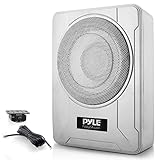
This is an active system: an 8-inch subwoofer in a compact low-profile enclosure with a 600-watt peak amplifier already built in. It exists for one installation scenario, and it solves it completely — a boat where you want bass but have nowhere to mount a separate amplifier and no appetite for building an enclosure. It suits pontoon owners, small cruiser owners, and anyone who wants a closed-locker install with a minimum of fabrication.
Key specs at a glance
- Configuration: active (amplified) enclosed subwoofer system
- Driver size: 8 inches
- Rated power: 600W peak, amplifier integrated
- Form factor: low-profile cabinet, sized for under-seat or locker installation
- Inputs: line-level and speaker-level inputs typical of this product class
Why it works
The integrated amplifier is the whole point. In a normal subwoofer install you need three things: a driver, an enclosure, and an amplifier. Each one has its own mounting problem. The amplifier needs airflow and a dry location. The enclosure needs volume and rigidity. The driver needs a sealed baffle. An active system collapses all three into one object, which means one mounting location, one power run, and one signal run. On a boat, that reduction in complexity is worth real money and real weekends.
The low-profile cabinet is the second advantage. Because it is designed to slide under a seat or into a locker, it can go in places that would never accept a conventional subwoofer box. The 8-inch driver is the right size for that cabinet — a 10-inch or 12-inch active system in the same footprint would need a much deeper cabinet, which defeats the purpose.
The 600W peak rating should be read as a peak figure, not a continuous one. Active marine subwoofer systems in this class typically produce a fraction of that as sustained output, which is fine — the design intent is to add bass fill to a system built around 6.5-inch coaxial speakers, not to win a sound competition. Set your expectations accordingly and you will be pleased. Expect it to fill out the bottom end of a pontoon or a small cruiser at moderate volume, not to rattle the dock.
Installation notes that matter: mount it where it cannot get wet from spray or rain, because the cabinet joints and amplifier heatsink are the weak points of any active system. Give the amplifier end some airflow — an enclosed locker with no ventilation will cause thermal shutdown on long, loud runs. Run a properly fused power cable directly from the battery or a distribution block, not from an existing accessory circuit, and ground it to a clean hull or engine-block point rather than a random screw.
Pros
- One-box install — no separate amplifier, no enclosure fabrication
- Low-profile cabinet fits under seats and into lockers
- Compact 8-inch driver is appropriate for the cabinet volume
- Dramatically shorter installation time than a component system
Cons
- Peak rating overstates real sustained output
- Integrated amplifier is not upgradeable or replaceable independently
- Enclosed cabinet limits placement options and airflow
- Less output than a properly powered passive 10-inch
Compared with the Lanzar 8″ Marine Subwoofer System
Both are slim amplified 8-inch systems with remote level control capability, so the comparison is about execution. The Pyle system is the more established name in the low-profile amplified category and has a longer track record in marine use. The Lanzar system carries a higher peak rating and a remote control. If remote level adjustment from the helm matters to you, the Lanzar has the edge. If you want the more conservative, better-documented option, take the Pyle.
6. KICKER 51MWF104 – Best for Free-Air Mounting Without an Enclosure

The KICKER 51MWF104 is the best overall pick in this roundup because it removes the hardest part of boat bass: the enclosure. It is a 10-inch, 4-ohm marine subwoofer explicitly rated for free-air (infinite-baffle) applications, which means it is designed to work with no box at all. It suits runabout, bowrider, and center console owners who have a solid panel — a seat base, a console side, a bulkhead — and no interest in losing a storage compartment to a subwoofer box.
Key specs at a glance
- Driver size: 10 inches
- Impedance: 4 ohm, single voice coil
- Mounting: free-air / infinite-baffle rated
- Series: KICKER MWF marine free-air line
- Power class: match to a marine amplifier in the 200W–400W RMS class at 4 ohm
Why it works
Free-air mounting is the single biggest space saver available in boat audio. In a conventional install, the subwoofer needs a sealed box of 0.6 to 1.0 cubic feet for a 10-inch driver, and that box has to go somewhere — usually a storage locker that you then cannot use. With a free-air driver, you cut a hole in a rigid panel, mount the driver to the panel, and seal the driver’s frame to the panel with a gasket so that the front wave and the back wave never meet. The cavity behind the panel becomes the “enclosure,” and the boat’s structure does the work.
The catch is that free-air is only as good as the panel. The baffle must be rigid — 3/4-inch marine plywood, a fiberglassed bulkhead, or a factory seat base with structure behind it. A flimsy panel will flex under the driver’s motion, and flexing baffles destroy bass output and eventually crack. If the panel you want to use is thin, laminate a second layer to it or add a plywood doubler ring around the cutout, bolted or glassed in place.
The cavity behind the panel must also be reasonably sealed from the front of the driver. If you mount a free-air subwoofer in a panel that has a huge open gap into the same airspace as the front of the cone, you create an acoustic short circuit and the driver will produce almost no bass. In practice this means sealing gaps with closed-cell foam, silicone, or expanding marine sealant. It is not hard, but it is the step people skip, and skipping it is the number one reason free-air installs disappoint.
KICKER’s marine line has a long history in boats, and the MWF series is built specifically for this application rather than adapted from a car driver. The 4-ohm single voice coil keeps amplifier selection simple: any stable 4-ohm marine Class D amplifier in the 200W–400W RMS class will drive it well. Wire it with tinned marine-grade copper, seal the terminals with dielectric grease, and use stainless mounting hardware — a subwoofer mounted in a seat base sees spray, humidity, and temperature swings that a car door never does.
Pros
- Free-air rated — no enclosure volume required
- 10-inch cone area with a straightforward 4-ohm load
- Preserves storage lockers and cockpit space
- Purpose-built marine free-air series from an established brand
Cons
- Demands a rigid, well-sealed baffle — a weak panel ruins performance
- Premium tier pricing
- Not suitable for installations where no solid panel exists
- Free-air designs generally trade some deep-bass extension for efficiency
Compared with the Polk Audio DB1242 SVC
Both can be used in space-conscious installs, but they work differently. The Polk DB1242 is a 12-inch shallow-mount driver that still wants an enclosure — it just wants a thin one. The KICKER 51MWF104 wants no enclosure at all. If you have a panel but no box, the KICKER is the answer. If you have a shallow box but no suitable panel, the Polk shallow 12 is the answer. Neither one substitutes for the other.
7. Lanzar 8″ Marine Subwoofer System – Best for One-Box Installs With Remote Level Control

The Lanzar 8-inch marine subwoofer system is a slim amplified woofer rated at 1000 watts peak with an RCA low-level input and a remote control. It suits boaters who want to add bass by running a single power cable and a single signal cable and calling it done, and who specifically want to adjust bass level from the helm without leaving the seat.
Key specs at a glance
- Configuration: slim amplified (active) marine subwoofer system
- Driver size: 8 inches
- Rated power: 1000W peak, amplifier integrated
- Inputs: RCA low-level input
- Controls: remote control included for level adjustment
- Environment: marketed as waterproof
Why it works
The remote control is the feature that distinguishes this system from other amplified subs. On a boat, bass balance changes constantly with conditions. At idle in a quiet cove, you want less bass. At 30 mph with the wind and the engine, you want more. Without a remote level control, you are either leaving the helm to reach the amplifier’s gain knob or living with whatever setting you chose at the dock. A dash- or helm-mounted remote lets you trim the bass in real time, which is a bigger usability upgrade than an extra 100 watts of peak rating.
The RCA low-level input is the second practical advantage. If your head unit has subwoofer preamp outputs — and most modern marine head units do — you run a single shielded RCA cable from the deck to the subwoofer’s input and you have a clean, low-noise signal path. Speaker-level inputs work too, but they pick up more noise and require more care with grounding. Use the RCA input if you have it.
The slim form factor and 8-inch driver mean this system fits under seats and inside lockers where a conventional box would not. As with any active system, understand that the peak rating is a peak rating. A 1000W peak figure does not mean the system produces 1000 watts continuously; it means the amplifier’s instantaneous capability is rated at that level. The practical output is enough to fill out the low end of a system built around 6.5-inch speakers in a small-to-midsize boat, which is exactly what this product is for.
Installation cautions worth repeating: run a fused power cable of adequate gauge directly to a battery or distribution block, keep the signal cable away from the power cable to avoid induced noise, and give the amplifier end of the cabinet airflow. The amplifier in an active system is the component most likely to fail first, and heat is the usual cause.
Pros
- Remote level control lets you trim bass from the helm
- RCA low-level input provides a clean signal path
- Slim, self-contained cabinet installs quickly
- 8-inch driver is appropriate for small and midsize cockpits
Cons
- Peak power rating overstates real sustained output
- Integrated amplifier cannot be upgraded separately
- Less output than a passive 10-inch on a dedicated amplifier
- Waterproofing claims depend on installation location and cabinet sealing
Compared with the Pyle 10-Inch Low-Profile Amplified System
The Pyle system offers a 10-inch driver and a 900W peak rating; the Lanzar offers an 8-inch driver, a 1000W peak rating, and a remote control. If you have the space for the larger cabinet, the 10-inch driver will move more air and produce more bass, and that is the more important difference. If your space is tight and you want helm-adjustable bass, the Lanzar is the better fit.
8. Pyle PLMRW8 – Best for the Lowest-Cost Waterproof 8-Inch
The Pyle PLMRW8 is the cheapest way onto this list. It is an 8-inch white waterproof outdoor marine subwoofer rated at 400 watts peak, and it exists for one purpose: getting some bass into a boat for as little money as possible. It suits jon boat owners, first-time installers, and anyone replacing a factory 8-inch cutout without wanting to modify the opening.
Key specs at a glance
- Driver size: 8 inches
- Rated power: 400W peak — a roughly 150W–200W RMS class driver
- Impedance: 4 ohm
- Finish: white cone and frame, single driver
- Environment: marketed as waterproof for marine and outdoor use
Why it works
The value proposition is simple: an 8-inch marine subwoofer, a matching cutout diameter for many factory openings, and a price that leaves budget for an amplifier. For a small boat with a modest head unit and a pair of 6.5-inch speakers, adding this driver on 150W RMS is a genuine transformation. It will not produce window-rattling bass, but it will produce the low-frequency foundation that small coaxial speakers physically cannot.
Because the peak rating is 400W, the RMS figure is likely in the 150W–200W range. Match it with a small marine Class D amplifier in that class, set the gain properly, and it will last. Overdrive it with a 400W RMS amplifier and it will not. This is the single most common mistake with budget marine subwoofers, and it is entirely avoidable with a five-minute gain-setting process: turn the head unit to about three-quarters volume on a familiar track, then raise the amplifier gain until you just hear distortion, then back it off slightly.
Enclosure requirements are modest. An 8-inch marine sub in this class typically wants roughly 0.3 to 0.5 cubic feet sealed, which you can build from marine plywood sealed with epoxy, or find as a cavity inside a console. Seal the driver’s frame to the baffle with a gasket, seal all box joints, and make sure the box is bolted down — a loose subwoofer box in a boat is both a sound problem and a safety problem.
Set expectations on durability. At the budget tier, expect the surround and the spider to be the first things to age, followed by the terminals if they are not protected. Smear dielectric grease on the terminals at installation, keep the driver out of direct standing water, and it will give you several seasons of service. Leave it where spray pools and it will not.
Pros
- Lowest cost entry to marine bass on this list
- 8-inch size fits small enclosures and existing cutouts
- White finish matches white gelcoat
- 4-ohm load works with inexpensive Class D amplifiers
Cons
- Peak rating with no stated RMS figure
- Modest output — this is bass fill, not bass dominance
- Requires an enclosure and careful gain setting
- Budget materials age faster in salt and sun
Compared with the Polk Audio MM1 8″ DVC
Both are 8-inch marine subwoofers, and the gap between them is wide. The Polk has a dual voice coil, a 900W peak rating, and a marine-audio pedigree; the Pyle has a single 4-ohm coil, a 400W peak rating, and a budget price. If your budget is genuinely fixed and you need an 8-inch driver, the Pyle is a legitimate choice. If you can stretch, the Polk will outperform it in every measurable way and hold up longer.
9. Polk Audio DB1242 SVC – Best for Maximum Cone Area on a Budget
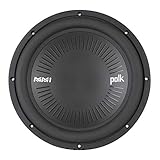
The Polk Audio DB1242 SVC is a 12-inch shallow subwoofer from Polk’s DB+ series, rated for both marine and car use. It is the budget route to 12-inch cone area, and it suits boaters with a large enough panel or enclosure to house a 12-inch driver but not enough cash for a premium 12. It also suits anyone building a dual-purpose system who wants one driver that can move between a truck and a boat.
Key specs at a glance
- Driver size: 12 inches
- Voice coil: single voice coil
- Mount type: shallow-mount
- Application: rated for marine and car use
- Series: Polk Audio DB+ series
Why it works
Twelve inches of cone area is the headline, and the physics are straightforward. A 12-inch driver has roughly 2.25 times the cone area of an 8-inch driver and roughly 44 percent more than a 10-inch. More area means more air moved for the same excursion, which means more output at low frequencies without working the driver as hard. If your goal is maximum bass per dollar and you have the space, a 12-inch budget driver usually beats a 10-inch mid-range driver on sheer output.
The shallow-mount design is what makes it viable on a boat. A conventional 12-inch subwoofer is a deep object, often 6 inches or more from the mounting flange to the back of the magnet, and that depth simply does not exist behind most gunwales and console panels. A shallow 12 cuts that depth substantially, which opens up mounting locations that would otherwise be closed to a driver this size. Measure the actual depth of the unit against the actual depth of your location, including clearance for the magnet and any vent, before you cut.
The marine-and-car dual rating is worth understanding rather than taking at face value. It means the driver is built with materials that tolerate moisture and UV better than a pure car-audio driver — typically a treated cone, a rubber surround rather than foam, and corrosion-resistant hardware. It does not mean the driver is submersible. Mount it where it gets airflow and occasional spray, not where it sits in standing water.
Power it with an amplifier sized to Polk’s published RMS figure for the specific revision you receive, which is the number that matters and which sellers sometimes omit in favor of a peak figure. If you cannot find an RMS rating, treat a single-coil 12 in this class as needing roughly 250W–400W RMS and set the gain conservatively. In a sealed enclosure, plan on roughly 1.0 to 1.5 cubic feet for a 12-inch driver of this type; if you are building a box, build it from 3/4-inch material, brace the largest panels, and seal every joint.
Pros
- 12-inch cone area at a budget price
- Shallow-mount frame opens up installation locations
- Rated for both marine and car use, so it moves between vehicles
- Polk Audio’s DB+ series is a long-established product line
Cons
- Still requires an enclosure — shallow is not free-air
- Single voice coil offers no impedance wiring flexibility
- Larger cone needs a larger box, which may not exist on a small boat
- Budget-tier pricing means budget-tier materials
Compared with the KICKER KMF124
Both are 12-inch drivers, and the comparison is essentially price versus purpose. The Polk DB1242 is a budget shallow-mount driver rated for dual marine and car use, which makes it a versatile, economical choice. The KICKER KMF124 is a purpose-built marine 12 with a 4-ohm coil and an illuminated grille, which makes it the better marine-specific installation but at a premium price. If the boat is the primary system, the KICKER is the stronger long-term buy. If the driver will migrate between a truck and a boat, the Polk makes more sense.
10. Pyle 10-Inch Low-Profile Amplified Subwoofer System – Best for Under-Seat and Console-Cavity Bass

This is the 10-inch version of Pyle’s low-profile amplified system, rated at 900 watts peak with the amplifier built into the cabinet. It suits boaters who want more cone area than an 8