Key takeaways
- Mummy: The narrow footbox and contoured hood reduce empty air space, improving warmth and weight efficiency. Choose it if you sleep on your back or side and prioritize backpacking performance.
- Semi-rectangular: This provides more shoulder and knee room while retaining a reasonably efficient footbox. It is a strong compromise for side sleepers who dislike restrictive mummy bags.
- Rectangular: The broad cut feels familiar and allows substantial movement. It suits warm-weather camping, cabins, and car camping, but the extra internal air takes more energy to warm and increases packed size.
- Quilt: A quilt removes insulation from the underside and attaches to the sleeping pad. It can be lighter and roomier, but requires correct attachment and careful draft management.
The best sleeping bags are the ones whose temperature rating, insulation, shape, and packed size match your coldest expected night—not simply the bag with the lowest advertised temperature.
For most campers, a versatile three-season synthetic bag rated around 20°F (-7°C) to 30°F (-1°C) offers the best balance of warmth, durability, and price. Choose a down bag when low weight and small packed size matter, a synthetic bag for damp conditions or a tighter budget, and a rectangular or semi-rectangular shape if you value room to move more than minimum weight.
Our top picks

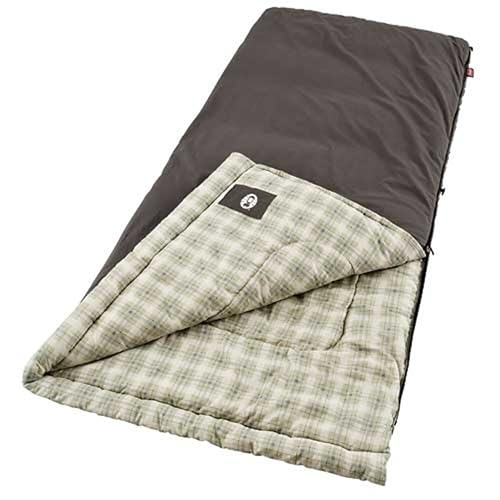
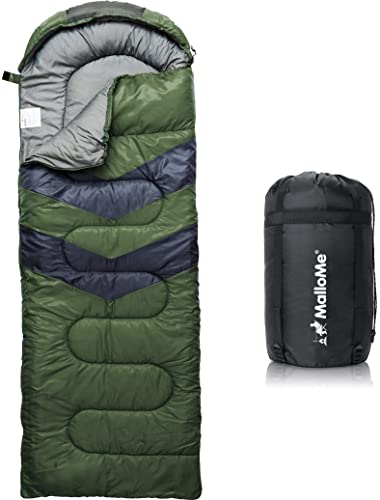

As an Amazon Associate we earn from qualifying purchases at no extra cost to you. Ratings are shown as listed on Amazon.
Quick picks by camping situation
| Camping situation | Best choice | Useful target specifications | Typical price range |
|---|---|---|---|
| Summer car camping | Rectangular synthetic bag | 40–55°F (4–13°C), 3–5 lb, full-length zipper | $40–$100 |
| Three-season backpacking | Mummy or semi-rectangular down bag | 20–30°F (-7 to -1°C), 1.5–2.8 lb, 650–850-fill down | $180–$450 |
| Wet climates and frequent use | Quality synthetic mummy bag | 20–35°F (-7 to 2°C), 2.5–4 lb, water-resistant shell | $100–$280 |
| Winter camping | Cold-rated down mummy bag | 0°F (-18°C) or lower, 2.5–4.5 lb, draft collar and hood | $350–$900+ |
| Minimal pack space | High-fill-power down bag | 20–30°F (-7 to -1°C), 1.5–2.3 lb, 5–9 liter packed volume | $250–$600 |
Temperature ratings: choose for the night, not the label
Sleeping-bag ratings are most useful when compared with an established testing standard, such as ISO 23537. A bag marked with a comfort rating near 32°F (0°C) is intended to feel comfortable to a typical cold sleeper around that temperature, while its lower limit may indicate a warmer sleeper can use it at a colder temperature. The exact experience depends on clothing, the sleeping pad, tent conditions, humidity, wind, and individual metabolism.
For general buying, use the comfort rating rather than the extreme or survival rating. Add a safety margin of roughly 10°F (6°C) if you sleep cold, camp at high elevation, or expect exposed campsites. For example, if nighttime lows may reach 35°F (2°C), a bag with a comfort rating around 25°F (-4°C) gives more useful margin than a bag rated exactly to 35°F.
Do not overlook the sleeping pad. A warm bag on a thin, poorly insulated pad can feel cold because compressed insulation under your body contributes little warmth. A three-season pad with an R-value around 3.5 to 5 is a sensible pairing for many spring-through-fall trips; colder conditions generally require more insulation.
Down versus synthetic insulation
Down
Down provides the best warmth-to-weight ratio and compresses exceptionally well. A 20°F down bag may weigh close to 2 pounds and fit into a small stuff sack, making it attractive for backpacking, bike touring, and limited storage.
Its disadvantages are higher cost and reduced performance when thoroughly wet. Modern water-resistant treatments and tightly woven shell fabrics improve moisture tolerance, but they do not make down waterproof. Down also needs careful drying and should be stored uncompressed.
Synthetic
Synthetic insulation is usually less expensive, dries faster, and continues to provide some insulation after absorbing moisture. It is a practical choice for humid regions, shoulder-season trips, children, scout groups, and campers who expect rough handling.
The tradeoff is bulk and weight. Synthetic fill gradually loses loft through repeated compression, so a frequently used bag may become less warm before the fabric looks worn. For car camping, that penalty is often worth accepting.
| Feature | Down | Synthetic |
|---|---|---|
| Typical weight for 20°F bag | 1.5–2.5 lb | 2.5–4.5 lb |
| Typical packed volume | 5–10 liters | 10–20 liters |
| Moisture tolerance | Lower when soaked | Higher |
| Typical lifespan before noticeable loft loss | Often 8–15 years with careful care | Often 5–10 years with frequent use |
| Best reason to buy | Low weight and small pack size | Lower price and easier wet-weather ownership |
Shape and sleeping position
- Mummy: The narrow footbox and contoured hood reduce empty air space, improving warmth and weight efficiency. Choose it if you sleep on your back or side and prioritize backpacking performance.
- Semi-rectangular: This provides more shoulder and knee room while retaining a reasonably efficient footbox. It is a strong compromise for side sleepers who dislike restrictive mummy bags.
- Rectangular: The broad cut feels familiar and allows substantial movement. It suits warm-weather camping, cabins, and car camping, but the extra internal air takes more energy to warm and increases packed size.
- Quilt: A quilt removes insulation from the underside and attaches to the sleeping pad. It can be lighter and roomier, but requires correct attachment and careful draft management.
Side sleepers should check shoulder, hip, and knee measurements rather than relying only on a “regular” or “wide” label. A useful fit test is to lie in your normal position and bend your knees. You should be able to move without pulling the zipper open or compressing the insulation, but the bag should not leave a large cold cavity around your torso.
Zippers, hoods, and details that matter at night
A full-length zipper is the most versatile choice for summer and car camping because it allows ventilation and can open the bag like a blanket. A half-length zipper saves weight but makes entry and temperature control less convenient. Two-way zippers are useful when you want to vent the feet while retaining warmth around your upper body.
Look for a zipper with a draft tube behind it, an anti-snag guard, and a substantial pull that can be found in darkness. Left- and right-hand versions may zip together, but compatibility depends on the manufacturer and zipper design, so verify before buying two bags for shared use.
A hood, insulated collar, and draft tube become increasingly valuable below freezing. For warm-weather bags, a hood can feel unnecessarily restrictive; a contoured top edge or pillow sleeve may be more comfortable. A footbox with enough room to flex your ankles is especially helpful for side sleepers.
A practical decision matrix
| Your priority | Recommended design | What to compromise |
|---|---|---|
| Lowest upfront cost | Synthetic rectangular or mummy bag | Weight and packed volume |
| One bag for most three-season trips | 20–30°F synthetic or midrange down mummy | May be too warm for midsummer |
| Smallest backpack | 650-fill or higher down mummy | Purchase price and moisture care |
| Cold sleeper | Lower comfort rating, hood, collar, warm pad | More weight and cost |
| Restless or side sleeper | Wide mummy, semi-rectangular bag, or quilt | Some thermal efficiency |
| Wet or coastal conditions | Synthetic with a water-resistant shell | Packability |
Worked cost calculation: when expensive is cheaper
Suppose a $90 synthetic bag lasts 60 nights of regular use, while a $300 down bag lasts 150 nights with careful storage and cleaning. The approximate purchase cost is $1.50 per night for the synthetic bag versus $2.00 per night for the down bag. If the down bag saves 1.5 pounds on each backpacking trip and you use it frequently, the higher purchase price may be worthwhile for carrying comfort and pack space. If you camp only twice a year, the cheaper synthetic option may remain the better financial decision for many years.
Ownership, cleaning, and common mistakes
The first parts to wear are often the zipper slider, footbox fabric, hood drawcord, and elastic around the opening. A sleeping-bag liner can reduce body oils reaching the insulation, but it adds weight and does not replace normal cleaning.
- Air the bag fully after every trip before storing it.
- Store it loose in a large breathable storage sack, never compressed for months.
- Use a sleeping pad that matches the bag’s temperature rating.
- Keep clothing dry and avoid going to bed in damp outer layers.
- Wash according to the manufacturer’s instructions with a suitable technical cleaner; avoid ordinary fabric softener.
- Dry completely, pausing to break up clumps in down or synthetic fill.
- Repair small shell tears promptly so insulation cannot escape.
For a first purchase, a 20–30°F (-7 to -1°C) synthetic mummy or semi-rectangular bag is the safest value for varied three-season camping. Move to a down mummy when every pound and liter matters, choose a rectangular synthetic model for relaxed warm-weather trips, and buy a dedicated winter bag only after confirming the actual overnight conditions and the insulation rating of your sleeping pad.