Key takeaways
- 16GB RAM: Acceptable for a lower-cost 1080p system, but it leaves less headroom for browsers, launchers, mods, and background applications.
- 32GB RAM: The practical target for a new mid-range or high-end gaming PC. It is particularly useful for large open-world games, mods, streaming, and multitasking.
- 64GB RAM: Worth considering for heavy mod packs, video production, virtual machines, or a five-year ownership plan—not necessary for ordinary gaming.
- 1TB SSD: The minimum sensible capacity for most buyers. After Windows and applications, the usable space is lower, and several large games can consume the remainder quickly.
- 2TB SSD: The better long-term choice. It reduces the need to uninstall games and is often cheaper than replacing a small drive later.
The best gaming PCs with RTX in 2026 are usually a Ryzen 5 or Core Ultra 5 system with an RTX 5060 for 1080p value, an RTX 5070 system for high-refresh 1440p, or an RTX 5080 system for demanding 4K gaming; the RTX 5090 is a specialist choice for maximum settings and a very high budget.
Our top picks


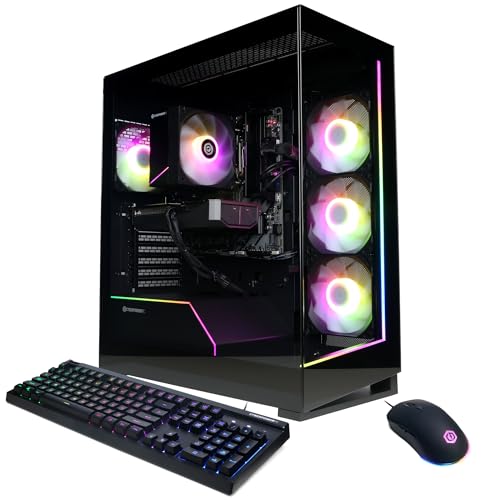
As an Amazon Associate we earn from qualifying purchases at no extra cost to you. Ratings are shown as listed on Amazon.
Quick picks by budget and situation
| Situation | Recommended configuration | Typical market range | Best use |
|---|---|---|---|
| Entry-level 1080p | RTX 5060, Ryzen 5 7600 or Core Ultra 5, 16GB RAM, 1TB SSD | $900–$1,200 | Esports and modern games at high settings |
| Balanced 1440p | RTX 5070, Ryzen 7 7800X3D or Ryzen 7 9700X, 32GB RAM, 1TB–2TB SSD | $1,400–$1,900 | High-refresh 1440p with ray tracing |
| High-end 1440p and 4K | RTX 5070 Ti, Ryzen 7 9800X3D or Core Ultra 7, 32GB RAM, 2TB SSD | $1,800–$2,400 | High settings, streaming, and long ownership |
| Enthusiast 4K | RTX 5080, Ryzen 7 9800X3D or Ryzen 9, 32GB–64GB RAM, 2TB SSD | $2,500–$3,500 | 4K ray tracing and high-refresh monitors |
| Maximum performance | RTX 5090, Ryzen 7 9800X3D or Ryzen 9 9950X3D, 64GB RAM, 2TB–4TB SSD | $4,000 and above | 4K enthusiast gaming and creator workloads |
Which RTX graphics card should you choose?
The graphics card matters more than the processor for most gaming-PC decisions. Nvidia’s RTX 5060 is aimed at 1080p, while the RTX 5060 Ti is a more comfortable option for demanding games and higher texture settings. Choose the 16GB version of the RTX 5060 Ti when the price difference is reasonable: the extra video memory can reduce texture compromises in newer games.
The RTX 5070 is the strongest general-purpose choice for many buyers. It has enough performance for 1440p ultra settings and supports Nvidia features such as DLSS frame generation and ray reconstruction. It is also a better match for a 1440p 165Hz monitor than an RTX 5060, although the highest frame rates will still depend on the game and settings.
The RTX 5070 Ti moves closer to high-end performance and is a sensible choice when you want to keep the PC for four or five years. The RTX 5080 is more appropriate for 4K, particularly when ray tracing is important. The RTX 5090 offers the highest performance but also requires a substantial power supply, a large case, and a budget that may be better spent on a faster monitor, larger SSD, or future upgrade.
Do not buy on GPU name alone
Compare the amount of video memory, the power-supply specification, and the physical dimensions. A compact RTX card may fit a small tower, while a large triple-fan model can occupy three or more expansion slots. Also check whether the prebuilt includes the full-performance version of the card rather than a lower-power design intended for a small chassis.
Processor balance: avoid paying for unused CPU performance
A Ryzen 5 7600, Ryzen 5 9600X, or Intel Core Ultra 5 processor is generally sufficient for an RTX 5060-class PC. These CPUs can deliver strong gaming performance without diverting too much of the budget from the graphics card. A Ryzen 7 7800X3D or Ryzen 7 9800X3D makes more sense with an RTX 5070 Ti or faster card, especially for competitive games at 200Hz or above.
For a mixed gaming and productivity system, the Ryzen 9 9900X, Ryzen 9 9950X3D, or a suitable Core Ultra 7 or Core Ultra 9 processor provides more multicore capacity. However, extra cores do not automatically increase game performance. A system with an RTX 5080 and an unnecessarily expensive workstation processor may perform worse in games than a cheaper configuration with a strong gaming-focused CPU and a larger graphics-card budget.
RAM and SSD capacity in 2026
- 16GB RAM: Acceptable for a lower-cost 1080p system, but it leaves less headroom for browsers, launchers, mods, and background applications.
- 32GB RAM: The practical target for a new mid-range or high-end gaming PC. It is particularly useful for large open-world games, mods, streaming, and multitasking.
- 64GB RAM: Worth considering for heavy mod packs, video production, virtual machines, or a five-year ownership plan—not necessary for ordinary gaming.
- 1TB SSD: The minimum sensible capacity for most buyers. After Windows and applications, the usable space is lower, and several large games can consume the remainder quickly.
- 2TB SSD: The better long-term choice. It reduces the need to uninstall games and is often cheaper than replacing a small drive later.
Prefer a PCIe 4.0 NVMe SSD from a recognizable manufacturer and check that the system has a second M.2 slot. PCIe 5.0 storage can be very fast in benchmarks, but it usually adds little to game loading compared with a good PCIe 4.0 drive.
Cooling, noise, and the case matter more than listings suggest
Look for a tower with a mesh front or other clear intake path, at least two intake fans, and one rear exhaust fan. An RTX 5070-class PC should ideally have three or more case fans, while an RTX 5080 or RTX 5090 system benefits from a spacious case with unobstructed airflow. A basic tower cooler is fine for a Ryzen 5; higher-power CPUs should use a substantial tower cooler or a quality 240mm liquid cooler.
Liquid cooling is not automatically better. It can lower temperatures under sustained workloads, but its pump is another component that can eventually fail. A large air cooler is often easier to maintain and replace. Whichever design you choose, avoid a sealed front panel, a case with no room for the graphics card, or a power supply mounted directly beside a hot intake area.
Upgrade paths to check before buying
AMD’s AM5 platform, used by processors such as the Ryzen 5 7600 and Ryzen 7 9800X3D, offers a relatively useful upgrade path because the same motherboard family supports multiple CPU generations. Confirm the exact BIOS support rather than assuming every board is ready for every chip.
For any prebuilt, check four details:
- The motherboard has two or four RAM slots, with at least one available slot if you plan to expand.
- The power supply has enough capacity and the correct native graphics-card connectors. Aim for roughly 650W for an RTX 5070 system, 850W for many RTX 5080 systems, and follow the card manufacturer’s recommendation for an RTX 5090.
- There is a second M.2 slot or a straightforward 2.5-inch drive mount.
- The case accepts a longer, thicker replacement graphics card and has removable dust filters.
Proprietary systems can be neat and quiet, but some use custom motherboards, power connectors, or cases that make upgrades difficult. Standard ATX or microATX components are usually preferable if you expect to replace the GPU or add storage.
Prebuilt families worth comparing
Lenovo Legion Tower systems, HP OMEN desktops, Alienware Aurora models, NZXT Player PCs, and CyberPowerPC configurations are real product families to compare, but the internal specification can change substantially between configurations. Treat the model name as a starting point, not a guarantee. Two computers with the same RTX card may differ in RAM speed, power supply quality, cooling, motherboard features, and SSD capacity.
For value, compare the complete configuration rather than the advertised GPU. A slightly more expensive PC with 32GB RAM, a 2TB SSD, a standard 850W power supply, and a ventilated case can be cheaper to own than a nominally lower-priced system that needs immediate upgrades.
Worked value calculation: when the upgrade pays off
Suppose a $1,050 RTX 5060 PC lasts four years and is used for 10 hours each week. That is approximately 2,080 hours, or about $0.50 per gaming hour before electricity and peripherals. A $1,650 RTX 5070 system used for five years at the same rate represents about 2,600 hours, or roughly $0.63 per hour. The more expensive PC is not automatically better value, but its extra performance and 32GB of RAM may delay a replacement and make the difference reasonable for a frequent player.
For occasional gaming, the cheaper RTX 5060 configuration is easier to justify. For daily gaming on a 1440p monitor, spending more on the RTX 5070 is usually more useful than spending the same amount on an unnecessarily powerful CPU.
Ownership realities: what wears out first
Dust buildup is the most common avoidable problem. Every two or three months, shut down the PC, unplug it, hold the fans still, and use short bursts of compressed air through the filters and heatsinks. Do not spin fans at extreme speed with an air jet, and do not open the power supply.
Fans can become noisy before other components fail, while SSDs eventually lose available endurance through heavy writes. Keep at least 15% of the SSD free, maintain backups of important files, and monitor temperatures rather than relying on a sudden performance problem. If a new PC regularly thermal-throttles, crashes under load, or has a rattling pump, use the warranty before replacing parts yourself.
Final buying recommendation
For most people, the best gaming PCs with RTX are built around an RTX 5070, a Ryzen 7 7800X3D or comparable current CPU, 32GB of RAM, and a 2TB NVMe SSD. Choose an RTX 5060 system when the budget is closer to $1,000 and 1080p is sufficient; choose an RTX 5070 Ti or RTX 5080 when you have a 1440p high-refresh or 4K display. Prioritize graphics performance, airflow, standard upgradeable parts, and adequate storage before paying extra for decorative features or a premium processor that your games will not fully use.