Key takeaways
- Check that the plate and clamp are rated for the combined weight of your camera, lens and accessories.
- Test a new plate in the clamp with the camera held over a soft surface before trusting it on a tripod.
- Re-tighten the plate screw and the clamp periodically, since vibration and use can loosen them.
- Do not over-tighten beyond the maker’s guidance, which can damage threads or the camera body.
- Keep dovetails and jaws clean and dry; sand, grit and salt can wear the surfaces.
- Check that the plate does not block the battery door, memory card door, ports or the tripod socket you need.
- Use a lens collar or lens foot with big lenses instead of letting the camera carry the weight.
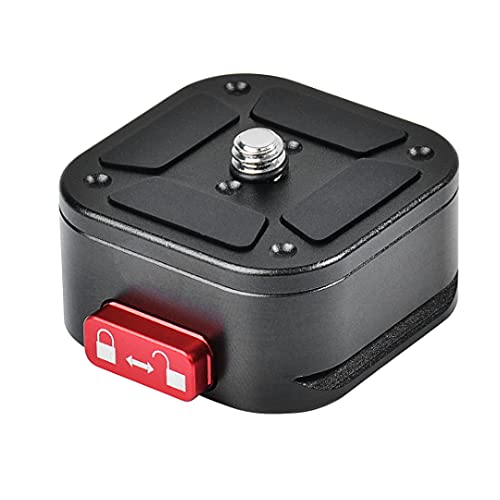
For most photographers, Peak Design’s Capture-style and Standard plates suit people who want fast, tool-free handling and a plate that also works as a camera strap anchor, Really Right Stuff and Kirk suit those who want camera-specific, precisely fitted plates and clamps, and Benro, SmallRig and Sunwayfoto suit buyers who want a broad range of Arca-compatible plates and clamps at a lower tier. Arca-Swiss is a dovetail style rather than a single brand, so what matters is how well a plate and a clamp from different makers actually fit together.
Our top picks


As an Amazon Associate we earn from qualifying purchases at no extra cost to you.
At a glance: plates and clamps
| Maker | Best for | What the maker lists | Limits | Tier |
|---|---|---|---|---|
| Really Right Stuff | Camera-specific L-plates and clamps with precise fit | Machined aluminium plates and clamps, many camera-specific designs | Premium tier; ordering by camera model | Premium |
| Kirk Enterprises | Custom-fit plates, L-brackets and lens plates | Camera-specific brackets and plates in the Arca style | Limited choice outside the maker’s supported models | Premium |
| Peak Design | Quick swap between tripod, strap and clip systems | Plates and clamps that fit Arca-Swiss, with a design used across its own camera clip and strap line | Best when you adopt the whole system | Mid-range |
| Benro | Broad range of plates and tripod heads | Arca-compatible plates, clamps and heads with various sizes | Tolerances vary between product lines | Budget to mid-range |
| SmallRig | Video rigs, cages and accessories | Arca-compatible plates and clamps for camera cages and rigs | Designed around cages more than long lenses | Budget to mid-range |
| Sunwayfoto | Wide choice of L-brackets, plates and clamps | Many camera-specific plates and clamp sizes | Fit varies from model to model | Budget to mid-range |
What matters when choosing plates and clamps
Arca-Swiss compatible does not always mean identical
The Arca-Swiss dovetail has a standard shape, but makers manufacture to slightly different tolerances. A plate from one maker can be loose or tight in another maker’s clamp. Reviewers usually advise testing a new plate in your own clamp before relying on it with an expensive camera and lens. If the fit is loose, a clamp with adjustable jaws or a different plate may fix it.
Clamp style: screw knob, lever and quick-release
A screw-knob clamp is the most common and holds well because you tighten it by hand. A lever clamp is faster to operate, but it needs adjustment to match the plate width. Some clamps have a safety stop or pin that stops the plate sliding out. For a heavy lens, favour clamps that the maker describes as having a positive stop.
Plate shape: flat, L-bracket and lens foot
A flat plate mounts to the camera base. An L-bracket lets you switch from landscape to portrait without turning the head, and many photographers like it for landscape and architecture. A lens plate or replacement foot moves the load to the lens when you use a long telephoto, which improves balance. Choose the shape based on how you shoot.
Anti-twist features and fit to the camera
A plate that is too short can allow the camera to twist when you press the shutter. Camera-specific plates have a lip or a pin that stops rotation. Generic plates rely on a single screw, so make sure you tighten it and re-check it. If your camera has a battery grip or a flip-out screen, check the plate does not block the door or the ports.
Weight capacity and materials
Makers list a maximum load for plates and clamps. Use that as an upper limit and stay well below it for extra safety, especially with long lenses or video rigs. Aluminium is the common material, with some makers offering stainless steel or magnesium components on certain items. Follow the maker’s torque or tightening guidance.
Clamp width and compatibility
Clamps come in standard widths and some in a wider size for heavy-duty use. Make sure the clamp width matches the plate profile you intend to use, and that your tripod head accepts the clamp’s mounting thread.
Picks by user type
Premium: Really Right Stuff and Kirk
These makers specialise in camera-specific plates and L-brackets. Their designs are made to fit particular models, which reduces twist and keeps the camera aligned. Reviewers often praise the machining and the thoughtful cut-outs for ports and doors. The limits are cost and the need to buy for your exact camera. They suit serious landscape, wildlife and studio photographers who use the same body for years.
Mid-range: Peak Design
Peak Design’s plates and clamps are designed around speed, and the plate is intended to work with the maker’s clip and strap system. This is a good option if you want to move a camera between a tripod, a clip on a pack and a strap without changing plates. The trade-off is that the full benefit comes from adopting the system, and heavy lens setups may call for a more specialised plate.
Budget to mid-range: Benro, SmallRig and Sunwayfoto
These makers offer a wide range of Arca-compatible plates, clamps, L-brackets and cage accessories. They are useful when you need several plates for several bodies, or when you build a video rig. Tolerances vary, so test the fit and keep the clamp tightened. They suit hobbyists, travellers and anyone who wants many plates without paying the premium tier for each one.
Pick this if
| If you … | Pick | Why |
|---|---|---|
| want the most precise fit for one camera | Really Right Stuff or Kirk | Camera-specific designs |
| move between tripod, clip and strap | Peak Design | One plate across the system |
| shoot in portrait and landscape on a tripod | L-bracket | Switch orientation without tilting the head |
| use a long telephoto | Lens plate or replacement foot | Balances the load on the lens |
| need many plates on a budget | Benro or Sunwayfoto | Wide range at lower tiers |
| build a video rig | SmallRig | Cage and rig accessories |
Fit, care and safety notes
- Check that the plate and clamp are rated for the combined weight of your camera, lens and accessories.
- Test a new plate in the clamp with the camera held over a soft surface before trusting it on a tripod.
- Re-tighten the plate screw and the clamp periodically, since vibration and use can loosen them.
- Do not over-tighten beyond the maker’s guidance, which can damage threads or the camera body.
- Keep dovetails and jaws clean and dry; sand, grit and salt can wear the surfaces.
- Check that the plate does not block the battery door, memory card door, ports or the tripod socket you need.
- Use a lens collar or lens foot with big lenses instead of letting the camera carry the weight.
Alternatives
- Manfrotto and other proprietary plates: Some tripod heads use their own plate shape; they work well within their system.
- Quick-release straps and clips: If you carry the camera more than you tripod it, a clip system may matter more than plates.
- Rail systems: Video users often prefer rod and rail setups with compatible plates.
- Tripod heads with built-in Arca clamps: Many ball heads already include an Arca-compatible clamp, so you may only need plates.
Choosing for specific kit
Mirrorless cameras with small bodies
Small bodies often have little room under the base, so a slim plate or an L-bracket designed for the model avoids blocking ports and the battery door. Check whether the plate leaves the tripod socket and any flip-screen hinge accessible. Many small-camera owners prefer a short plate with an anti-twist lip.
DSLRs with grips and long lenses
Heavier bodies with grips usually call for a longer plate and a sturdy clamp. For telephoto lenses, mount the lens foot to the clamp and let the camera hang from the lens collar. This approach reduces stress on the camera mount and improves balance, and it applies to mirrorless cameras with big lenses too.
Video and cage set-ups
Video rigs add handles, monitors and microphones, which move the centre of gravity. A longer plate under the cage lets you slide the rig forward or back until it balances on the head. Check that every screw has a lock washer or thread locker when the maker advises it.
Travel and hiking
For travel, small plates and compact clamps save weight. Some travellers keep a plate fitted to the camera permanently and choose one that does not catch on a strap or bag. If you remove the plate to use the camera handheld, a slim design is more comfortable.
Frequently Asked Questions
Are all Arca-Swiss plates interchangeable?
Not always. The dovetail shape is shared, but makers use different tolerances, so a plate may be loose or tight in another maker’s clamp. Test the fit with your own gear before relying on it.
Do I need an L-bracket?
If you change between landscape and portrait often on a tripod, an L-bracket saves time and keeps the camera centred over the head. If you mostly shoot in one orientation, a flat plate is enough. L-brackets are made for specific cameras, so choose one for your model.
How do I stop my camera twisting on the plate?
Use a plate designed for your camera, with an anti-twist lip or pin, and tighten the screw fully. Make sure the plate is long enough to reach a stable position under the camera body. If the plate still turns, add a lens foot for heavier lenses.
Is a lever clamp better than a screw clamp?
Lever clamps are quicker to operate, but they need to be adjusted to the plate. Screw clamps are simple and widely used. Pick the one you find easier to operate reliably, and use a safety stop for heavy lenses.
How much weight can a plate and clamp hold?
Makers publish a maximum load for each product, which is the number to follow. Stay below it, and note that the tripod and head have their own limits too. For heavy telephoto lenses, mount the lens rather than the camera body.
Can I use Arca plates on a video rig?
Yes, many cages and rigs include Arca-compatible mounts. Check the screw sizes and the position of the plate so that the camera balances on the head. Makers such as SmallRig design plates and clamps for this use.
More from Amazon
Programs that pair well with the guide above. Offers and eligibility are set by Amazon and may change.
Read from a large library of eBooks and audiobooks on any device. Check Amazon for current plans.
Explore Kindle UnlimitedAudiobooks and podcasts to listen to on the go. Eligible new members can start with a free trial.
Try Audible freeFree shipping on eligible items, Prime Video and more. Eligible new members can start with a free trial.
Start a Prime free trialAd-free music streaming. Eligible new subscribers can start with a free trial.
Try Music Unlimited freeAs an Amazon Associate we earn from qualifying purchases.