Key takeaways
- Active area: 6.0 × 3.7 in (152 × 95 mm), roughly 22 square inches of drawing surface
- Pressure sensitivity: 4,096 levels, with a battery-free electromagnetic pen
- Pen: two programmable side buttons, no eraser end
- Shortcut controls: four ExpressKeys, each remappable per application
- Resolution and report rate: 2,540 lines per inch, 133 points per second
- Connection: USB-A cable only — no Bluetooth, no battery to charge
- Compatibility: Windows and macOS; the listing includes a software bundle
- Physical class: about 8 × 6 in footprint, roughly half a pound
The best pen tablet for photo editing overall is the Wacom Intuos Medium with Bluetooth. Its 8.5 × 5.3-inch active area gives you roughly 45 square inches of drawing surface — enough to retouch a 24-megapixel file without the cursor outrunning your hand — and its 4,096 pressure levels, four ExpressKeys and wireless option make it the most comfortable long-session tool in this roundup. It suits photographers who retouch several times a week on a desktop and who occasionally want to work untethered from a laptop.
If you want the most canvas per dollar, the HUION Inspiroy H950P matches that footprint class, doubles the pressure resolution to 8,192 levels, adds eight shortcut keys, and sits a price tier lower. If budget is the binding constraint, the XPPen StarG640 is the cheapest way to get pressure-sensitive editing at all. And if you already own a touchscreen tablet and only ever nudge sliders and tap layer masks, the Abiarst universal stylus costs less than a replacement set of pen nibs.
Top 3 Picks
Best overall: Wacom Intuos Medium, Bluetooth
It is the only tablet here that combines a genuinely comfortable active area with wireless freedom and a shortcut layout you can learn in an afternoon. The 8.5 × 5.3-inch surface maps cleanly onto a 27-inch 1440p display without the twitchiness that plagues smaller pads, and the rechargeable battery means one less cable fighting your keyboard for desk space. It is a premium-tier purchase, but it is the one most retouchers will still be using five years from now.
Best budget: XPPen StarG640
At six by four inches it is small, and it has no shortcut keys at all — but it delivers the one feature that actually separates a pen tablet from a mouse: 8,192 levels of pressure sensitivity in a battery-free pen. If you are moving from mouse-and-keyboard retouching and you want to find out whether a pen suits you before spending more, this is the least expensive honest answer.
Best value in the mid-range: HUION Inspiroy H950P
An 8 × 5-inch active area, eight programmable shortcut keys and 8,192 pressure levels for mid-range money is the strongest specification-per-price combination in this list. It is wired only, and the driver ecosystem is not as polished as Wacom’s, but for a photographer who wants a large canvas and hardware buttons without paying premium prices, it is the obvious alternative to the Intuos Medium.
Quick Comparison
Every tablet below is an opaque (non-display) pen tablet except the Abiarst stylus, which is a passive capacitive pen for screens you already own. Price tiers are relative bands, not fixed prices — listings change constantly, so treat “mid-range” as “roughly half of premium” rather than a number.
| Product | Best for | Active area | Pressure levels | Shortcut controls | Connection | Price tier |
|---|---|---|---|---|---|---|
| Wacom Intuos Small (wired) | First pen tablet on a shallow desk | 6.0 × 3.7 in (152 × 95 mm) | 4,096 | 4 ExpressKeys | USB-A only | Mid-range |
| HUION Inspiroy H950P | Most canvas and buttons per unit of spend | 8 × 5 in (203 × 127 mm) | 8,192 | 8 programmable keys | USB | Mid-range |
| Wacom Intuos Medium (Bluetooth) | Serious weekly retouching on a large display | 8.5 × 5.3 in (216 × 135 mm) | 4,096 | 4 ExpressKeys | USB + Bluetooth | Premium |
| Wacom Intuos Small (Bluetooth) | Laptop-first retouchers who travel | 6.0 × 3.7 in (152 × 95 mm) | 4,096 | 4 ExpressKeys | USB + Bluetooth | Premium |
| Abiarst Universal Stylus | Slider nudging on a touchscreen you already own | Not applicable (capacitive tip) | None | None | Passive, no pairing | Budget |
| XPPen StarG640 | Cheapest route to pressure-sensitive editing | 6 × 4 in (152 × 102 mm) | 8,192 | None | USB | Budget |
How We Chose
This roundup is built from published manufacturer specifications, category norms and the practical requirements of photo-editing workflows — not from bench tests or loaner units. We started by filtering for the five specifications that actually change how retouching feels: active area, pressure resolution, shortcut controls, connection type and physical footprint. A tablet with a huge canvas but no way to reach zoom without leaving the stylus is a different tool from one with a small canvas and four well-placed keys, so no single spec decided the list.
We then sorted candidates by situation rather than by rank. A first-time buyer on a 13-inch laptop and a working photographer with a calibrated 27-inch display need different things from the same category, and a list that crowns one winner for both is not useful. We kept price tiers as bands rather than figures because street prices move weekly and vary by region. We also required each pick to have a clear upgrade path — either within its own family or to a pen display — so that buying one does not trap you. Products that only make sense as a novelty, or that duplicate another pick’s role, were left out. Every item here is a real, currently listed product from a brand with an established driver and support history in the photo-editing market.
1. Wacom Intuos Small, Wired Graphic Drawing Tablet with Pen + Software – Best for First-Time Retouchers on a Small Desk
As an Amazon Associate we earn from qualifying purchases at no extra cost to you.

The wired Intuos Small is the tablet to buy when you are not yet sure whether pen-based retouching will stick. It is the smallest and least expensive way into Wacom’s ecosystem, and it asks almost nothing of your desk: about eight inches wide and six deep, roughly half a pound, and a single USB-A cable. It suits photographers editing on a 13- or 14-inch laptop, students learning dodging and burning, and anyone whose desk is already dominated by a keyboard, a monitor and a cup of coffee.
Key specifications
- Active area: 6.0 × 3.7 in (152 × 95 mm), roughly 22 square inches of drawing surface
- Pressure sensitivity: 4,096 levels, with a battery-free electromagnetic pen
- Pen: two programmable side buttons, no eraser end
- Shortcut controls: four ExpressKeys, each remappable per application
- Resolution and report rate: 2,540 lines per inch, 133 points per second
- Connection: USB-A cable only — no Bluetooth, no battery to charge
- Compatibility: Windows and macOS; the listing includes a software bundle
- Physical class: about 8 × 6 in footprint, roughly half a pound
What it does well
The strength here is not any single number — it is the combination of a well-tuned pen and a driver that behaves. The battery-free pen never needs charging and never asks you to remember where the charging cable went, and the 2,540 LPI resolution is far beyond what a 24-megapixel file can resolve at normal viewing distance. In a retouching session, that translates into smooth brush edges on skin, hair and fabric without the stair-stepping you get from a mouse.
The four ExpressKeys are more useful than the count suggests. Most retouchers map them to brush size down, brush size up, undo and a tool toggle — healing brush or dodge, depending on the stage of the edit. Because the driver supports per-application profiles, those four keys can mean something different in your raw converter than they do in your pixel editor, and you never have to relearn the layout.
The wired connection is genuinely a feature for some buyers. There is no pairing step, no battery degradation over the years, and no risk of a dropped Bluetooth session mid-stroke. For a tablet that lives permanently on a desk, the cable is simply one more thing to route behind the monitor.
The 6 × 3.7-inch canvas is the compromise. Mapping it to a 2560 × 1440 display works out to roughly 427 pixels of cursor travel per inch of hand travel horizontally, and about 389 vertically. That is a fast, responsive feel, and it is excellent for broad adjustments — gradient masks, graduated filters, global dodging. It becomes less pleasant when you need sub-pixel precision on a mask edge, because every small hand tremor is amplified by the same ratio.
Pros
- Smallest practical footprint of any tablet in this roundup; fits beside a full-size keyboard
- Battery-free pen means no charging discipline and no long-term battery decay
- Wired USB connection is immune to pairing dropouts and wireless latency
- Four ExpressKeys with per-application profiles are enough for the core retouching shortcuts
- Established driver support and a mature ecosystem of nibs and accessories
- Often the least expensive way to get a pressure-sensitive pen from a major brand
Cons
- The 6 × 3.7-inch active area feels cramped for masking on 4K displays
- No Bluetooth — you cannot step away from the desk with it
- 4,096 pressure levels rather than the 8,192 that competing budget tablets advertise
- Only four hardware keys, so tool switching still leans on the keyboard
- No eraser end on the pen, which some editors use constantly for mask cleanup
How it compares with the nearest alternative
The closest competitor is the XPPen StarG640, which costs less, offers 8,192 pressure levels and uses a similarly sized battery-free pen — but gives up hardware shortcut keys entirely and comes from a smaller support ecosystem. If you touch-type comfortably and your left hand already lives on the keyboard, the StarG640 is the better value. If you want buttons under your non-dominant hand and a driver you can set once and forget, the Intuos Small earns its mid-range tier. Buyers who want the same body without the cable should look at the Wacom Intuos Small with Bluetooth, which is identical in canvas size and pressure resolution but sits a tier higher on price.
2. HUION Inspiroy H950P 8×5 inch Drawing Tablet 8192 Pen Pressure – Best for the Most Canvas and Buttons per Dollar

The Inspiroy H950P is the tablet to buy when you have decided that pen retouching is part of your workflow and you want the largest working surface your budget allows. At 8 × 5 inches it offers roughly 40 square inches of active area — nearly double the smallest pick here — plus eight programmable shortcut keys, for a mid-range price. It suits photographers who retouch on a 27-inch or larger display, illustrators who also do photo work, and anyone who wants hardware buttons instead of keyboard shortcuts.
Key specifications
- Active area: 8 × 5 in (203 × 127 mm), roughly 40 square inches
- Pressure sensitivity: 8,192 levels — double the Wacom Intuos line
- Pen: battery-free, with tilt recognition for angled brush behaviour
- Shortcut controls: eight programmable keys in a vertical column
- Resolution and report rate: 5,080 lines per inch, 233 points per second
- Connection: USB, wired only
- Compatibility: Windows and macOS, with configurable per-application profiles
- Physical class: roughly one pound; the widest footprint in this roundup
What it does well
The active area is the headline. Mapping 8 × 5 inches onto a 2560 × 1440 display yields about 320 pixels of cursor travel per inch of hand travel horizontally and 288 vertically — roughly a third slower than a 6-inch-wide pad. That difference is exactly what you want for precision work: a healing-brush dab on a stray sensor spot, or a mask edge along a strand of hair, needs a slower cursor more than it needs a fast one. On a 4K display the gap widens further, and the H950P is the only mid-range option here that keeps cursor travel in a comfortable range at that resolution.
The eight shortcut keys are the second advantage. With four keys you map the essentials; with eight you can keep both brush-size keys, undo, zoom in, zoom out, hand tool, layer mask and a tool toggle all under your left hand, and rarely touch the keyboard at all. For long retouching sessions that matters more than it sounds — every trip to the keyboard is a break in the rhythm of the edit.
The 8,192 pressure levels and 233-point-per-second report rate are specification advantages that show up in specific situations: long, slow strokes where a gradient of opacity needs to build smoothly, and fast strokes where a low report rate would otherwise force the driver to interpolate between samples. At 233 points per second, samples arrive roughly every 4.3 milliseconds, which is dense enough that fast dodging strokes stay smooth.
The compromises are physical. This is the largest tablet in the roundup, so it needs a genuinely deep desk, and it is wired only — there is no Bluetooth variant in this model line. It also relies on a third-party driver stack, which is perfectly capable but historically receives updates on a slower cadence than Wacom’s.
Pros
- 8 × 5-inch active area at a mid-range price — the best canvas-per-dollar ratio here
- 8,192 pressure levels, double what the Wacom Intuos models offer
- Eight programmable shortcut keys cover a full retouching toolset without the keyboard
- High 5,080 LPI resolution and 233 points-per-second report rate keep fast strokes smooth
- Tilt recognition adds natural variation to angled brush strokes
- Battery-free pen, so no charging routine
Cons
- Wired only — no wireless option at any price in this model
- The largest desk footprint of any pick here; measure before you buy
- Driver updates tend to lag behind Wacom’s release cadence
- Eight keys in a single column take longer to learn than four widely spaced ones
- No eraser end on the pen
How it compares with the nearest alternative
The direct alternative is the Wacom Intuos Medium with Bluetooth. The two are within half an inch of each other on active area, and the Intuos Medium adds wireless freedom and a more refined driver. The H950P answers with twice the pressure levels, twice the shortcut keys and a mid-range price tier instead of premium. If your tablet never leaves the desk and you want maximum canvas per unit of spend, the H950P wins. If you move between a desktop and a laptop, or you value driver maturity above all else, the Intuos Medium is the better long-term purchase. Against the budget XPPen StarG640, the H950P is a straight upgrade in every dimension that matters except price.
3. Wacom Intuos Medium, Bluetooth Graphic Drawing Tablet with Pen + Software – Best for Serious Weekly Retouching
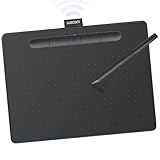
If you retouch several times a week and you want the tablet to disappear into the workflow rather than demand attention, the Intuos Medium with Bluetooth is the pick. Its 8.5 × 5.3-inch active area is the largest in this roundup at roughly 45 square inches, and the wireless connection means you can clear the desk of cables entirely. It suits working photographers, retouchers handling client files, and anyone editing on a display 27 inches or larger.
Key specifications
- Active area: 8.5 × 5.3 in (216 × 135 mm), roughly 45 square inches
- Pressure sensitivity: 4,096 levels, battery-free pen
- Pen: two programmable side buttons, no eraser end
- Shortcut controls: four ExpressKeys with per-application profiles
- Resolution and report rate: 2,540 lines per inch, 133 points per second
- Connection: USB and Bluetooth; rechargeable internal battery
- Compatibility: Windows and macOS; the listing includes a software bundle
- Physical class: roughly one pound, with a footprint in the 10 × 7 in range
What it does well
The active area is the reason to choose this over its smaller sibling. At 8.5 inches wide, a 2560 × 1440 display maps to about 301 pixels of cursor travel per inch of hand travel; on a 4K display of the same physical size it is about 452 pixels per inch. Both numbers sit in the range where precise masking feels controlled rather than twitchy. When you are cleaning up a mask around flyaway hair or building a dodge-and-burn layer on a face, that extra control is the entire point of using a pen instead of a mouse.
The Bluetooth connection is the second differentiator. Unplugging the cable does not just tidy the desk; it lets you sit back from the monitor, rest the tablet on your lap, and work in a more relaxed posture for long sessions. The battery is rechargeable over USB and is sized for a full working day of intermittent use, which is the realistic pattern — you are not drawing continuously for eight hours.
What you are really paying the premium for, though, is the driver. Wacom’s software lets you set per-application profiles so that ExpressKeys, pressure curves and pen-button assignments switch automatically when you move from your raw converter to your pixel editor. Pressure curves matter more than most buyers realise: a slightly softer curve at the low end makes light dodging strokes easier to control, and being able to save that curve per application is a genuine workflow improvement rather than a marketing bullet point.
The 4,096 pressure levels are the one place this tablet looks weaker than cheaper competition on paper. In practice the difference between 4,096 and 8,192 levels is a question of how finely the pen’s travel is divided, not how sensitive it is — both are far beyond what a brush-opacity ramp can visibly resolve at normal brush sizes. The Intuos pens also have a low activation force, meaning very light contact still registers, which matters more for light-touch retouching than the headline level count.
Pros
- Largest active area in this roundup at 8.5 × 5.3 inches
- Bluetooth plus USB gives you a genuinely cable-free desk option
- Per-application profiles and adjustable pressure curves in a mature driver
- Low pen activation force makes light dodging and burning easier to control
- Rechargeable battery sized for a full day of intermittent editing
- Best long-term support and accessory availability of any brand here
Cons
- Premium price tier — the most expensive tablet in this list
- 4,096 pressure levels on paper versus 8,192 from cheaper rivals
- Only four ExpressKeys despite the larger body
- Bluetooth introduces a small latency penalty and a battery to manage
- Takes up real desk depth; not a good fit for a shallow or shared desk
How it compares with the nearest alternative
The obvious rival is the HUION Inspiroy H950P, which offers a nearly identical working surface for a mid-range price along with eight keys and 8,192 pressure levels. The trade is wireless freedom, driver maturity and per-application pressure curves against raw specification and price. For a photographer who moves between two machines, or who has ever been frustrated by a driver that ignores a shortcut, the Intuos Medium justifies the premium. For a fixed desktop setup where the tablet never moves, the H950P delivers most of the experience for less. Against the smaller Wacom Intuos Small with Bluetooth, this is the same software experience with a meaningfully larger canvas — the upgrade to make if your current pad feels cramped.
4. Wacom Intuos Small, Bluetooth Graphic Drawing Tablet with Pen + Software – Best for Laptop-First Retouchers Who Travel
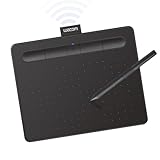
This is the same six-by-three-point-seven-inch tablet as the wired Intuos Small, with the cable replaced by a rechargeable Bluetooth radio. It suits photographers who edit on a laptop and want to work from a sofa, a hotel desk or a café table without a cable snaking across the keyboard, and anyone who shares a desk and needs to pack the tablet away at the end of a session.
Key specifications
- Active area: 6.0 × 3.7 in (152 × 95 mm), roughly 22 square inches
- Pressure sensitivity: 4,096 levels, battery-free pen
- Pen: two programmable side buttons, no eraser end
- Shortcut controls: four ExpressKeys with per-application profiles
- Resolution and report rate: 2,540 lines per inch, 133 points per second
- Connection: Bluetooth with USB charging and wired fallback
- Compatibility: Windows and macOS; the listing includes a software bundle
- Physical class: about 8 × 6 in, roughly half a pound — light enough for a laptop bag
What it does well
The pitch is portability without compromise on the pen. The stylus is identical to the wired model’s — battery-free, two side buttons, 4,096 pressure levels — so the editing experience is the same whether you are at your desk or on the road. The difference is that the tablet itself is small enough to slip into the laptop sleeve next to a 14-inch notebook, and there is no cable to lose in transit.
For travel editing, the wireless connection solves a real problem. Hotel desks are narrow and often have a lamp or a phone in the way; a tablet that sits anywhere within Bluetooth range of the laptop removes one more obstacle. The USB connection remains as a fallback, which matters on long trips where you would rather not think about battery state at all — plug it in and it behaves exactly like the wired model.
The four ExpressKeys carry over, with the same per-application profiling. On a laptop this is more valuable than on a desktop, because laptop keyboards are cramped and often lack a full number pad or dedicated function row; moving brush sizing, undo and zoom onto the tablet frees you from a keyboard that was not designed for editing.
The limitation is the canvas. Six inches of active width on a 15-inch laptop display is a reasonable match, but if you dock that laptop to a 27-inch 4K monitor the mapping becomes fast: roughly 640 pixels of cursor travel per inch of hand travel horizontally. That is fine for global adjustments and frustrating for pixel-level masking. The honest way to think about this tablet is as a travel companion that doubles as a desk tablet on a modest display, not as a primary tool for a large calibrated monitor.
Pros
- Bluetooth freedom in a body small enough for a laptop sleeve
- Identical pen and pressure performance to the wired Intuos Small
- USB fallback for long trips where charging is inconvenient
- Four ExpressKeys with per-application profiles take pressure off a cramped laptop keyboard
- Battery-free pen means only one thing in the kit needs charging
- Mature driver with reliable Bluetooth reconnection
Cons
- Premium price tier for the same active area as the wired version
- The small canvas is a poor match for a 4K desktop display
- Bluetooth adds a small latency penalty compared with a cable
- Battery adds a charging routine the wired model never demands
- Only four shortcut keys
How it compares with the nearest alternative
Against the wired Wacom Intuos Small, this is a straight trade of money for mobility: identical canvas, identical pressure, identical keys, plus Bluetooth and a battery. If the tablet never leaves your desk, the wired version is the smarter purchase. If it travels, the wireless version pays for itself in convenience the first time you edit on a train. Against the Wacom Intuos Medium with Bluetooth, this is the same wireless experience with a smaller canvas — the Medium is the better choice if portability is secondary and screen size is primary. And against the mid-range HUION Inspiroy H950P, you are choosing brand, driver maturity and wireless over roughly double the drawing surface.
5. Stylus Pens for Touch Screens, Abiarst High Precision Universal Stylus – Best for Quick Touch-Ups on a Tablet You Already Own

The Abiarst universal stylus is not a pen tablet and should not be judged as one. It is a passive capacitive stylus — a battery-free, unpaired stick with a soft tip that your existing touchscreen treats as a finger. It suits photographers who already edit on an iPad, an iPhone or an Android tablet and who want finer control over sliders, crop handles and layer taps than a fingertip provides, without buying a second device.
Key specifications
- Type: passive capacitive stylus — no battery, no pairing, no drivers
- Pressure sensitivity: none; the screen registers contact, not force
- Shortcut controls: none
- Compatibility: any capacitive touchscreen, including iPad, iPhone, Galaxy tablets and phones
- Tip: soft rounded tip; exact tip material varies by variant
- Weight class: typically under 25 g — lighter than most dedicated styluses
- Charging: none, ever
What it does well
The value proposition is narrow but real: precision of aim. A fingertip covers a large area of a phone or tablet screen, which makes it hard to grab a small crop handle, tap a specific layer thumbnail, or place a gradient endpoint accurately. A stylus with a tip a few millimetres across solves that problem immediately, and it does so for a budget-tier price with no setup whatsoever.
Because it is passive, there is nothing to charge and nothing to pair. It works on any capacitive screen you pick up, which means one stylus can serve a phone, a tablet and a laptop touchscreen without any configuration. For travel, that is genuinely useful — it lives in a bag pocket and is always ready.
What it cannot do is the thing that matters most in photo editing: pressure. Brush opacity, brush size and flow all respond to how hard you press when you use a pressure-sensitive pen. A capacitive stylus reports contact as a binary event, so every brush stroke arrives at full opacity unless you change settings manually. That rules out natural dodging and burning, variable-opacity healing, and most of the expressive retouching techniques that make a pen tablet worth owning.
It is also worth being clear about what it is not. It is not a substitute for an active stylus that pairs with a specific tablet, and it does not add palm rejection — your hand still registers on the screen unless the app or device provides rejection independently. Used within its limits, as a precision pointing tool for sliders, masks and menus, it is a perfectly sensible accessory.
Pros
- Budget-tier price — the cheapest item in this roundup by a wide margin
- No battery, no pairing, no drivers, no setup of any kind
- Works across every capacitive touchscreen you own
- Far more precise than a fingertip for sliders, crop handles and layer panels
- Light enough to carry everywhere; nothing to recharge before a trip
Cons
- No pressure sensitivity at all, which removes the main advantage of pen-based retouching
- No shortcut buttons or customisable controls
- No palm rejection of its own
- Tip material varies between variants, so feel is inconsistent across listings
- Cannot replace a proper pen tablet for masking, dodging or burning
How it compares with the nearest alternative
The nearest alternative is the XPPen StarG640, and the comparison is not close for anyone serious about retouching: for a budget-tier price slightly above a stylus, the StarG640 adds a real 6 × 4-inch active area and 8,192 levels of pressure sensitivity, which changes what you can do rather than just how accurately you can tap. The stylus makes sense only if you have already decided not to carry a second device — if your entire workflow lives on an iPad or a phone, and your editing consists of sliders, presets and crop adjustments rather than brushwork. If you own a tablet with active-stylus support, the manufacturer’s own pen is a better purchase than a universal capacitive one.
6. Drawing Tablet XPPen StarG640 Digital Graphic Tablet 6×4 Inch Art Tablet with Battery-Free Stylus – Best for the Cheapest Route to Pressure-Sensitive Editing
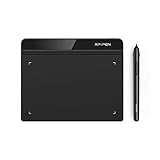
The StarG640 is the tablet to buy when the budget is fixed and you still want the one feature that matters. It is a six-by-four-inch opaque tablet with a battery-free pen and 8,192 pressure levels, and it costs less than most competitors’ entry models. It suits photographers who want to test whether pen retouching fits their workflow, students, and anyone editing on a single 1080p or 1440p display who does not want to spend mid-range money to find out.
Key specifications
- Active area: 6 × 4 in (152 × 102 mm), roughly 24 square inches
- Pressure sensitivity: 8,192 levels — the same class as mid-range tablets
- Pen: battery-free, no side buttons on the base model
- Shortcut controls: none — no ExpressKeys or programmable buttons
- Resolution and report rate: 5,080 lines per inch, 266 points per second
- Connection: USB, wired only
- Compatibility: Windows and macOS