Key takeaways
- Fixed head gates: inexpensive and durable, but less adaptable to different goats.
- Sliding or adjustable gates: better for a mixed herd and young goats, provided the locking mechanism cannot pinch.
- Pivoting gates: quick to operate, but hinges and latch hardware need regular inspection.
- Neck straps or ropes: useful as supplementary control, not a substitute for a properly designed head gate.
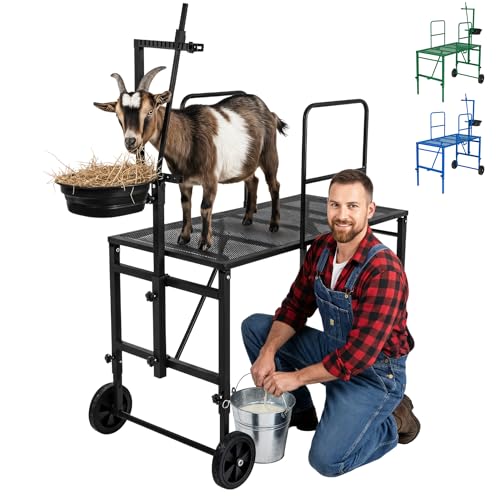
The best goat milking stands are sturdy, washable platforms with a correctly sized head restraint and a feeder positioned to keep the goat calm without forcing her neck downward.
For most small farms, a raised wooden or steel stand about 18–24 inches wide, 36–48 inches long, and 16–20 inches high offers the best balance of stability, comfort, and portability. Choose a heavier steel or reinforced stand for frequent milking or multiple goats; choose a lighter folding model when storage and transport matter most.
Our top picks



As an Amazon Associate we earn from qualifying purchases at no extra cost to you. Ratings are shown as listed on Amazon.
Best goat milking stands by situation
| Situation | Best stand type | Priorities | Typical budget range |
|---|---|---|---|
| One or two goats, occasional milking | Basic wooden platform with stanchion | Low cost, simple cleaning, adequate bracing | $100–$220 |
| Daily milking of several goats | Heavy-duty steel or reinforced wood stand | Rigid restraint, high weight capacity, replaceable hardware | $220–$500 |
| Limited storage or frequent transport | Folding or knock-down stand | Low folded size, manageable weight, locking joints | $150–$350 |
| Nervous, young, or inexperienced goats | Wide platform with adjustable head gate | Non-slip surface, gentle restraint, accessible feeder | $180–$400 |
| Large dairy breeds or heavy does | Extra-wide, reinforced stand | 350–500 lb capacity, longer platform, strong leg bracing | $250–$600 |
What separates a good milking stand from a frustrating one?
Platform size and working height
A platform that is too small makes a goat feel unstable and leaves little room for repositioning. A useful minimum is approximately 18 inches wide by 36 inches long. For larger breeds, or for goats that move while being milked, aim for 20–24 inches wide and 42–48 inches long.
Height is a personal fit issue. A 16–18-inch platform works well for many adults and keeps the udder at a comfortable working level. A taller 20–24-inch stand may reduce bending for a tall milker, but it needs a broad base and strong cross-bracing. Measure the milker’s preferred hand position before buying: stand beside a step or platform and check whether the udder would sit comfortably near waist level.
A slightly textured surface is safer than smooth painted wood or bare metal. Rubber matting, textured composite decking, or a well-secured grooved surface can improve footing. Avoid loose mats that curl at the edges or trap manure underneath.
Restraint design
The head gate should hold the goat comfortably without squeezing the jaw or pressing against the throat. Adjustable vertical bars or a pivoting stanchion are more useful than a fixed opening because goat head sizes vary considerably.
- Fixed head gates: inexpensive and durable, but less adaptable to different goats.
- Sliding or adjustable gates: better for a mixed herd and young goats, provided the locking mechanism cannot pinch.
- Pivoting gates: quick to operate, but hinges and latch hardware need regular inspection.
- Neck straps or ropes: useful as supplementary control, not a substitute for a properly designed head gate.
Look for rounded edges, smooth bolt ends, and a latch that can be opened with one hand. The goat should be able to lower and raise her head slightly while eating. Restraint should prevent sudden backing or turning, not immobilize the neck.
Feeder placement
Feeder location has a direct effect on milking behavior. A feeder mounted in front of the head gate keeps the goat facing forward and leaves both sides of the udder accessible. It should sit high enough that the goat does not have to crouch, but low enough to eat naturally.
A practical target is a feeder lip approximately 8–12 inches above the platform, with the feed positioned 6–12 inches in front of the goat’s nose when she is restrained. A removable bucket or trough is easier to sanitize than a permanently enclosed box. Avoid feeders with deep corners that retain wet grain, and avoid placement so close to the milker that elbows repeatedly strike it.
Head-to-head comparison of common stand constructions
| Construction | Typical weight | Practical capacity | Cleaning | Portability | Best use |
|---|---|---|---|---|---|
| Basic treated-wood stand | 45–80 lb | 250–350 lb | Good if sealed; inspect cracks | Moderate | Small herds and occasional use |
| Reinforced plywood and lumber | 65–110 lb | 350–500 lb | Good with sealed edges and removable mat | Low to moderate | Daily use and larger goats |
| Powder-coated steel frame | 55–100 lb | 400–600 lb | Very good; check chips and rust | Moderate | Frequent milking and long service life |
| Folding steel or aluminum stand | 30–65 lb | 250–400 lb | Good if joints stay accessible | Excellent | Shows, transport, and small spaces |
These are useful buying targets rather than specifications for every model. Always verify the manufacturer’s stated capacity, especially if the stand has folding legs. A stand rated for 300 pounds should not be treated as equally stable under a 300-pound moving animal; a capacity with a safety margin is preferable.
Materials: wood versus steel
Wood is easy to repair and often less expensive. It also absorbs vibration, which can help a nervous goat settle. Its weak points are exposed end grain, screw holes, and joints that remain damp after washing. Sealing the edges and using stainless or coated fasteners can extend its life.
Steel offers excellent rigidity and usually tolerates repeated loading better. Powder coating protects the surface, but scratches and weld points can become rust locations. Check underneath the platform and around leg joints, where manure and wash water collect.
Aluminum keeps a portable stand light and resists rust, but thinner tubing can flex under a large goat. It is most suitable when the frame has generous cross-bracing and a clearly stated weight rating.
Cleanability and daily ownership
Sanitation is easier when the platform has few seams and the feeder can be removed. A sealed, sloped surface or a removable rubber mat is preferable to absorbent unfinished plywood. Avoid carpet, fabric, and deeply grooved rubber that cannot be lifted for washing.
- Brush off manure and loose bedding immediately after milking.
- Remove the feeder and wash it separately.
- Rinse the platform with low-pressure water so debris does not enter hinges or electrical equipment nearby.
- Use a livestock-appropriate cleaner according to its label, then rinse thoroughly.
- Allow the stand to dry before storing it or adding a new mat.
Do not leave wet feed in the trough overnight. Damp grain can spoil and creates an unpleasant cleaning problem. Inspect the restraint before each use: look for protruding screws, cracked wood, bent bars, loose hinges, and latch movement.
Common mistakes when choosing a goat milking stand
- Buying for the smallest goat: a narrow platform may be unsafe for mature does or pregnant animals.
- Ignoring the milker’s height: an otherwise stable stand can still cause uncomfortable bending at every milking.
- Choosing portability over rigidity: folding legs are useful only when their locks do not flex under movement.
- Using a slippery painted surface: even a calm goat may lose footing when shifting weight.
- Accepting a feeder that is too low: this encourages awkward neck posture and can make the animal step backward.
- Forgetting replacement parts: mats, latches, hinges, and feeder fasteners are the components most likely to need replacement.
How to choose the right stand in five steps
- Measure your largest goat. Record body length, approximate weight, and head width. Select a platform at least several inches longer and wider than the space she naturally occupies.
- Measure the milker’s working height. Prioritize a comfortable udder position over a standard stand height.
- Choose capacity with room to spare. For a 180-pound goat, a 300-pound rating is a more sensible target than a 200-pound rating, especially on a portable frame.
- Check every contact surface. The platform, head gate, feeder, and latch should all be smooth, stable, and free from sharp edges.
- Plan the cleaning routine. If you cannot remove the mat and feeder easily, the stand will be harder to maintain than its purchase price suggests.
Bottom line
For most owners, the best goat milking stand is a 36–48-inch-long platform with a 18–24-inch width, a non-slip washable surface, an adjustable head gate, a removable front feeder, and a capacity at least 100–150 pounds above the heaviest goat. Choose reinforced wood for value and repairability, steel for frequent use and rigidity, or a folding metal design when storage and transport are decisive. The safest choice is not necessarily the heaviest one; it is the stand that fits the goat, suits the milker’s height, stays stable during movement, and can be cleaned completely after every session.