Key takeaways
- Compare the best book darts and metal line markers, from original Book Darts tins in bronze, brass and mixed metals to stainless and bulk arrow markers.
A bookmark remembers a page. It cannot remember the sentence halfway down that page, the recipe step you keep losing, or the line in a contract you need to find again in a hurry. Readers solve that gap with dog-ears, sticky flags that cover the words they protect, or pencil marks that borrowed and library books should never receive. Book darts exist for exactly this problem: paper-thin metal markers that slide onto a page and point at one specific line, then come back out without leaving a trace.
As an Amazon Associate, we earn from qualifying purchases.
Quick Answer
The original Book Darts tins are the benchmark: the 125-count mixed metals tin suits readers who mark several books at once, while the bronze and brass 125-count tins give a single-metal supply for heavy annotators. Stellar Factory offers a smaller 50-count stainless option, and the Lusofie 150-piece arrow set is the bulk pick for classrooms and study groups.
A Line Marker Is Not a Bookmark
A book dart is a small strip of metal, folded once, roughly an inch long. The fold slips over the edge of a page and the pointed end aims at the line you want to keep. Because the metal is paper-thin, dozens of darts can sit inside a closed book without bulging the spine, and the tips stay visible along the fore-edge so a marked passage can be found from outside the book.
Three design points decide how a set behaves. First, grip: the fold must hold on thin Bible paper and on heavy textbook stock without sliding down the page or crimping it. Second, metal: bronze, brass and stainless steel all spring back to shape, but they differ in color, which matters when one reader uses color to separate themes, courses or readers sharing a shelf. Third, shape: the original dart is a plain pointed tab, while newer arrow-style markers trade the slim profile for a larger, easier-to-grab head.
Darts also differ from every other marking tool in one respect: nothing touches the text. There is no adhesive to yellow, no ink to bleed, and no fold to weaken the page corner, which is why the format is popular with collectors, librarians and anyone marking books they do not own.
The Picks
Book Darts Line Markers, 125 Count Tin, Mixed Metals

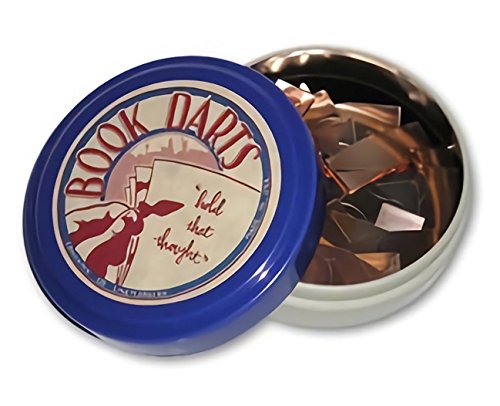
The mixed tin is the most flexible starting point because it combines all three of the maker’s metals in one box: bronze, brass and stainless steel darts that work identically but read as three different colors against a page. That makes color-coding effortless, one metal for definitions, another for passages to quote, a third for questions to revisit. The count of 125 is sized for readers who keep several books in rotation and mark freely rather than rationing markers. The darts are precision cut in the United States by Book Darts, Inc., and the reusable tin keeps loose darts from migrating into sofa cushions.
Specs:
– Brand: Book Darts
– Model: TIN125CTMIXED
– Count: 125 markers
– Material: Bronze, brass and stainless steel mix
– Dart length: About 1 inch
– Packaging: Reusable storage tin
– Origin: Made in the USA
Book Darts Line Markers, 125 Count Tin, Bronze
Bronze is the warmest of the three metals, a reddish-brown tone that stands out against cream and white paper without the brightness of brass. This single-metal tin suits readers who mark one long project, a thesis, a multi-volume history, a year of devotional reading, and want every marker to match. Bronze also develops a soft patina over time, which collectors tend to like on older books. The darts share the same paper-thin folded profile as the rest of the line, and the 125 count means a full book can be marked densely, line by line, without running short.
Specs:
– Brand: Book Darts
– Model: TIN125CTBRONZE
– Count: 125 markers
– Material: Bronze
– Dart length: About 1 inch
– Packaging: Reusable storage tin
– Origin: Made in the USA
Book Darts Line Markers, 125 Count Tin, Brass
Brass is the classic Book Darts metal, listed by the maker in a dull gold finish that reads clearly in low light and against aged, yellowed pages where bronze can blend in. Teachers and students who mark textbooks often land here, because the bright tip is easy to spot when flipping quickly during a lecture or discussion. Brass is also the metal most people picture when they think of the original product, and this tin carries the same 125-count format, the same folded one-inch profile and the same United States production as the other single-metal tins.
Specs:
– Brand: Book Darts
– Model: TIN125CTBRASS
– Count: 125 markers
– Material: Brass
– Finish: Dull gold
– Dart length: About 1 inch
– Packaging: Reusable storage tin
– Origin: Made in the USA
Stellar Factory Book Darts, Thin Stainless Steel Mini Bookmarks, 50 Count

Stellar Factory takes the same paper-thin concept and trims it down: a 50-count set of stainless steel mini markers for readers who want to try the format, or who mark lightly and do not need a 125-piece supply. Stainless steel is the hardest of the metals used in this category, so the fold keeps its spring through repeated moves between books, and the silver tone pairs well with modern hardcovers and technical manuals. The smaller count also makes this the natural gift size and the easiest set to keep in a pencil case or reading kit rather than on a desk.
Specs:
– Brand: Stellar Factory
– Model: sf-bookdart
– Count: 50 markers
– Material: Stainless steel
– Style: Thin mini line markers
– Packaging: Compact retail pack
Lusofie 150Pcs Book Darts, Arrow Metal Bookmarks, 3 Colors

The Lusofie set changes the formula in two ways: the markers are cast zinc alloy rather than folded sheet metal, and each one is shaped as a small arrow with a clip back. The arrow head is larger and easier to grab than a paper-thin tab, which helps younger readers and anyone marking thick workbooks. The 150-piece count is the largest in this roundup, split across steel, gold and black finishes for simple color-coding. The trade-off is profile: cast arrows sit slightly prouder on the page than folded darts, so they suit study books and planners better than slim volumes that must close perfectly flat.
Specs:
– Brand: Lusofie
– Count: 150 markers
– Material: Zinc alloy
– Colors: Steel color, gold and black
– Style: Arrow-shaped clip markers
– Item weight: 1.76 ounces
How to Choose
Start with how much you mark. A reader working through one novel at a time may never open a second tin, so a 50-count set is enough; researchers, teachers and book-club annotators who mark in parallel should go straight to a 125-count or 150-count supply, because running out mid-book is the one frustration every dart user mentions.
Choose metal by visibility and meaning. Brass shows best on yellowed paper, bronze on bright white paper, and stainless steel where a neutral silver look matters. If you mark for more than one reason, a mixed tin or a three-color set lets color carry the meaning, so a glance at the fore-edge tells you which marks are quotes, which are questions and which are deadlines.
Match the marker to the paper. Folded sheet-metal darts are the safest choice for thin or valuable pages because they add almost no thickness and grip without teeth. Cast arrow clips are sturdier and easier to handle, but their extra bulk belongs in textbooks, cookbooks and planners rather than in a first edition.
Finally, think about storage. A lidded tin keeps a hundred loose darts contained on a desk; a small retail pack travels better. Whichever format you pick, darts are reusable indefinitely, so the real cost driver is count, not replacement.
Who Should Skip Book Darts
Readers who only ever need to find their place should skip this category entirely, because a dart marks a line, not a stopping point, and a plain bookmark does that job for less fuss. Anyone who reads mostly on an e-reader gains nothing from physical markers. Darts are also a poor fit for marking in very small paperbacks with tight margins, where a one-inch tab can crowd the text block, and for households with toddlers, since a tin of small metal pieces needs to live out of reach. If you prefer your marks to carry written notes, sticky annotation tabs remain the better tool.
Frequently Asked Questions
Do book darts damage pages?
Used as directed, no. A dart slides over the page edge and holds by gentle spring pressure, so there is no adhesive, ink or puncture involved. The maker describes the markers as designed to leave no lasting mark, and the format is widely used on collectible and library books. Very fragile or brittle pages deserve extra care with any clip-style tool.
How many book darts does one book need?
It depends on marking density. A casual reader might use five to ten darts in a novel, while a student marking a textbook chapter by chapter can place forty or more. That is why tins run from 50 to 150 pieces: choose the count that covers your most heavily marked book, with spares for the next one.
What is the difference between bronze, brass and stainless steel darts?
Functionally, very little: all three are paper-thin, springy and reusable. The difference is color and tone. Brass is a dull gold, bronze is reddish-brown, and stainless steel is silver. Readers use the colors to code themes, subjects or readers, and pick a single metal when they want every mark to look the same.
Can book darts be reused?
Yes. Darts are meant to move from book to book for years. When a passage no longer matters, slide the dart off and return it to the tin. The folded metal springs back to its original grip, and there is no adhesive to wear out, which is the main advantage over sticky flags.
Final Verdict
For most readers, the Book Darts mixed metals 125-count tin is the right first purchase: three colors for coding, enough markers for several books at once, and the original folded design that made the format popular. Bronze and brass single-metal tins serve heavy annotators who want a uniform look, the Stellar Factory 50-count set is the low-commitment stainless option, and the Lusofie arrows win on sheer count for classrooms and study groups. Pick by metal and count, and the line you marked will still be pointed out months later.
More from Amazon
Programs that pair well with the guide above. Offers and eligibility are set by Amazon and may change.
Read from a large library of eBooks and audiobooks on any device. Check Amazon for current plans.
Explore Kindle UnlimitedAudiobooks and podcasts to listen to on the go. Eligible new members can start with a free trial.
Try Audible freeFree shipping on eligible items, Prime Video and more. Eligible new members can start with a free trial.
Start a Prime free trialAd-free music streaming. Eligible new subscribers can start with a free trial.
Try Music Unlimited freeAs an Amazon Associate we earn from qualifying purchases.