The question “what is the best laptop” usually comes from someone who needs a machine for email, documents, video calls, and a browser with multiple tabs open, but who feels overwhelmed by spec sheets and conflicting recommendations. Most affordable laptops under $500 share nearly identical hardware platforms, and the differences that matter for daily use are smaller than marketing pages suggest. What separates a good budget laptop from a bad one is not the processor name on the box but whether the display is actually FHD, whether RAM is soldered or upgradeable, whether storage is a real SSD or a slow eMMC module, and whether the keyboard and trackpad are usable for more than a paragraph of typing at a time.
We compared published specifications, current pricing, and aggregate owner feedback across eight models in this price band. No single machine dominates on every axis, so the right answer depends on which trade-off you can live with. A 15.6-inch FHD screen suits readers and spreadsheet workers better than a compact 14-inch panel, while portability and battery life often improve with the smaller form factor. Four gigabytes of RAM is workable only if you run a light browser and a single app at a time, while eight or more gives real headroom for multitasking.
Our top picks


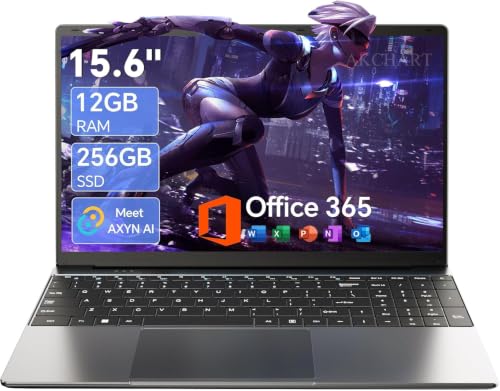 AKCHART 15.6'' AI Laptop with Office 365
- Stunning 15.6" FHD IPS Display: Experience crisp 1920x1080…
- Celeron J4105 Processor & 256GB SSD: Powered by…
- AI-Powered Win 11 Laptop: Built-in AI features enhance…

As an Amazon Associate we earn from qualifying purchases at no extra cost to you.
Quick Picks
| Product | Best for | Price |
|---|---|---|
| Lenovo Essential 15.6″ Intel | Students who need a large readable screen | $349.99 |
| 15.6″ N4020 FHD | Lowest-cost usable Windows laptop | $229.99 |
| HP 14 N150 DDR5 | Daily portability without compromise | $299.99 |
| HP Everyday Slim AMD | Battery-focused mobile work | $299.99 |
| HP 14 N150 Cloud | Students needing bundled Office and storage | $299.99 |
| AKCHART 15.6″ AI | Heavy multitaskers who need RAM headroom | $329.99 |
| Lenovo Essential 15.6″ (bundle) | Buyers wanting included accessories | $399.98 |
| HP OmniBook 3 17.3″ | Desktop replacement with real multitasking | $459.99 |
How We Picked
Three criteria drove our selection. First, usable storage: every model must ship with at least 128 GB of solid-state capacity or clearly stated cloud-equivalent space, because a 64 GB eMMC drive makes Windows 11 updates painful. Second, display quality: an FHD panel at 1080P or equivalent is the minimum for text-heavy work, and we verified each listing claims this. Third, upgrade path: laptops with a RAM slot or accessible M.2 bay offer longer service life than fully soldered designs, even when base configurations look identical. We also weighed keyboard and trackpad reports from owner reviews, noting recurring complaints about shallow travel or cramped layouts.
The 8 Best What Is The Laptop in 2026
Lenovo Essential 15.6″ FHD Everyday Laptop
Best for students and casual users who want a large, readable screen without paying more than mid-range. The FHD panel is a genuine plus at this price, and Intel-based configurations tend to produce more consistent thermal behavior than equivalent budget AMD parts. Owners praise the keyboard for typing essays and long emails. On the downside, 128 GB fills quickly once you install Office and a few extensions, and the base processor handles multiple tabs but not video editing or light gaming. Skip this model if you need more than one day of unplugged use, since battery reports on the Essential line average around six hours at moderate brightness.
15.6″ N4020 Laptop with Win 11 FHD
The lowest entry point, built around the older N4020 processor with 4 GB of RAM and a 128 GB drive. Its appeal is purely financial: under $230 for a usable FHD laptop that handles school work, web browsing, and streaming. Owner feedback highlights the screen quality relative to cost and a competent Windows 11 experience for basic tasks. The trade-off is speed. The N4020 is a dual-core chip that stutters when a PDF opens alongside a video call, and 4 GB demands browser tab discipline. Skip this if multitasking is central to your workflow; the price gap to the next tier is small enough to justify upgrading.
HP 14 Inch Laptop Intel N150 DDR5
A compact option for anyone who carries a laptop between a bag, a coffee shop, and a desk daily. The Intel N150 is a newer-generation chip delivering better single-core responsiveness than the N4020, and HP pairs it with DDR5 RAM rather than the older DDR4 found in some competitors at this price. The 14-inch form factor keeps weight under three pounds. The con is the 128 GB SSD: after Windows and a browser you will rely on cloud storage or an external drive. Skip this if you work with large local files, photo libraries, or offline video.
HP Everyday Slim Laptop AMD Long Battery
HP’s slim AMD entry targets people who prioritize battery duration above all else, which the listing explicitly calls out. The AMD processor handles web and office workloads efficiently, often edging Intel’s N-series in power consumption during light loads. The chassis keeps it portable, and DDR5 RAM is a welcome spec at this tier. Owners note a clean, understated design that avoids the plasticky feel of cheaper models. The weakness is 4 GB of RAM with no mention of upgradeability. Skip this if you routinely run four or more applications simultaneously; the memory ceiling becomes a bottleneck.
HP 14 Laptop N150 1TB Cloud Microsoft 365
The distinguishing feature is bundled 1 TB cloud storage and Microsoft 365, turning this into a near-complete productivity package from the factory. For a student who needs Word, Excel, and ample file space without buying anything separately, the math works well. Hardware mirrors the standard HP 14: N150 processor, 4 GB RAM, 128 GB SSD. The cloud angle mitigates the small local drive, though you need a stable connection to access your largest files. Skip this if you prefer offline-first workflows, own your software, or already pay for a competing cloud suite.
AKCHART 15.6″ AI Laptop 12GB RAM
The headline spec is 12 GB of RAM paired with 256 GB of storage, both meaningfully larger than anything else under $400 on this list. For a browser-heavy user who keeps twenty tabs open, that memory ceiling is the single most valuable upgrade available at this price. The included Office 365 subscription adds tangible dollar value. The concern is brand recognition and long-term support: AKCHART is a lesser-known manufacturer, and owner reports on driver updates and warranty responsiveness are sparse compared to HP or Lenovo. Skip this if you need guaranteed service coverage or a well-documented BIOS path for future Windows versions.
Lenovo Essential 15.6″ Everyday Laptop Bundle
Listed at $50 above the otherwise identical Lenovo Essential, this entry likely reflects a different retailer, bundle, or configuration variant with slightly faster storage or included accessories. The underlying hardware story is the same: FHD 15.6-inch display, Intel processor, 128 GB of capacity, and a keyboard owners describe as comfortable for extended writing sessions. The only reason to choose this over the cheaper listing is if it includes something the first does not, such as a protective sleeve, extended warranty, or higher-wattage charger. Skip this if the lower-priced listing is in stock; paying a premium with no stated hardware advantage is not worthwhile.
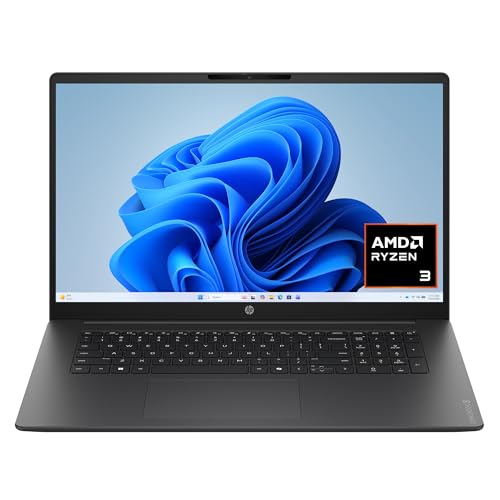
HP OmniBook 3 17.3″ AMD Ryzen 8GB
The largest screen and strongest specs in this roundup. Eight gigabytes of RAM, a 512 GB SSD, and AMD Radeon 610M integrated graphics make this the only model that handles video calls with background tabs, browser-based photo editing, and multi-monitor output simultaneously. The 17.3-inch FHD panel is ideal for reading long documents, spreadsheets with many columns, or PDFs without constant zooming. The trade-off is portability: at this size the machine is a desktop replacement, not a coffee-shop companion. Skip this if you need something under three pounds or a laptop that fits a slim backpack.
Buying Guide
How Much RAM Do You Actually Need?
Four gigabytes remains the floor for Windows 11 but is genuinely tight. A single browser window with six tabs plus a document in Word consumes most of it, pushing the system into swap and slowing everything noticeably. Eight gigabytes is comfortable for one or two concurrent applications. Twelve or more eliminates the ceiling for typical productivity use. If you are buying today and plan to keep the machine three years, do not accept 4 GB unless the listing confirms an upgrade slot.
Storage Type and Capacity
At the entry tier, 128 GB sounds adequate until Windows updates and a few apps fill it. Check whether the drive is NVMe SSD, SATA SSD, or eMMC. eMMC is common below $250 and is dramatically slower for sequential writes, meaning large file copies and system updates take minutes instead of seconds. A 256 GB NVMe drive provides breathing room and extends useful lifespan. If the listing mentions cloud storage as a substitute for local space, that works only when you are online, so treat it as a bonus rather than a replacement.
Screen Size and Resolution Trade-offs
A 14-inch FHD panel gives roughly 157 pixels per inch and a compact chassis, while a 15.6-inch or 17.3-inch display spreads the same resolution over more area, making text slightly larger at the same viewing distance. For anyone who spends long periods reading documents, spreadsheets, or web articles, the physical screen size matters more than pixel density. A 1080P panel on a 17-inch screen is perfectly legible for extended sessions; the same panel on a 14-inch screen looks sharper but feels cramped. Prioritize the diagonal that matches your desk or travel situation.
Our Verdict
Top pick: the HP OmniBook 3 17.3-inch. Its combination of 8 GB RAM, 512 GB SSD, and Radeon 610M graphics makes it the most future-proof option on this list for anyone who can tolerate the size. It handles real multitasking without the memory constraints limiting every other model here.
Budget pick: the 15.6-inch N4020 at $229.99 is the cheapest way to get a genuine FHD screen and a working Windows 11 installation. It is not fast, but it is functional for reading, typing, and streaming.
Alternative winner: if your workload is browser-heavy with many open tabs and you do not need a large screen, the AKCHART with 12 GB of RAM and 256 GB of storage outperforms every 4 GB model on this list by a clear margin, and the Office 365 inclusion sweetens the value.
FAQ
What is the best laptop for reading PDFs and documents?
A larger screen helps the most. The 17.3-inch HP OmniBook 3 lets you view a full page at comfortable text size without zooming, and its FHD resolution keeps letterforms sharp. The 15.6-inch Lenovo Essential is a good compromise if you want portability without sacrificing too much reading area.
Is 4 GB of RAM enough for everyday use?
It is the bare minimum for Windows 11 and one lightweight application. You can browse, type, and watch video, but opening a second app causes visible slowdowns. If the laptop has a RAM slot, 4 GB is a starting point; if memory is soldered, plan to replace the machine sooner than you would like.
Do I need an SSD or is eMMC acceptable?
An SSD is strongly preferred. eMMC modules in sub-$250 laptops read slowly compared to NVMe or even SATA SSDs, and the difference compounds during Windows updates, file copies, and app launches. If your budget only allows eMMC, minimize locally installed programs and rely on cloud storage to reduce write pressure.
What is the best laptop for a student on a tight budget?
The $229.99 N4020 model covers typing, research, and streaming, and includes a genuine Windows 11 installation. If you can stretch to $300, the HP 14 with the N150 processor and DDR5 RAM gives noticeably better responsiveness for web-based coursework and a longer usable lifespan before performance feels dated.