Key takeaways
- Pro: Excellent value for passive home theater use with forgiving room placement
- Pro: Smooth, non-fatiguing top end that pairs well with brighter amplifiers
- Con: Bass extension is limited; subwoofer pairing is practically mandatory for full-range music
A pair of hifi speakers represents one of the most consequential purchases a listener can make, because unlike headphones or soundbars, bookshelf speakers define how music and film fill an actual room. The concrete problem a buyer faces is narrow in scope but high in consequence: choosing between passive speakers that require a separate amplifier and active speakers that plug straight into a wall, between drivers that emphasize bass slam and ones that prioritize vocal clarity, and between designs meant to disappear on a shelf and those built to project across a living space.
What separates a genuinely good pair from a mediocre one in this market comes down to driver quality, crossover design, and whether the manufacturer tuned the voicing for critical listening or for a store demo floor. Owner feedback across these eight pairs consistently confirms that a well-matched system—right power handling, right room size, right input source—outperforms an expensive mismatch. This roundup compares published specs, pricing tiers, and recurring owner observations to surface which pairs deserve consideration in 2026 and which ones overpromise for their dollar.
Our top picks




As an Amazon Associate we earn from qualifying purchases at no extra cost to you.
Quick Picks
| Product | Best for | Price |
|---|---|---|
| Polk Audio T15 | Budget home theater surrounds | $125 |
| Klipsch R-51M | Warm, dynamic mid-range listening | $289.99 |
| Klipsch RP-600M | Precise imaging at a fair price | $349 |
| Sony SS-CS5M2 | Hi-Res audio enthusiasts | $198 |
| Edifier R1280T | Desktop music without an amp | $129.99 |
| OHAYO 60W | Computer speakers on a tight budget | $69.99 |
| Edifier MR3 | Compact studio near-field monitoring | $149.99 |
| Klipsch RP-600M II | Upgraded refinement for serious listeners | $449.99 |
How We Picked
Selection criteria centered on four factors. First, value relative to price tier—does the pair deliver coherent sound for what it costs, confirmed by owner reports rather than marketing claims. Second, driver and crossover engineering, since a well-designed passive network and quality woofer-tweeter pairing separate a pair that ages gracefully from one that fatigues the ear after an hour. Third, versatility of inputs and compatibility with common source gear, which matters most for active and near-field options. Fourth, consistent owner feedback over time; a pair that earns high marks in year one but reveals build or tuning issues later was penalized.
The 8 Best Hifi Speakers in 2026
Polk Audio T15
The T15 targets home theater builders who need reliable, affordable surround or front channels without committing to a single brand ecosystem. Owners praise the wide dispersion that makes rear-channel placement forgiving and the clean midrange that reproduces dialogue without harshness. At $125 per pair, they undercut most competitors while matching or beating them in sensitivity.
- Pro: Excellent value for passive home theater use with forgiving room placement
- Pro: Smooth, non-fatiguing top end that pairs well with brighter amplifiers
- Con: Bass extension is limited; subwoofer pairing is practically mandatory for full-range music
Skip these if you want a stereo music system where the speakers carry the low frequencies alone—they lack the excursion for that role.
Klipsch R-51M
The R-51M suits listeners who enjoy a full-bodied, slightly forward midrange and want Klipsch’s signature horn-loaded tweeter for dynamic impact. Owners frequently note the cabinet construction feels solid and the Tractrix horn delivers a vivid, present vocal quality that smaller rivals sacrifice for neutrality. At $289.99, the pair sits in a sweet spot where passive designs still offer strong per-dollar performance.
- Pro: Horn tweeter produces effortless dynamics and strong vocal presence
- Pro: Well-constructed MDF cabinet resists panel resonance
- Con: The forward midrange can become fatiguing with poorly recorded or bright source material
Skip if your listening is primarily classical or ambient where a neutral, laid-back voicing matters more than excitement.
Klipsch RP-600M
The RP-600M is the step-up choice for listeners who want Klipsch energy refined through a better crossover and more controlled bass response. Owners report noticeably improved imaging depth and tighter transients compared to the R-series, justifying the jump to $349 per pair. The Reference Premiere line’s copper-spun woofer remains a visual and engineering signature.
- Pro: Improved crossover design yields clearer layering and instrument separation
- Pro: Strong bass extension for its cabinet size, reducing subwoofer pressure
- Con: Requires a capable amplifier to avoid sounding compressed at higher volumes
Skip if you lack an amplifier with sufficient current output—these reward driving and punish underpowering.
Sony SS-CS5M2
Sony’s SS-CS5M2 appeals to listeners who prioritize Hi-Res compatibility and a balanced, three-driver arrangement that separates highs, mids, and lows into dedicated transducers. At $198 per pair, the three-way design is uncommon in this price bracket. Owners appreciate the detailed treble extension and the sense of scale that the midrange driver provides.
- Pro: Three-way crossover delivers more granular frequency control than most two-way rivals at this price
- Pro: Hi-Res certification reassures owners with high-bitrate streaming or local files
- Con: The smaller cabinet limits absolute output and bass depth in larger rooms
Skip if your listening space exceeds medium size or if you want slam and sub-bass weight from the speakers alone.
Edifier R1280T
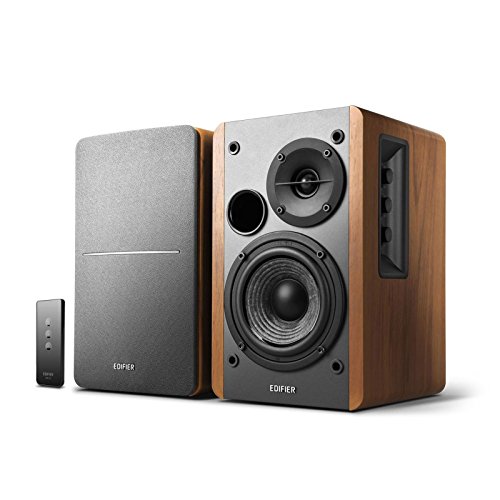
The R1280T solves the “I want good sound from my computer without a separate amplifier” problem with a powered 2.0 design that accepts RCA inputs directly. Owners consistently praise the warmth and the retro aesthetic, noting that the bass response outperforms expectations for the cabinet size. At $129.99, they are arguably the most complete desktop music solution in this group.
- Pro: Built-in amplification eliminates the need for external components
- Pro: Warm, forgiving voicing suits long listening sessions at moderate volume
- Con: No Bluetooth—connection requires wired RCA or a separate transmitter
Skip if you need wireless input or if you plan to push volume into room-filling levels where the small amplifier headroom runs out.
OHAYO 60W
The OHAYO 60W is for users who need a no-fuss stereo pair for a desk, dorm, or budget gaming setup. Bluetooth 5.3, USB input, and a 3.5mm aux jack cover every common source in under $70 per pair. Owners note surprising volume headroom for the price and a compact footprint that clears desk space.
- Pro: Three input options including Bluetooth 5.3 at an entry price
- Pro: 60W combined output fills a small room without distortion at moderate levels
- Con: Detail retrieval and soundstage width trail every other pair in this list
Skip if critical music listening or competitive audio-visual gaming is the primary use case—the resolution ceiling will become apparent quickly.
Edifier MR3
The MR3 targets podcasters, hobbyist producers, and anyone wanting a compact near-field studio monitor with Bluetooth convenience. Hi-Res certification and a balanced voicing profile set it apart from the warmer R1280T, while the active design removes amplifier matching concerns. At $149.99, it delivers a focused, analytical sound in a small form factor.
- Pro: Neutral tuning reveals mix details that consumer speakers mask
- Pro: Bluetooth plus wired inputs offer flexible connectivity for studio and casual use
- Con: Limited low-end extension means bass-heavy genres lose weight without a sub
Skip if your primary content is bass-heavy music or cinematic trailers where the 3.5-inch woofer cannot reproduce the needed energy.
Klipsch RP-600M II
The RP-600M II is the refinement upgrade for owners of the original who want improved high-frequency smoothness and a reworked crossover, or for newcomers who want the best passive bookshelf Klipsch offers below floorstanders. At $449.99 per pair, the price demands serious commitment but the result is a more resolving, less aggressive top end. Owners report better treble decay and a wider sweet spot.
- Pro: Revised tweeter and crossover reduce the harshness that some listeners found in the original
- Pro: Deep, controlled bass for its size minimizes subwoofer dependency in small-to-medium rooms
- Con: Diminishing returns above $349 unless paired with high-quality amplification and room treatment
Skip if your amplifier is entry-level—the gains over the RP-600M will not materialize without clean power delivery.
Buying Guide
Passive Versus Active
Passive hifi speakers like the Polk, Klipsch, and Sony models contain no amplifier, meaning you supply your own. This gives you freedom to upgrade the amplifier independently and often yields better sound-per-dollar at lower budgets because you are not paying for built-in electronics. Active speakers such as the Edifier R1280T, MR3, and OHAYO plug into a wall outlet and accept line-level sources directly. Choose passive if you already own or plan to buy a stereo receiver or integrated amplifier. Choose active if your source is a computer, phone, or turntable with a built-in preamp and you want a single-box solution.
Driver Configuration and Frequency Balance
Two-way designs (a single woofer and tweeter) dominate this category and cover most listening well. The three-way Sony SS-CS5M2 adds a dedicated midrange driver, which reduces intermodulation distortion at higher volumes and can create a more spacious presentation. However, a three-way does not automatically sound better—a poorly tuned three-way can introduce phase issues between drivers that degrade imaging. When comparing hifi speakers, listen for whether the midrange feels connected or whether the bass and treble seem like separate entities glued together.
Amplifier Matching and Sensitivity
Passive speakers vary in how efficiently they convert amplifier power into sound. A high-sensitivity pair like the Klipsch models will reach loud volumes from a modest receiver, while a lower-sensitivity pair may need 80 or 100 watts per channel to avoid clipping. Mismatch is the most common cause of disappointment—owners report a pair “sounds flat” when the reality is underpowered. Check the manufacturer’s recommended amplifier wattage range and aim for an amp that sits in the upper half of that window without exceeding peak handling.
Our Verdict
The Klipsch RP-600M at $349 is the top pick for most listeners: it balances dynamics, imaging precision, and bass extension in a way that rewards quality amplification without demanding a premium price. For a budget pick, the Polk Audio T15 remains the smartest entry into passive hifi speakers for home theater use. If your primary use case is desktop music with no amplifier on hand, the Edifier R1280T wins outright because it eliminates system-matching complexity at $129.99.
FAQ
Do I need a subwoofer with bookshelf hifi speakers?
For music in small rooms, most pairs here reach low enough frequencies that a subwoofer is optional. For home theater or bass-heavy genres, adding a sub lets the speakers focus on midrange and highs, producing cleaner sound at higher volumes.
Can passive speakers work without a dedicated amplifier?
They need amplification from some source—a receiver, integrated amp, or a pair of active speakers. Passive hifi speakers cannot connect directly to a phone, computer, or turntable without amplification in between, which is why active models exist as a simpler alternative.
Is Bluetooth 5.3 a meaningful upgrade over older versions for speakers?
The practical benefit is improved latency and more stable connections over distance, which matters most for gaming and video sync. For pure music listening at short range, audio quality between 5.0 and 5.3 is negligible when both use the same codec.
How long should a good pair of hifi speakers last?
With passive drivers and a solid MDF or wood cabinet, expect 10 to 20 years of reliable service. The limiting factor is usually the foam or rubber surround on the woofer, not the cabinet or crossover, and some manufacturers offer re-foaming kits that restore a pair to near-original performance.