Key takeaways
- Pro: Lowest cost-per-ball among branded distance options
- Pro: Dimple pattern earns praise for reducing left-right dispersion on long drives
- Con: Surlyn cover produces minimal spin on wedge shots, so short-game control is limited
A golfer shopping for a new dozen balls faces a frustrating trade-off: the premium urethane constructions that spin well around greens carry a price per ball that makes losing a drive feel painful, while the cheapest options often sacrifice feel and consistency to the point where they barely justify carrying them. The eight balls on this list were selected and compared using published specifications, current pricing, and aggregated owner feedback across forums and retail reviews to help you narrow the field before you buy.
What separates a genuinely good golf ball from a mediocre one at any price point comes down to three things: how consistently the core transfers energy at impact, how the cover and dimple design stabilize flight in wind, and whether the feel at address matches your swing speed. A high-handicapper swinging a 90-mph driver needs different engineering than a scratch player who controls a 115-mph swing, and the 2026 market makes that distinction sharper than ever.
Our top picks




As an Amazon Associate we earn from qualifying purchases at no extra cost to you.
Quick Picks
| Product | Best For | Price |
|---|---|---|
| TaylorMade Distance+ (12-Pack) | Maximum value distance seekers | $19.99 |
| Callaway Supersoft | Slow-swinging players who want soft feel | $26.97 |
| Titleist Velocity | Fairway speed with a tour-brand name | $24.97 |
| Titleist Pro V1 | Low-handicap players demanding spin control | $57.97 |
| Titleist TruFeel | Players prioritizing short-game touch | $24.97 |
| Amazon Basics Core Soft (24-Pack) | Range use and bulk practice | $25.17 |
| TaylorMade SpeedSoft Ink USA | American-designed budget performance | $24.97 |
| TaylorMade Distance+ (Dozen) | Distance at the lowest dozen price | $21.97 |
How We Picked
We evaluated each ball against four criteria drawn from manufacturer specs and owner-reported experience: compression rating relative to swing speed, core technology and its effect on energy transfer, cover construction (Surlyn versus urethane) and its influence on greenside spin, and price-per-ball consistency across retailers. A ball only earned a spot if owners repeatedly confirmed that the advertised performance matched what they experienced on the course.
The 8 Best Golf Balls 2026 in 2026
TaylorMade Distance+ (12-Pack)
At roughly $1.67 per ball, this twelve-pack is the cheapest legitimate distance option from a major brand. The React Speed Core is a reformulated ionomer core that generates higher initial ball speed on full shots, while the Extended Flight Dimple Pattern keeps launches stable in crosswinds. Owners with moderate swing speeds consistently report added carry over their previous budget balls.
- Pro: Lowest cost-per-ball among branded distance options
- Pro: Dimple pattern earns praise for reducing left-right dispersion on long drives
- Con: Surlyn cover produces minimal spin on wedge shots, so short-game control is limited
Skip it if you frequently play par-5 greenside approaches that need backspin to stop quickly.
Callaway Supersoft
Callaway’s flagship low-compression ball remains the go-to recommendation for golfers under 85 mph of driver speed. Its ultra-soft core and cover combination produces a muted, forgiving sound and feel off the clubface, and owners with joint sensitivity in their hands specifically choose it for reduced vibration. Flight is notably straight because the soft construction limits side spin.
- Pro: Exceptional feel for slower swing speeds without a mushy dead sensation
- Pro: Owners report noticeably tighter dispersion compared to harder distance balls
- Con: At swing speeds above 95 mph, energy transfer lags behind firmer cores
Pass on this if you are a faster swinger who wants a firmer click and higher launch off the tee.
Titleist Velocity
Titleist’s answer to the distance-ball segment uses a fast LSX core paired with a high-flex Surlyn cover to maximize speed without the harshness older velocity models carried. The 322 octahedral dimple design gives it a flatter, piercing trajectory that experienced players prefer when wind is a factor. Owner feedback highlights its durability as a standout trait over a full round.
- Pro: Noticeably longer flight than comparable mid-price balls with the same cover type
- Pro: Cover resists scuffing well through multiple rounds
- Con: Greenside spin is modest, making pitch-and-putt control less precise than urethane options
Not ideal if your short game relies on spin-dependent shots around the green.
Titleist Pro V1
The Pro V1 is the reference standard against which virtually every tour-level ball is judged. Its three-piece construction pairs a soft ZG core with a 352-dimple urethane elastomer cover, delivering the rare combination of high speed off the driver and aggressive spin on wedges. Owners at every handicap level note that it feels like a tour ball in every measurable way except the price.
- Pro: Best-in-class short-game spin and stopping power on approach shots
- Pro: Extremely tight manufacturing tolerances mean negligible batch-to-batch variation
- Con: At roughly $4.83 per ball, losing two or three per round gets expensive fast
If you play in windy conditions or on hard, fast fairways, premium balls like the Pro V1 offer the most reliable all-around performance, but if you mostly play casual rounds and rarely attack pins, the cost is hard to justify.
Titleist TruFeel
TruFeel occupies an interesting middle ground: it borrows Titleist’s softer feel DNA from the Tour Soft line while keeping a lower price than premium urethane balls. The RTI core and low-compression construction produce a quiet, cushioned impact sensation that owners with sensitive hands or arthritic joints gravitate toward. It is also Titleist’s quietest ball by sound signature.
- Pro: Excellent feel-to-price ratio for players who prioritize comfort over spin
- Pro: Consistent flight with reduced side spin due to the soft cover
- Con: Limited backspin means it can run out on firmer greens
Consider a firmer option if you want a more responsive feel or play predominantly soft-condition courses.
Amazon Basics Core Soft (24-Pack)
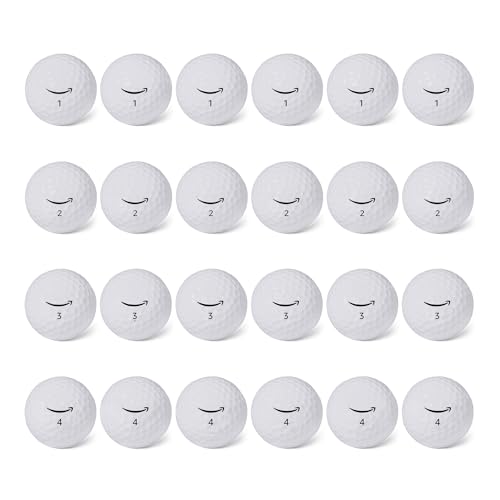
This twenty-four-ball pack undercuts every major brand on price per unit and targets golfers who need a large supply for range sessions, casual nine-holes, or recovery situations. The low-compression core gives it a soft feel for the price bracket, and the side-stamp alignment marks are a genuinely useful feature usually reserved for premium balls. Owner reviews confirm performance is acceptable for practice but note dimple consistency varies more than branded equivalents.
- Pro: Lowest cost per ball on this list by a clear margin
- Pro: Alignment aids included at a price where they are rare
- Con: Noticeable performance drop compared to branded balls on full-power drives
Avoid using these for competitive rounds where consistent ball flight affects your scoring.
TaylorMade SpeedSoft Ink USA
TaylorMade’s SpeedSoft Ink series pairs a low-compression Speed Soft core with the company’s IONIX cover technology, producing a ball that sits between the ultra-soft Supersoft category and firmer distance balls. The USA Dozen version carries a patriotic design that appeals to players who want visual personality without paying a novelty premium. Owners report good feel and reasonable distance balance for mid-swing-speed players.
- Pro: Balanced combination of soft feel and respectable distance from a trusted brand
- Pro: Distinctive design earns compliments on the course at no cost premium
- Con: Spin control around greens trails urethane-covered competitors
Skip it if you need maximum backspin for precise wedge play.
TaylorMade Distance+ (Dozen)
The single-dozen version of the Distance+ shares identical construction to the twelve-pack above but at a slightly higher per-ball cost, making it sensible only for players who want to sample the product before committing to bulk. Performance is the same React Speed Core and Extended Flight Dimple combination that earns distance marks from owners at mid-range swing speeds.
- Pro: Identical performance to the twelve-pack with a lower entry cost
- Pro: Straighter flight than most balls in this price range
- Con: No functional advantage over the twelve-pack other than a smaller commitment
If you have already used the twelve-pack, buy that version for the better per-ball value.
Buying Guide
Compression and Swing Speed
Compression determines how much the ball deforms at impact and directly governs feel and energy transfer. Players with driver speeds below 85 mph benefit from low-compression balls (roughly 50-65 on the manufacturer scale) that launch more easily and reduce side spin. Faster swingers above 100 mph need firmer cores to prevent over-compression, which causes ballooning and lost distance. Matching compression to your actual speed matters more than any marketing label on the box.
Cover Material and Greenside Control
Surlyn and ionomer covers are tough, resistant to cuts, and produce lower spin on all shots. Urethane covers are softer, generate significantly more friction on clean-wedge contacts, and allow skilled players to shape shots and stop balls on firm greens. The practical threshold is your scoring: if you rarely need spin to land a wedge inside eight feet, Surlyn is fine. If you play pins on tight par-3s, urethane justifies its premium.
Dimple Design and Launch Stability
Dimple count and pattern control how air flows around the ball in flight, which governs launch angle, carry, and roll. High-count shallow dimple designs reduce drag at high speed for maximum carry, while variable-depth patterns help maintain a consistent flight path through turbulent wind. When comparing balls, look for specific wind-stability mentions in owner reviews rather than trusting dimple count alone, because total number tells you very little without knowing the geometry.
Our Verdict
The best overall ball on this list is the Titleist Pro V1 for anyone whose game demands both distance and spin control and whose budget absorbs the cost. For pure value, the TaylorMade Distance+ 12-Pack at $1.99 per ball is unbeatable as a distance-only option from a brand with proven core engineering. If you swing below 85 mph, the Callaway Supersoft earns its spot over both because its feel and dispersion advantage at slower speeds outweighs the Distance+ raw carry edge.
FAQ
Is it worth buying expensive golf balls as a high handicapper?
Generally not. Premium urethane balls shine on short-game shots that require spin control and on approach shots that demand precise trajectory shaping. If you are still working on consistent contact and course management, a distance or mid-tier ball delivers 90 percent of the performance for a fraction of the cost.
Do all golf balls have the same size and weight?
Yes. The USGA and R&A mandate a minimum diameter of 1.68 inches and a maximum weight of 1.62 ounces, so every conforming ball is within those boundaries. The performance differences come entirely from internal construction, cover material, and dimple geometry.
How many balls should I carry?
Most players carry at least three and a comfortable number depends on your loss rate and course conditions. If you regularly lose balls to water or rough, a dozen that costs under $25 keeps the round affordable without a performance compromise on any given hole.
Can I mix different golf ball models in one round?
You can legally play any conforming ball on any hole, but switching mid-round disrupts your feel and confidence on short-game shots. It is better to commit to one model for the full eighteen and adjust your expectations around its strengths and weaknesses.