Key takeaways
- Panel: 27-inch QD-OLED, 16:9
- Native resolution: 2560×1440 (QHD), approximately 109 pixels per inch
- Refresh rate: 240Hz, with 0.03ms-class gray-to-gray response
- Adaptive sync: G-Sync Compatible and FreeSync Premium Pro class support — confirm the exact certification on the current listing
- Ports: DisplayPort 1.4 and HDMI 2.1 inputs, plus a USB hub on most variants
- Stand: height, tilt, swivel, and pivot adjustment, with a 100 x 100 mm VESA pattern for an arm
- OLED care: pixel shift, static logo and taskbar dimming, screen saver, and periodic panel refresh cycles
The best OLED gaming monitor for most people in 2026 is the Samsung 27″ Odyssey OLED G6 (G61SH). It pairs a 27-inch QD-OLED panel at 2560×1440 with a 240Hz refresh rate and 0.03ms-class pixel response, which is the sweet spot for a normal desk, a mid-range graphics card, and a mix of competitive shooters and story-driven games. If your budget is tighter, the LG 27GX704A-B delivers the same 27-inch QHD/240Hz formula in a WOLED panel at the budget tier, and it is the pick we would hand to a first-time OLED buyer. If you want maximum immersion and have the desk depth to support it, the LG 45GX900A-B curved ultrawide is the premium choice, while the Alienware AW3425DW is the smarter premium buy for anyone who wants ultrawide width without giving up pixel density. Everything below is matched to desk space, GPU headroom, and how much static desktop content you leave on screen all day.
Top 3 Picks
Best overall: Samsung 27″ Odyssey OLED G6 (G61SH). A 27-inch QD-OLED at 2560×1440 and 240Hz is the most balanced configuration on the market: roughly 109 pixels per inch, enough refresh rate to make motion look clean, and a footprint that fits a 48-inch-wide desk without a monitor arm. It suits a mid-range or better GPU and a player who splits time between ranked shooters and single-player games.
Best budget: LG 27GX704A-B. The same size and refresh class as our top pick, but positioned at the budget tier. It uses LG’s WOLED panel technology, which has a polarizer and tends to hold black levels better in a bright room with a window behind you, and it carries G-Sync Compatible adaptive sync. If you want OLED motion clarity without stretching the budget, start here.
Best premium: LG 45GX900A-B. A 45-inch curved 3440×1440 OLED at 240Hz that fills your peripheral vision in a way no 27-inch panel can. It is the right pick only if you have at least 30 inches of desk depth and roughly 44 inches of usable width, because at that size the pixel density drops to about 83 PPI and you need to sit further back for it to look sharp.
Quick Comparison
Every monitor below is a current OLED gaming display. Prices move constantly, so the tiers here describe relative market position rather than a fixed figure.
| Product | Best for | Size & resolution | Refresh & response | Panel type | Typical connectivity | Price tier |
|---|---|---|---|---|---|---|
| Samsung 27″ Odyssey OLED G6 (G61SH) | Best overall balance | 27″ / 2560×1440 (16:9) | 240Hz / 0.03ms class | QD-OLED | DisplayPort 1.4, HDMI 2.1, USB hub | Mid-range |
| LG 27GX704A-B UltraGear | Best budget entry | 27″ / 2560×1440 (16:9) | 240Hz / 0.03ms class | WOLED | DisplayPort 1.4, HDMI 2.1 | Budget |
| ASUS ROG XG27AQDMGR | Best glossy budget panel | 27″ / 2560×1440 (16:9) | 240Hz / 0.03ms class | WOLED, glossy | DisplayPort 1.4, HDMI 2.1 | Budget |
| ASUS ROG Strix XG27ACDNG | Best for competitive play | 26.5″ / 2560×1440 (16:9) | 360Hz / 0.03ms class | QD-OLED + heatsink | DisplayPort 1.4 (DSC), HDMI 2.1 | Mid-range |
| LG 45GX900A-B UltraGear | Best premium immersion | 45″ curved / 3440×1440 (21:9) | 240Hz / 0.03ms class | OLED, curved | DisplayPort 1.4, HDMI 2.1 | Premium |
| Alienware AW3425DW | Best premium ultrawide | 34.2″ curved / 3440×1440 (21:9) | 240Hz / 0.03ms class | QD-OLED, curved | DisplayPort 1.4, HDMI, USB hub | Premium |
| AOC Q27GAZD | Best value QD-OLED | 27″ / 2560×1440 (16:9) | 240Hz / 0.03ms class | QD-OLED | DisplayPort, HDMI, G-Sync Compatible | Budget |
| Alienware AW2725DF | Best high-refresh 1440p | 26.7″ / 2560×1440 (16:9) | 360Hz / 0.03ms class | QD-OLED | DisplayPort 1.4 (DSC), HDMI, FreeSync Premium Pro | Mid-range |
How We Chose
This roundup is built from published specifications, manufacturer documentation, and established category behavior rather than from lab measurement. The shortlist was limited to OLED gaming monitors that are currently listed from brands with a track record in the category: Samsung, LG, ASUS, Alienware, and AOC.
Five criteria decided the order. First, panel generation and type, because QD-OLED and WOLED differ in real ways: QD-OLED tends to produce higher color volume and slightly lifted blacks under bright ambient light, while WOLED’s polarizer holds black levels better in a lit room and its white subpixel helps text rendering. Second, native resolution and pixel density, since a 27-inch QHD panel at roughly 109 PPI looks meaningfully sharper than a 45-inch panel at the same resolution and roughly 83 PPI. Third, refresh rate and response, with 240Hz treated as the practical baseline and 360Hz as a specialist tier that demands a strong CPU as well as a strong GPU. Fourth, the port complement and bandwidth, because 1440p at 360Hz requires display stream compression or HDMI 2.1 to carry the signal. Fifth, burn-in mitigation and warranty language, along with desk footprint, stand ergonomics, and VESA mounting. Price tiers reflect relative market position, not a specific figure, because listing prices change daily.
1. Samsung 27″ Odyssey OLED G6 (G61SH) – Best for Most Gamers
As an Amazon Associate we earn from qualifying purchases at no extra cost to you.

This is the monitor to buy if you want one screen that does everything well and nothing spectacularly badly. The G61SH is a 27-inch QD-OLED at 2560×1440 with a 240Hz refresh rate, which puts it in the middle of the price range while covering the two configurations most players actually own: a standard-width desk and a graphics card that can comfortably exceed 144 frames per second at 1440p.
Who it suits: someone with 40 to 50 inches of usable desk width, sitting 24 to 30 inches from the panel, playing a blend of ranked shooters, racing games, and single-player titles. It is also the least disruptive OLED to add to a shared room, because a 27-inch 16:9 panel is only about 23.5 inches wide and does not dominate a desk the way an ultrawide does.
Key specifications:
- Panel: 27-inch QD-OLED, 16:9
- Native resolution: 2560×1440 (QHD), approximately 109 pixels per inch
- Refresh rate: 240Hz, with 0.03ms-class gray-to-gray response
- Adaptive sync: G-Sync Compatible and FreeSync Premium Pro class support — confirm the exact certification on the current listing
- Ports: DisplayPort 1.4 and HDMI 2.1 inputs, plus a USB hub on most variants
- Stand: height, tilt, swivel, and pivot adjustment, with a 100 x 100 mm VESA pattern for an arm
- OLED care: pixel shift, static logo and taskbar dimming, screen saver, and periodic panel refresh cycles
The strengths are the ones that matter day to day. At 240Hz, each frame is held on screen for about 4.17 milliseconds, and because OLED pixels switch essentially instantly, there is no visible smear behind fast-moving objects — the motion clarity is the reason to pay the OLED premium in the first place. QD-OLED adds strong color volume, so HDR highlights in supported games look punchy without washing out mid-tones. The 109 PPI density is high enough that desktop text and UI elements look clean at normal viewing distance, and the Samsung OLED care suite is comprehensive: pixel shifting nudges the image by a few pixels on a schedule, logo detection dims static elements, and the panel runs a refresh cycle after several hours of cumulative use to even out pixel wear.
The trade-offs are category-wide rather than unique to this model. QD-OLED panels omit the polarizer that WOLED uses, so in a room with strong ambient light — a window directly behind your chair, or a bright overhead fixture — blacks can appear slightly lifted compared with a WOLED screen. The subpixel layout on QD-OLED can also produce faint color fringing on small text, which some people notice immediately and others never see. And as with every OLED, the long-term wear pattern is uneven: static elements like a taskbar, a minimap, or a game HUD are the first things to leave a mark if you leave them on screen for hundreds of hours.
Pros
- Balanced 27-inch QHD configuration that fits ordinary desks
- 240Hz with effectively instantaneous pixel response
- Strong QD-OLED color volume for HDR content
- Comprehensive burn-in mitigation settings
- USB hub plus a fully adjustable stand and VESA mounting
- Mid-range positioning rather than flagship pricing
Cons
- Blacks can look slightly lifted in a brightly lit room
- Some viewers notice color fringing on small text
- No 360Hz option for players chasing the highest frame rates
- Static desktop elements still carry long-term wear risk
Against the nearest alternative in this list, the Alienware AW2725DF, the Samsung trades refresh rate for flexibility: the Alienware runs at 360Hz, which is a genuine advantage if you can actually feed it that many frames, but the Samsung’s USB hub and mid-range positioning make it the better single-monitor purchase for a mixed-use desk. Against the budget LG 27GX704A-B, the Samsung costs more and buys you QD-OLED color volume in exchange for slightly weaker black performance in bright rooms.
2. LG 27GX704A-B – Best Budget OLED Entry
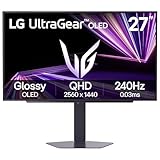
The 27GX704A-B is the monitor we would recommend to someone who wants OLED motion clarity but is not willing to pay mid-range or premium prices to get it. It is a 27-inch WOLED panel at 2560×1440 with a 240Hz refresh rate, 0.03ms-class response, and G-Sync Compatible adaptive sync, which means it hits the same core specification as far more expensive screens.
Who it suits: a first-time OLED buyer with a 27-inch-sized desk and a mid-range graphics card, especially someone who games in a room with a window or bright lighting. Because WOLED uses a polarizer, black levels hold up better under ambient light than they do on QD-OLED, which makes this the more forgiving panel type for a typical living room or home office.
Key specifications:
- Panel: 27-inch WOLED, 16:9
- Native resolution: 2560×1440 (QHD), approximately 109 pixels per inch
- Refresh rate: 240Hz, 0.03ms-class response
- Adaptive sync: G-Sync Compatible
- Ports: DisplayPort and HDMI inputs — verify the exact HDMI generation on the listing before buying for console use
- Stand: tilt and height adjustment on typical configurations, with VESA mounting support
- OLED care: pixel shift, logo dimming, screen saver, and automatic panel refresh
The single biggest strength here is that the fundamentals are not cut down. You still get 240Hz, you still get 0.03ms-class switching, and you still get the near-infinite contrast ratio that defines OLED — roughly 1.5 million to 1 contrast against the 1000:1 to 3000:1 range typical of IPS and VA panels. What the budget tier trims is usually the extras: fewer ports, a simpler stand, no USB hub, and a less elaborate on-screen menu.
WOLED also has a genuine advantage for productivity-adjacent use. Because the panel includes a white subpixel alongside the red, green, and blue ones, small text renders more cleanly than on a QD-OLED panel at the same resolution — a difference you notice in spreadsheets and documentation far more than in games. The polarizer keeps the screen looking black rather than gray when a lamp is on behind you.
The honest limitations: WOLED panels typically give up some color volume at high brightness compared with QD-OLED, so HDR highlights are slightly less saturated in very bright scenes. The budget tier also tends to mean a stand with fewer adjustment axes and a plainer port selection, which matters if you want to run a console, a PC, and a work laptop through one screen. And there is no way around the OLED ownership reality: a static taskbar left on screen for eight hours a day is the fastest path to visible wear, regardless of price tier.
Pros
- 240Hz OLED performance at the budget tier
- Polarizer holds black levels in bright rooms
- Clean small-text rendering thanks to the white subpixel
- Standard 27-inch QHD footprint that fits most desks
- G-Sync Compatible adaptive sync
- Best value entry point into OLED gaming
Cons
- Lower color volume at peak brightness than QD-OLED
- Fewer ports and a simpler stand than mid-range models
- No USB hub on the base configuration
- Same long-term burn-in risk as every OLED
Compared with the Samsung G61SH, this monitor gives up QD-OLED color volume and a USB hub but gains better black performance in a lit room and a lower price. Compared with the ASUS ROG XG27AQDMGR, both are budget 27-inch 240Hz WOLED screens; the deciding factor is the finish, since the ASUS uses a glossy coating that looks punchier in a dark room while this LG’s more diffuse treatment handles reflections better in daylight.
3. ASUS ROG XG27AQDMGR – Best Budget Glossy OLED

The XG27AQDMGR is the enthusiast’s budget pick. It is a 27-inch WOLED panel at 2560×1440 with a 240Hz refresh rate and HDR support, and its distinguishing feature is a glossy screen coating that most budget OLEDs avoid. Glossy finishes are polarizing, and that is exactly why this monitor exists: it produces noticeably deeper perceived contrast in a controlled lighting environment than the matte and anti-glare treatments used elsewhere in this price bracket.
Who it suits: a player with a dark or dimly lit gaming space who wants the image to look as saturated and contrasty as possible, and who does not mind repositioning a lamp or drawing a curtain. If your desk faces a window, this is the wrong pick — the reflections will drive you mad. If your room is already dark, it is arguably the best-looking budget panel in this roundup.
Key specifications:
- Panel: 27-inch WOLED, 16:9, glossy finish
- Native resolution: 2560×1440 (QHD), approximately 109 pixels per inch
- Refresh rate: 240Hz, 0.03ms-class response
- Adaptive sync: G-Sync Compatible and FreeSync support in the ROG line — confirm the current listing
- HDR: HDR10 support with OLED’s near-infinite contrast
- Ports: DisplayPort and HDMI inputs
- OLED care: ASUS ROG OLED care utilities including pixel shift, screen dimming, and panel refresh reminders
The glossy coating is the headline. On a matte or heavily anti-glared panel, ambient light scatters across the surface and slightly lifts perceived black levels even on an OLED. A glossy finish does not scatter that light, so in a dark room the difference between an in-game shadow and the bezel nearly disappears. That is the effect people mean when they say an OLED looks like a window into another world, and it is most visible on a glossy panel.
Beyond the finish, this is a conventional budget OLED and that is fine. At 240Hz with 0.03ms-class response, motion clarity is excellent for the price, and WOLED’s polarizer means black levels stay solid even if you do end up with a lamp on. The white subpixel keeps text clean for mixed use, and the 109 PPI density at 27 inches is the sweet spot for 1440p — sharp enough for desktop work without demanding a graphics card capable of pushing 4K frame rates.
The obvious caveat is reflections. A glossy panel in a bright room behaves like a mirror, and a bright window directly behind you will show up in dark scenes. The second caveat is that budget positioning generally means fewer ports and a simpler stand, so if you need a USB hub or a fully articulating arm-friendly stand, check the specification before committing. And as always with OLED, static desktop elements remain the long-term risk.
Pros
- Glossy coating delivers the deepest perceived contrast in the budget tier
- 240Hz with 0.03ms-class response
- WOLED polarizer keeps blacks solid in lit rooms
- Clean text rendering for mixed gaming and work
- ROG OLED care utilities built in
- 27-inch QHD footprint suits standard desks
Cons
- Reflections are a real problem in bright rooms
- Budget-tier port selection and stand adjustment
- No USB hub on typical configurations
- Lower peak color volume than QD-OLED alternatives
Compared with the LG 27GX704A-B, the two are near-identical on paper: both are 27-inch 1440p 240Hz WOLED screens at the budget tier. The decision comes down to finish and features — choose the ASUS for a dark room and maximum contrast, the LG for a brighter room and slightly more forgiving reflections. Against the mid-range Samsung G61SH, the ASUS trades color volume and a USB hub for a lower price and a glossier, punchier image.
4. ASUS ROG Strix XG27ACDNG – Best for Competitive Play

This is the monitor for players who care about frame rate above everything else. The XG27ACDNG is a 26.5-inch QD-OLED at 2560×1440 with a 360Hz refresh rate and 0.03ms-class response, and it adds a custom heatsink to manage panel temperature. At the mid-range tier, it is the most direct answer to the question “what is the fastest 1440p OLED I can buy without going premium?”
Who it suits: a competitive shooter player with a high-end graphics card and a fast CPU, who can genuinely sustain frame rates above 240 per second. If your system tops out around 150 fps, you are paying for refresh rate you cannot use. This monitor rewards a machine that can feed it.
Key specifications:
- Panel: 26.5-inch QD-OLED, 16:9
- Native resolution: 2560×1440 (QHD), approximately 111 pixels per inch
- Refresh rate: 360Hz, 0.03ms-class response
- Bandwidth: 1440p at 360Hz exceeds the uncompressed capacity of DisplayPort 1.4, so display stream compression or HDMI 2.1 is required to carry the full signal
- Cooling: custom heatsink design to dissipate panel heat and reduce reliance on aggressive brightness limiting
- Adaptive sync: G-Sync Compatible and FreeSync support in the ROG line
- OLED care: ASUS OLED care utilities with pixel shift, logo dimming, and panel refresh scheduling
The numbers are worth spelling out. At 240Hz, a new frame appears every 4.17 milliseconds. At 360Hz, that drops to about 2.78 milliseconds. Because OLED pixels switch essentially instantly, there is no response-time floor limiting how quickly the panel can follow that cadence, so the improvement in motion clarity is real rather than theoretical — tracking a target through a fast strafe is measurably easier when the image updates 120 more times per second.
The heatsink is a subtler but meaningful feature. OLED brightness is limited by how much current the panel can take before pixels degrade faster, and heat accelerates that degradation. A dedicated heatsink lets the display sustain higher brightness for longer before the automatic brightness limiter steps in, and it avoids the small whine that fans can introduce on actively cooled designs. For a monitor you intend to keep for five years, that thermal headroom is a genuine durability argument.
The trade-offs are the usual ones plus one specific to this configuration. QD-OLED blacks can look slightly lifted under strong ambient light, and the triangular subpixel structure can produce faint fringing on small text. Beyond that, feeding 360Hz at 1440p is a genuine hardware demand — it needs display stream compression or an HDMI 2.1 connection, and your CPU has to keep up with frame delivery, which is often the real bottleneck at these refresh rates.
Pros
- 360Hz refresh rate with 0.03ms-class response
- Custom heatsink supports sustained brightness and long-term durability
- Highest pixel density in this roundup at roughly 111 PPI
- QD-OLED color volume for HDR content
- Mid-range price for a flagship-class refresh rate
Cons
- Requires a high-end GPU and CPU to exploit fully
- Display stream compression or HDMI 2.1 needed at full refresh
- QD-OLED ambient-light black lift and text fringing
- No USB hub or productivity extras at this price point
The nearest alternative here is the Alienware AW2725DF, which also runs 360Hz at 1440p in a QD-OLED panel. The ASUS differentiates on the custom heatsink and a slightly smaller 26.5-inch diagonal, which nudges pixel density up a fraction. If you want the same refresh class with a brand whose OLED warranty has historically been generous about burn-in coverage, the Alienware is the alternative to weigh.
5. LG 45GX900A-B – Best Premium for Immersion
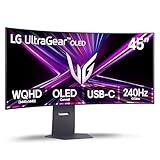
The 45GX900A-B is the most immersive monitor in this roundup and the one that requires the most planning before you buy it. It is a 45-inch curved OLED at 3440×1440 with a 240Hz refresh rate, 0.03ms-class response, and NVIDIA G-Sync support. Nothing else on this list fills your field of view the way it does, and nothing else demands as much desk real estate.
Who it suits: a player with a deep desk — at least 30 inches front to back — and roughly 44 inches of usable width, ideally in a dedicated gaming space where the monitor is not competing with other furniture. It is also the right pick for sim racers, flight sim players, and anyone who plays in first person and wants peripheral vision to be part of the experience.
Key specifications:
- Panel: 45-inch curved OLED, 21:9
- Native resolution: 3440×1440 (WQHD), approximately 83 pixels per inch
- Physical size: roughly 41 inches wide and 18 inches tall before the stand, which is wider than many desks allow
- Refresh rate: 240Hz, 0.03ms-class response
- Adaptive sync: NVIDIA G-Sync support
- Ports: DisplayPort and HDMI inputs; some models in this family add USB-C with power delivery, so confirm on the listing
- OLED care: pixel shift, logo dimming, screen saver, and periodic panel refresh
The case for this monitor is simple: at 45 inches, a 21:9 panel wraps around your view far enough that the edges sit in peripheral vision. In a racing sim or a first-person game, that changes how you read motion, and it is a genuinely different experience from a 27-inch panel. Combined with 240Hz refresh and OLED response, fast panning stays clean across a much wider image.
The case against it is the pixel density. At 3440×1440 spread across 45 inches, you are looking at roughly 83 PPI, compared with about 110 PPI on a 34-inch ultrawide at the same resolution and about 109 PPI on a 27-inch QHD panel. That difference is visible: desktop text is softer, small UI elements are chunkier, and you need to sit further back — a common rule of thumb is to sit roughly 1.5 to 2 times the panel height away, which for an 18-inch-tall screen means 27 to 36 inches, and realistically more for a screen this wide. Sitting too close makes individual pixels perceptible in flat-colored areas.
Physical fit is the other consideration. A 41-inch-wide panel needs a desk that can take it, and the stand footprint is substantial. If your desk is 60 inches wide or narrower, you will be giving the monitor most of it. A VESA arm rated for the panel’s weight is often the better answer than the bundled stand.
Pros
- 45-inch curved panel delivers unmatched immersion
- 240Hz with 0.03ms-class OLED response
- 21:9 aspect ratio is excellent for sims and cinematic games
- G-Sync support for smooth frame pacing
- Comprehensive OLED care settings
Cons
- Roughly 83 PPI means softer text and visible pixels up close
- Requires a deep, wide desk or a heavy-duty monitor arm
- Premium price tier
- Ultrawide aspect ratio leaves black bars in 16:9 content
- Same burn-in exposure as any OLED
Compared with the Alienware AW3425DW, this is a straight trade: the LG gives you 11 more inches of diagonal and more immersion, while the Alienware gives you about 110 PPI on a 34-inch panel, which looks noticeably sharper for desktop work and everyday use. If your monitor is also your workstation, the Alienware is the more sensible premium purchase. If it is purely a gaming display in a dedicated room, the LG wins on presence.
6. Alienware AW3425DW – Best Premium Ultrawide

The AW3425DW is the premium ultrawide for people who want width without sacrificing sharpness. It is a 34.2-inch curved QD-OLED at 3440×1440 with a 240Hz refresh rate and 0.03ms-class response. Where the 45-inch LG trades pixel density for size, this monitor keeps density at roughly 110 PPI — essentially the same as a 27-inch QHD panel — while still giving you a 21:9 field of view.
Who it suits: someone who games and works on the same screen. The 34-inch ultrawide has the same vertical height as a 27-inch 16:9 monitor, roughly 13 inches, so it feels familiar for documents and web pages, but it adds about 8 inches of horizontal space for a second column of windows. That combination makes it the best premium pick for a home office that doubles as a gaming setup.
Key specifications:
- Panel: 34.2-inch curved QD-OLED, 21:9
- Native resolution: 3440×1440 (WQHD), approximately 110 pixels per inch
- Vertical height: roughly 13 inches, matching a 27-inch 16:9 panel
- Refresh rate: 240Hz, 0.03ms-class response
- Curvature: 34-inch ultrawides in this class typically use a gentle curve in the 1800R range; the listing name truncates the figure, so confirm it before buying
- Adaptive sync: G-Sync Compatible and FreeSync support
- Ports: DisplayPort, HDMI, and a USB hub on typical configurations
- OLED care: pixel shift, logo dimming, screen saver, and panel refresh scheduling
The strongest argument for this monitor is the combination of density and width. At about 110 PPI, text is crisp at normal viewing distance, which matters if you spend eight hours a day in documents and only two hours in games. At the same time, 3440×1440 gives you roughly 33 percent more horizontal pixels than 2560×1440, which is enough room for three side-by-side windows or a wide spreadsheet without horizontal scrolling.
Alienware’s approach to OLED ownership is also worth noting. The brand has historically offered multi-year warranties that explicitly cover burn-in on its OLED monitors, which is a meaningful difference from a warranty that treats image retention as normal wear. Check the current terms on the listing, but this is one of the few categories where warranty language genuinely changes the risk calculation.
The caveats are predictable. A curved 34-inch ultrawide is roughly 31 inches wide, so it needs a desk at least 48 inches wide and ideally 30 inches deep. QD-OLED panels lift black levels slightly under strong ambient light and can show faint color fringing on small text. And 240Hz, while excellent, is one step below the 360Hz panels in this list — a gap you will only feel if you are already running frame rates above 240 per second.
Pros
- About 110 PPI, so text stays sharp despite the ultrawide size
- Same vertical height as a 27-inch 16:9 panel, so the switch feels natural
- 240Hz with 0.03ms-class OLED response
- USB hub and generous port selection
- Historically strong burn-in warranty coverage from Alienware
- Best premium pick for mixed gaming and productivity
Cons
- Premium price tier
- Needs a wide, deep desk
- QD-OLED ambient-light black lift and text fringing
- 240Hz rather than 360Hz
Against the LG 45GX900A-B, this is the sharper, more practical premium option: you give up 11 inches of diagonal and a good deal of immersion, and in return you get roughly 27 more pixels per inch and a monitor that works as a workstation. Against the Samsung G61SH, the Alienware costs more but buys you ultrawide width, a USB hub, and a stronger burn-in warranty position.
7. AOC Q27GAZD – Best Value QD-OLED

The Q27GAZD is the value play in this roundup. It is a 27-inch QD-OLED at 2560×1440 with a 240Hz refresh rate, G-Sync Compatible support, and NVIDIA G-SYNC branding, positioned at the budget tier. It gives you the same panel technology as mid-range QD-OLED monitors for less money, which makes it the pick for someone who wants QD-OLED color and does not need the extras.
Who it suits: a buyer on a strict budget who prioritizes image quality over feature count. If you use a single PC, connect with one DisplayPort cable, and do not need a USB hub or a laptop dock, this monitor delivers the core OLED experience — 240Hz, 0.03ms-class response, near-infinite contrast — without the mid-range markup.
Key specifications:
- Panel: 27-inch QD-OLED, 16:9
- Native resolution: 2560×1440 (QHD), approximately 109 pixels per inch
- Refresh rate: 240Hz, 0.03ms-class response
- Adaptive sync: NVIDIA G-Sync Compatible
- Ports: DisplayPort and HDMI inputs on typical configurations
- Mounting: VESA-compatible for a monitor arm
- OLED care: pixel shift and static-element dimming features; expect a leaner set of utilities than premium brands
The value proposition is straightforward: QD-OLED color volume at a budget price. You get the wide color gamut and high contrast that make HDR content look dimensional, plus the 240Hz refresh rate that makes the panel feel fast. At roughly 109 PPI, desktop text is clean at normal viewing distance, and the 27-inch 16:9 footprint is the easiest of any monitor here to fit on an existing desk.
What you give up is mostly convenience. Budget-tier OLEDs typically ship with fewer ports, no USB hub, a simpler stand with fewer adjustment axes, and a less elaborate on-screen menu. That matters if you plan to switch between a work laptop and a gaming PC, or if you want to run a console and a PC simultaneously. It does not matter if you plug in one DisplayPort cable and leave it alone.
The panel-level caveats are shared with every QD-OLED on this list: blacks can look slightly lifted in a brightly lit room, and the subpixel structure can produce faint fringing on small text. Burn-in risk is unchanged — static elements left on screen for long stretches are the first things to wear, so use the screen saver, enable pixel shift, and let the panel run its refresh cycles.
Pros
- QD-OLED color volume at the budget tier
- 240Hz with 0.03ms-class response
- About 109 PPI for clean desktop text
- Standard 27-inch QHD footprint fits most desks
- G-Sync Compatible adaptive sync
- VESA mounting support
Cons
- Leaner OLED care utility set than premium brands
- Fewer ports and no USB hub
- Simpler stand with limited adjustment
- QD-OLED ambient-light black lift
Compared with the Samsung G61SH, this monitor is the same size, resolution, refresh rate, and panel type for less money, trading away the USB hub, the more polished OSD, and Samsung’s more extensive burn-in mitigation suite. Compared with the LG 27GX704A-B, it swaps WOLED’s better bright