Key takeaways
- Polar patterns: cardioid, omnidirectional, figure-8, selectable
- Capsule: 1-inch dual-diaphragm condenser
- Frequency response: 20 Hz–20 kHz
- Sensitivity: 28 mV/Pa
- Equivalent noise level: 16 dB-A
- Maximum SPL: 155 dB
- Switches: −20 dB attenuation pad and a 300 Hz low-cut filter
- Power: 48 V phantom
- Included: spider shock mount and a hard carry case
The best multi-pattern condenser microphone for most home and project studios is the Audio-Technica AT2050. It combines three switchable polar patterns with a dual-diaphragm capsule, published self-noise of 11 dB SPL, a 149 dB maximum SPL that rises to 159 dB with the −10 dB pad engaged, and an 80 Hz high-pass filter — enough range to track a lead vocal, a spaced pair of drum overheads, and a two-person interview without buying a second microphone. If budget is the binding constraint, the MXL 770X bundle delivers a multi-pattern large-diaphragm microphone plus the mount and accessories that are usually purchased separately. If your room is quiet and your recordings are exposed, the AKG C314’s roughly 8 dB-A self-noise is the number that justifies the premium tier. The comparisons below cover polar-pattern choices, self-noise, sensitivity, and included controls, so you can match a specific microphone to your voice, your instruments, and the noise floor of the room you actually record in.
Top 3 Picks
Best overall: Audio-Technica AT2050
The AT2050 is the safest single purchase on this list because it refuses to specialize. Three patterns, a genuinely low 11 dB SPL self-noise figure, a pad that extends headroom to 159 dB, and an 80 Hz filter cover vocals, acoustic instruments, drum overheads, and room capture with one body. It sits in the mid-range tier but behaves like a microphone well above its price class.
Best budget: MXL 770X bundle
The 770X bundle is the cheapest way to get a switchable large-diaphragm condenser plus the shock mount, cable, and pop-filter accessories that a first studio otherwise buys piece by piece. It is not a low-noise microphone by premium standards, and its top end is deliberately bright, but for a first home setup recording vocals, guitar, and streams it removes several purchases at once.
Best premium: AKG C314
The C314 is the pick when self-noise is the deciding specification rather than a tiebreaker. Its published figure of roughly 8 dB-A is among the quietest in this group, which matters when you are stacking eight or ten tracks of a quiet source and every decibel of hiss compounds. It also carries the AKG C-series switch set: a −20 dB pad and a 100 Hz low-cut.
Quick Comparison
Every microphone below is a real, currently listed large-diaphragm condenser. Two of them — the Mackie EM-91C and, depending on the configuration you find, the Warm Audio WA-87jr — are not fully switchable multi-pattern designs. They are included deliberately, because part of choosing a multi-pattern microphone is deciding whether you actually need one, and the honest answer for a solo podcaster in a small room is often no. Spec figures below are published manufacturer numbers where the manufacturer publishes them, and described by spec class where it does not.
| Microphone | Best for | Polar patterns | Key published specs | Price tier |
|---|---|---|---|---|
| AKG P420 | Ensemble and room recording | Cardioid, omni, figure-8 | 1-inch dual-diaphragm; 20 Hz–20 kHz; 16 dB-A self-noise; 155 dB max SPL; 28 mV/Pa sensitivity; −20 dB pad; 300 Hz low-cut; 48 V | Mid-range |
| AKG C114 | Podcasting and streaming voice | Multi-pattern, C-series switching | Large-diaphragm C-series body; XLR output; 48 V phantom; self-noise in the low-teens dB-A class | Mid-range |
| Turnstile Audio TAC1100 | First multi-pattern microphone | Cardioid plus additional selectable patterns | Large-diaphragm multi-pattern capsule; 48 V phantom; budget-class self-noise, high-teens dB-A range | Budget |
| MXL 770X bundle | Starter vocal kit with accessories | Multi-pattern bundle configuration | Large-diaphragm condenser; 20 Hz–20 kHz class response; 48 V phantom; bundle includes mount and accessories | Budget |
| Audio-Technica AT2050 | All-round home and project studio | Cardioid, omni, figure-8 | Dual-diaphragm condenser; 20 Hz–20 kHz; 11 dB SPL self-noise; 149 dB max SPL (159 dB with pad); −42 dB (7.9 mV) sensitivity; −10 dB pad; 80 Hz high-pass; 11–52 V phantom; approx. 380 g | Mid-range |
| AKG C314 | Low-noise critical tracking | Cardioid, omni, figure-8 | 1-inch dual-diaphragm; 20 Hz–20 kHz; approx. 8 dB-A self-noise; approx. 155 dB max SPL; approx. 20 mV/Pa; −20 dB pad; 100 Hz low-cut; 48 V | Premium |
| Warm Audio WA-87jr | Vintage-voiced vocals | Compact 87-style design — confirm pattern configuration on the current listing | Transformer-balanced 87-style FET circuit; large-diaphragm capsule; 48 V phantom; ships with shock mount | Premium |
| Mackie EM-91C | Simple budget voiceover and streaming | Cardioid, single pattern | Large-diaphragm cardioid condenser; 20 Hz–20 kHz class response; 48 V phantom; typically supplied with a shock mount | Budget |
How We Chose
This guide is assembled from published manufacturer specifications, brand documentation, and the structural facts of how condensers behave in real rooms — not from studio sessions with the products in hand. Selection criteria were applied in four passes. First, specification substance: does the microphone publish a real self-noise figure, a real maximum SPL, and a defined switch set, or does it hide behind marketing language? Microphones that publish numbers get ranked on those numbers. Second, category fit: does the model occupy a distinct position in the pattern-and-price landscape, or does it duplicate something already covered? Third, use-case clarity: each entry has to answer a specific question a buyer would actually ask — “what do I record an ensemble with,” “what is the cheapest credible first multi-pattern mic,” “what do I buy if my room is silent.” Fourth, upgrade path: a microphone that leaves you stranded is a worse recommendation than one that still earns its place after you have added a second and third microphone to the locker. Price is expressed only as a tier, because street pricing moves constantly and a tier is the part that stays true.
1. AKG P420 – Best for Ensemble and Room Recording
As an Amazon Associate we earn from qualifying purchases at no extra cost to you.

The P420 is the microphone to reach for when you are pointing one capsule at several sources at once. Choirs, string sections, a drum kit heard as a single instrument, a horn section in a rehearsal room, a piano with the lid open — these are the jobs where a multi-pattern large-diaphragm condenser stops being a luxury and starts being the correct tool. It suits a project studio that records groups more often than it records one person at a time, and it suits a home recordist who wants a second microphone that can capture a room rather than another vocal mic.
Key specs
- Polar patterns: cardioid, omnidirectional, figure-8, selectable
- Capsule: 1-inch dual-diaphragm condenser
- Frequency response: 20 Hz–20 kHz
- Sensitivity: 28 mV/Pa
- Equivalent noise level: 16 dB-A
- Maximum SPL: 155 dB
- Switches: −20 dB attenuation pad and a 300 Hz low-cut filter
- Power: 48 V phantom
- Included: spider shock mount and a hard carry case
The headline strength is headroom. A 155 dB maximum SPL means the P420 does not flinch in front of a snare drum two feet away, a trumpet at close range, or a guitar cabinet turned up past the point where the neighbours start leaving notes. That headroom is the reason it works as an ensemble microphone: you can place it where the balance sounds right rather than where the microphone can survive, and the −20 dB pad gives you a second gear for the loudest sources without changing position.
The switch set is practical but opinionated. The pad is a full 20 dB rather than the more common 10 dB, which is generous for loud sources but coarse if you only need a small trim. The low-cut filter sits at 300 Hz, which is high — high enough to remove proximity-effect buildup from a close voice, room rumble from a floor-level stand, and handling noise, but also high enough to thin out a baritone vocal or a cello if you leave it engaged by mistake. Treat that filter as a problem-solver, not a default.
The 16 dB-A self-noise figure is respectable without being exceptional. On a loud ensemble it is inaudible. On a solo fingerpicked guitar in a quiet room with a lot of gain applied, it is a faint but present floor. If your work is mostly exposed quiet sources, the AT2050 or the C314 in this list will beat it on that single measurement. If your work is mostly loud or multi-source, that difference will never reach your mixes.
Pros
- 155 dB maximum SPL handles drums, brass, and amplifiers without repositioning
- Three patterns make it a genuine room and ensemble tool, not a vocal mic with extra switches
- Ships with a proper spider shock mount and a hard case, both of which cost real money separately
- High 28 mV/Pa output pairs easily with budget interfaces that have limited clean gain
- Solid, heavy body that sits still on a stand
Cons
- 16 dB-A self-noise is average for the tier — audible on very quiet, heavily gained sources
- The 300 Hz low-cut is high enough to thin low voices and low instruments
- The −20 dB pad is coarse if you only need a gentle trim
- Weight demands a sturdy stand and a stable boom arm
- No intermediate pad or filter settings
How it compares
Against the Audio-Technica AT2050, the P420 wins on maximum SPL and loses on self-noise and filter flexibility. If you record loud sources or capture rooms, take the P420; if you record quiet sources or want a gentler 80 Hz filter, take the AT2050. Against the AKG C314, the P420 is the working-horse version of the same idea — same pattern concept, less headroom refinement, noticeably more self-noise, and a lower tier of price.
2. AKG C114 – Best for Podcasting and Streaming Voice

The C114 sits in AKG’s C-series, the family that starts at the single-pattern C214 and climbs to the multi-pattern C314. It is aimed squarely at spoken word: podcasting, streaming, voiceover, and interview work, where the microphone spends its life 4 to 10 inches from one or two mouths and almost never in front of a drum kit. It suits a creator who wants a studio-brand XLR microphone with pattern flexibility, and who is willing to buy an audio interface with clean gain rather than a USB microphone.
Key specs
- Type: large-diaphragm XLR studio condenser, C-series lineage
- Polar patterns: multi-pattern switching as listed
- Frequency response: full-range studio condenser class, 20 Hz–20 kHz range
- Self-noise: low-teens dB-A class, typical of the C-series
- Power: 48 V phantom required
- Output: balanced XLR
For a spoken-word microphone, the two specifications that matter most are self-noise and off-axis behaviour, and the C-series is built around both. A low self-noise figure means you can apply heavy compression to a voice track without lifting a hiss floor into audibility — and voice work is almost always compressed heavily. Controlled off-axis response means the microphone rejects the sound of a keyboard, a laptop fan, or a co-host sitting slightly to the side rather than colouring everything it hears.
The pattern switch is the part that earns its place in a podcasting context rather than a music one. Cardioid is the solo setting: one voice, maximum rejection of the room behind the microphone. Figure-8 is the two-person setting: place the microphone between two speakers facing each other across a table and each sits in a lobe, which is a fundamentally different and often better sound than two microphones in cardioid pointed at two people. Omnidirectional is the round-table setting, and it is also the pattern that picks up the most room, which is why it is the one you use last.
Because this is a mid-tier microphone rather than a budget one, the practical cost of ownership includes an interface with enough clean gain. A low-output condenser plus a noisy preamp is a worse combination than a slightly noisier microphone plus a quiet preamp. Budget for the interface as part of the microphone decision.
Pros
- C-series capsule heritage with a genuinely low self-noise class for voice work
- Pattern switching opens up two-person interviews and round-table recording
- Balanced XLR output and 48 V operation fit any standard studio chain
- Purpose-built for the distances and levels that spoken word actually uses
- Sits in the same ecosystem as the C214 and C314, so a second AKG body feels familiar
Cons
- Mid-range pricing means the total cost includes an interface with clean gain
- Not the microphone to choose if loud instruments are also on the schedule
- Requires 48 V phantom power, so it will not run from a USB-only setup
- Pattern switching adds a control you must remember to check before every session
How it compares
Against the Audio-Technica AT2050, the C114 is the more specialized voice tool and the AT2050 is the more general one; if you record music as well as speech, the AT2050’s broader headroom makes it the safer single purchase. Against the AKG C314, the C114 is the practical podcasting entry point while the C314 is the low-noise critical-recording instrument — the gap between them is mostly self-noise, headroom, and price tier rather than basic capability.
3. Turnstile Audio TAC1100 – Best for a First Multi-Pattern Microphone

The TAC1100 is the answer to a specific question: what is the least expensive way to get a large-diaphragm condenser with more than one polar pattern? It suits a student, a hobbyist, or someone building a first home setup who wants to learn what omnidirectional and figure-8 actually sound like in their own room before spending mid-range money on the concept. It also suits a second-studio or rehearsal-space setup where the microphone will live on a stand and take some abuse.
Key specs
- Type: large-diaphragm multi-pattern condenser, XLR output
- Polar patterns: cardioid plus additional selectable patterns
- Frequency response: 20 Hz–20 kHz class
- Self-noise: budget-class, high-teens dB-A range
- Power: 48 V phantom
- Construction: metal body, stand-mount configuration
At the budget tier, the engineering trade-offs are predictable and worth understanding rather than resenting. The capsule and the electronics are built to a price, which shows up first in self-noise and second in consistency between units. A budget condenser will typically publish or exhibit a noise floor in the high teens dB-A, meaning it is fine for a close-miked vocal, an amplifier, or a drum overhead, and less fine for a quiet acoustic guitar tracked at a distance with heavy gain. Knowing which side of that line your work falls on is more useful than any single specification.
The genuine value here is educational. A multi-pattern microphone lets you hear, in your own room, why omnidirectional capture sounds bigger and more distant, why figure-8 rejects the sides and picks up the back, and why cardioid is the default for close work. That experience transfers directly to how you use a premium microphone later. A buyer who spends budget money on pattern flexibility and then upgrades in two years has spent that money well.
Budget microphones also tend to include fewer accessories. Expect to add a shock mount, a pop filter, and a decent stand, and factor those into the total. If a bundle that includes them exists at a similar tier, the bundle is usually the better first purchase.
Pros
- Pattern switching at the lowest price tier in this list
- Large-diaphragm character and a full-range response for the money
- Low-risk way to learn how omni and figure-8 behave in your own room
- XLR output keeps it compatible with any interface you upgrade to later
- Sensible choice for a rehearsal room or second location where damage is a real possibility
Cons
- Budget-class self-noise is audible on quiet sources tracked at a distance
- Unit-to-unit consistency is less predictable than at higher tiers
- Accessories such as shock mount and pop filter are often extra purchases
- Resale value is limited if you upgrade quickly
- Switch hardware is generally less durable than on premium bodies
How it compares
Against the MXL 770X bundle, the TAC1100 is the more pattern-focused purchase and the 770X is the more accessory-focused one; if the bundle includes the mount and filter you need, it usually represents better total value. Against the Audio-Technica AT2050, the TAC1100 saves money and gives up the low self-noise and the 80 Hz filter that make the AT2050 a long-term keeper. Buy the TAC1100 to learn, and buy the AT2050 to keep.
4. MXL 770X – Best Budget Bundle
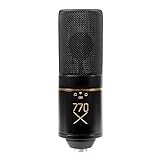
The 770X is sold as a bundle, and the bundle is the point. It suits a first-time buyer who has an interface and a computer but no accessories, and who wants to reach a working recording setup in one purchase rather than four. It suits vocalists, streamers, and singer-songwriters tracking acoustic guitar and voice, and it suits anyone who wants a spare multi-pattern microphone on hand without spending mid-range money on it.
Key specs
- Type: large-diaphragm condenser, multi-pattern bundle configuration
- Frequency response: 20 Hz–20 kHz class
- Power: 48 V phantom
- Output: balanced XLR
- Included: bundle accessories, typically a shock mount, cable, and pop filter depending on configuration
- Finish: black
MXL has built its reputation on entry-level condensers, and the family sound is consistent: a lifted presence region that makes a vocal sit forward in a mix with almost no EQ. For a beginner recording into a laptop with modest monitoring, that brightness is genuinely helpful — it makes a take sound finished. For a more experienced engineer, the same lift can read as sibilance on a bright voice, and it is the first thing you reach for an EQ to tame.
The bundle maths is the real argument. A shock mount, a pop filter, and a microphone cable bought separately add up to a meaningful fraction of a budget microphone’s price, and they are exactly the items a first-time buyer forgets. A bundled kit removes that friction. The trade-off is that bundled accessories are usually basic rather than good — a functional shock mount, an adequate cable — but functional is the correct standard at this tier.
Self-noise at the budget tier is where the compromise lives. Expect a noise floor in the high-teens dB-A range, which is fine for close vocals and loud sources and less fine for quiet, distant capture. Practically: use it close, use it on sources that make sound, and it will not disappoint.
Pros
- Bundle removes the accessory purchases that trip up first-time buyers
- Bright, forward presence makes vocals sit in a mix with minimal processing
- Multi-pattern configuration gives pattern flexibility at the budget tier
- XLR output remains compatible with any future interface upgrade
- Low total cost of entry to a complete recording chain
Cons
- Budget-class self-noise limits quiet, distant source capture
- Presence lift can exaggerate sibilance on already-bright voices
- Bundled accessories are basic rather than premium
- Limited upgrade value once you move to mid-range microphones
- Requires 48 V phantom power and therefore an interface
How it compares
Against the Turnstile Audio TAC1100, the 770X bundle wins on total cost of a working setup because the accessories are included, while the TAC1100 is the cleaner comparison if you already own a shock mount and a cable. Against the Audio-Technica AT2050, the 770X is the budget stepping stone and the AT2050 is the long-term tool — the difference is 11 dB SPL versus a high-teens noise floor and an 80 Hz filter versus a fixed response.
5. Audio-Technica AT2050 – Best Overall
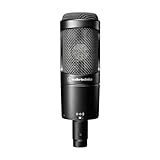
The AT2050 is the microphone most people should buy if they are buying one. It suits a home or project studio that records a bit of everything — vocals, acoustic guitar, drum overheads, piano, interviews, the occasional amplifier — and it suits anyone who wants a microphone that will still be earning its place after two or three other microphones have joined the locker. It is the definition of a mid-range workhorse: unglamorous, flexible, and hard to outgrow.
Key specs
- Polar patterns: cardioid, omnidirectional, figure-8, switchable
- Capsule: dual-diaphragm condenser with externally biased element
- Frequency response: 20 Hz–20 kHz
- Open-circuit sensitivity: −42 dB (7.9 mV) re 1 V at 1 Pa
- Self-noise: 11 dB SPL (A-weighted)
- Maximum SPL: 149 dB; 159 dB with the −10 dB pad engaged
- Switches: −10 dB pad and 80 Hz high-pass filter
- Phantom power: 11–52 V DC
- Weight: approximately 380 g
- Included: shock mount and protective pouch
The 11 dB SPL self-noise figure is the specification that separates the AT2050 from most of the mid-range field. That is quiet enough that a quiet source — a fingerpicked guitar, a soft vocal, a room tone bed — can be gained up aggressively without the microphone becoming the loudest thing in the track. Combined with the 80 Hz high-pass filter, which sits low enough to remove rumble and handling noise without thinning a baritone voice, the switch set is designed to solve problems rather than to look impressive on a spec sheet.
The pad deserves specific attention because it is the correct value. A −10 dB pad is a trim, not a safety net; it buys you about 10 dB of extra headroom for a close-miked snare, a loud guitar amplifier, or a vocalist who leans in. On a microphone with a 149 dB ceiling that pushes the limit to 159 dB, which is beyond what almost any source in a home studio will produce. The 11–52 V phantom power range also means it will run from interfaces that deliver less than a full 48 V, which is a real advantage with bus-powered audio interfaces.
Tonally the AT2050 is neutral-leaning rather than flattering. It does not add the upper-mid presence lift that a budget condenser adds, and it does not add the transformer colour that a vintage-voiced microphone adds. That neutrality is what makes it a generalist. It also means it is less forgiving: a bad room sounds like a bad room through an AT2050, whereas a coloured microphone can partially mask it. Buy the AT2050 and treat the room as part of the signal chain.
Pros
- 11 dB SPL self-noise is genuinely low for the mid-range tier
- Three patterns cover vocals, instruments, room capture, and stereo techniques
- −10 dB pad extends headroom to 159 dB, which handles essentially any home-studio source
- 80 Hz high-pass filter is low enough to be useful without thinning voices
- Runs on 11–52 V phantom, so it works with bus-powered interfaces
- Ships with a shock mount and pouch, and weighs a manageable 380 g
Cons
- Neutral character does not flatter a poor room or a harsh source
- Not the lowest self-noise option in this list — the C314 is quieter
- Less maximum SPL than the AKG P420 for extreme sources
- Switch set is small; no intermediate pad or filter positions
- Mid-range price means it is a considered purchase rather than an impulse one
How it compares
Against the AKG P420, the AT2050 trades 6 dB of maximum SPL for 5 dB less self-noise and a much more usable 80 Hz filter; for quiet sources and general studio work the AT2050 is the better microphone, and for loud ensembles the P420 is. Against the AKG C314, the AT2050 gives up roughly 3 dB of self-noise and some headroom in exchange for a lower price tier — a worthwhile trade unless your work is exclusively quiet, exposed material.
6. AKG C314 – Best Premium

The C314 is for the recordist whose limiting factor is the noise floor. It suits a treated room, a quiet source, and a workflow that stacks many tracks — layered background vocals, a string quartet tracked one player at a time, delicate acoustic instruments, quiet Foley-style detail work. It also suits anyone who wants a single premium large-diaphragm condenser that covers all three main patterns and will not need replacing.
Key specs
- Polar patterns: cardioid, omnidirectional, figure-8, switchable
- Capsule: 1-inch dual-diaphragm condenser
- Frequency response: 20 Hz–20 kHz
- Self-noise: approximately 8 dB-A
- Maximum SPL: approximately 155 dB
- Sensitivity: approximately 20 mV/Pa
- Switches: −20 dB attenuation pad and 100 Hz low-cut filter
- Power: 48 V phantom
- Included: spider shock mount and metal carry case
The roughly 8 dB-A self-noise figure is the reason to buy it. Three decibels of noise floor is not a subtle difference when you are summing eight vocal layers, each with 20 dB of compression applied. Noise adds up in a stack, and a microphone that is 3 dB quieter contributes half the noise power of the next best option. In a treated room with a quiet preamp, the C314 is effectively silent on a close source.
The switch set is the professional configuration: a −20 dB pad for loud sources and a 100 Hz low-cut. The 100 Hz filter is a more conservative choice than the P420’s 300 Hz, which means it removes rumble, HVAC noise, and floor vibration while leaving the fundamental of a low voice intact. That conservatism is deliberate in a microphone intended for critical recording.
Two ownership realities come with a premium microphone. The first is that it exposes your room. A microphone this quiet and this accurate will faithfully capture the reflections, the computer fan, and the traffic outside; the self-noise advantage only pays off if the room noise floor is low enough for it to matter. The second is that the included spider shock mount and metal case are not accessories here, they are part of the design intent — use them. A premium capsule is a precision component and should not live on a bare stand in a dusty room.
Pros
- Approximately 8 dB-A self-noise, among the quietest in this group
- Three patterns with a professional switch set: −20 dB pad and 100 Hz low-cut
- High headroom of roughly 155 dB maximum SPL
- Spider shock mount and metal case included as standard
- Neutral, accurate character that takes EQ and compression without complaint
Cons
- Premium price tier — the largest investment on this list
- Reveals room problems rather than hiding them
- The low-noise advantage is wasted in an untreated or noisy room
- Requires a genuinely quiet preamp to realize its noise performance
- Overkill if you record loud sources in a modest space
How it compares
Against the Audio-Technica AT2050, the C314 buys roughly 3 dB of self-noise and about 6 dB of extra headroom for a substantially higher price; whether that is worth it depends entirely on how quiet your room and your sources are. Against the AKG P420, the C314 is the precision instrument and the P420 is the working tool — the P420 handles louder sources with less fuss, while the C314 wins on every measurement that matters for exposed, quiet recording.
7. Warm Audio WA-87jr – Best for Vintage-Voiced Vocals

The WA-87jr is a transformer-flavoured large-diaphragm condenser in the classic 87 lineage, and it suits a vocalist or producer who wants colour rather than neutrality. It is the microphone you choose when you have decided the voice in front of you should sound warm, thick, and slightly compressed before any plugin is loaded. It suits pop, rock, and soul vocals, electric guitar cabinets, and any source where a little transformer character is an improvement rather than a distortion.
Key specs
- Type: transformer-balanced large-diaphragm FET condenser in the 87 style
- Polar patterns: compact 87-style design — confirm the pattern configuration on the current listing, as the “jr” designation indicates a pared-back version of the full-size family member
- Circuit: transformer-balanced output stage
- Power: 48 V phantom
- Included: shock mount
The defining characteristic of an 87-style FET design is the combination of a transformer-balanced output and a capsule tuned for a gentle upper-mid presence with a controlled top end. In practice that reads as a vocal that needs less work to sit in a dense mix. Where the AT2050 tells the truth about your room, the WA-87jr tells a slightly more flattering version of it — which is exactly the right choice for some productions and the wrong one for others.
Transformer colour is not a defect to be corrected, but it is a commitment. The low end thickens, transients soften very slightly, and the top end rounds off. On a solo acoustic guitar in a sparse arrangement, that softening can cost you the detail that makes the part interesting. On a loud rock vocal in a busy arrangement, it is the difference between a track that fights for space and one that occupies it naturally.
The pattern question deserves honest treatment. Warm Audio’s “jr” models are the simplified members of their respective families, and simplified usually means fewer switchable options than the full-size design. If switchable polar patterns are a hard requirement for you — because you record two-person interviews or you want room capture — verify the pattern configuration on the current listing before you commit, and treat this microphone as a tone-first, pattern-second choice.
Pros
- Transformer-balanced 87-style circuit delivers classic vocal warmth and density
- Flattering upper-mid character reduces the work needed to place a vocal in a mix
- Premium build quality at a price tier below the flagship 87-style designs
- Ships with a shock mount
- Excellent on electric guitar cabinets and any source that benefits from weight
Cons
- Pattern configuration
Affiliate disclosure. As an Amazon Associate we earn from qualifying purchases at no extra cost to you. Prices accurate as of the date shown.Best Multi-Pattern Condenser Microphones for RecordingCheck price on Amazon