Key takeaways
- Compare the best book storage boxes for keeping books safe, from acid-free archival boxes to sturdy scrapbook cases for home libraries and archives.
- Top Pick: Lineco Museum Archival Storage Box, Drop Front
- Runner-up: Lineco Archival Document Storage Box with 12 Folders
- Also consider: Golden State Art Clamshell Archival Storage Box
The best book storage box for most readers is the Lineco Museum Archival Storage Box in the 14.75 by 18.75 by 3 inch size, because it pairs genuine archival board with a drop front that lets large books and flat items slide out without bending, and its metal-edge corners keep the box square when stacked. Readers who want a complete starting kit should look at the Lineco Archival Document Storage Box with 12 Folders, which adds acid-free folders, gloves, a bone folder, a pH testing pen and photo bags in the same box. Readers who want the lowest-cost way into true archival board should look at the Golden State Art Clamshell, and readers who want a hard plastic box that shrugs off closet humidity should look at the Pioneer Jumbo Scrapbook Storage Box. For oversized books, newspapers and flat art, the Gaylord Archival Newspaper Preservation Box is the pick, at 25 by 19 by 2.5 inches.
This guide compares five boxes that actually store books, not boxes that look like books. The distinction matters on this site, because the delivered decorative book boxes guide covers faux books made for display, and the delivered comic book storage boxes guide covers boxes sized for bagged comics. The five boxes here are for hardcovers, paperbacks, family Bibles, scrapbooks and oversized volumes that need to sit flat, stay dry and stay away from the acid and lignin in ordinary cardboard. Every figure below comes from the manufacturers’ published specification data and listing data, so you can match a box to the books you own without guessing.
As an Amazon Associate, we earn from qualifying purchases.
Table of Contents
- What to look for in a book storage box
- Quick comparison
- 1. Lineco Museum Archival Storage Box, Drop Front
- 2. Lineco Archival Document Storage Box with 12 Folders
- 3. Golden State Art Clamshell Archival Storage Box
- 4. Pioneer Jumbo Scrapbook Storage Box
- 5. Gaylord Archival Newspaper Preservation Box
- Listing checks and the recall record
- Frequently asked questions
- Conclusion
- Product and ASIN Reference
What to look for in a book storage box
Acid-free and lignin-free are two separate claims, and a box for books should carry both. Acid-free describes the board’s current pH, and lignin-free means the board was made without the wood compound that breaks down into acid over time. Ordinary cardboard carries both acid and lignin, and both migrate into whatever the box touches, browning and embrittling paper over decades. A box that claims only one of the two is half a promise. All three archival board picks in this guide state both claims, and the Pioneer plastic pick is acid-free, lignin-free and PVC-free by a different route, because plastic has no wood fiber to break down.
Buffered board is right for most paper and wrong for some photographs. Buffered board carries an alkaline reserve, usually calcium carbonate, that neutralizes acid migrating in from outside or from the documents themselves. That is the right chemistry for books, letters, newspapers and maps. It is the wrong chemistry for a few photographic processes, including albumen prints and cyanotypes, where an alkaline environment can damage the image. If the box will hold photographs as well as books, look for a passed Photographic Activity Test, the standardized incubation test published as ISO 18916, which checks whether a material stains or fades photographic layers. The Gaylord pick in this guide states a passed test; the Lineco picks do not state one, which is why the Gaylord is the safer box for anything irreplaceable that includes photographs.
The opening decides how the books come out. A drop front folds down so a large book slides out flat instead of being lifted over a rigid wall, and lifting a fragile book over a lip is exactly how corners get creased. A clamshell opens completely flat, so you place items rather than posting them into a slot, which is the gentlest handling for a fragile volume. A lift-off lid is the simplest opening and the cheapest to make, and it means unstacking to open the box, which is a real cost when boxes are stacked three high on a shelf. Match the opening to the books: drop front or clamshell for anything fragile or oversized, lift-off lid for sturdy books that get handled often.
Measure the books before ordering, and measure inside the box, not outside. A box that measures 14.75 by 18.75 inches outside may hold a book a full inch smaller once the board thickness and the lid are counted, and a book that fits on the diagonal does not fit at all. The Pioneer pick publishes both outside and inside dimensions, and the gap is a quarter inch on each side. The Lineco museum pick is sized around 14 by 18 inch documents, and the Gaylord newspaper pick is sized around unfolded newspapers. For a standard hardcover, which runs about 6 by 9 inches, any pick here works; for a family Bible, a large art book or a scrapbook, the inside dimensions are the whole decision.
Plastic and board protect against different things. Rigid board boxes breathe, which is good for paper in a dry room and bad in a damp one, because board softens with moisture and no board box in this guide is water resistant. Hard plastic boxes, like the Pioneer pick, shrug off closet humidity and resist crushing, and they will not yellow or feed acid into a collection over decades. Fabric collapsible boxes sit between the two, kinder to handle and able to fold flat when empty, but with no crush strength and no water resistance worth the name, and none is picked here. Store every box in this guide off the floor on a sturdy shelf, in a dry room, away from exterior walls.
Stacking strength comes from the corners, not the walls. Metal-edge construction wraps the corners in metal, which is where a board box usually fails first, and it is what keeps a box square under the weight of the boxes above it. The Lineco and Gaylord picks both carry metal edges. A box without them sags, and a sagging box puts weight on the books inside. If the plan is to stack three or four boxes high, treat metal edges as a requirement, not a feature.
Quick comparison
| Box | Best for | Material | Outside size | Opening |
|---|---|---|---|---|
| Lineco Museum Archival Storage Box | Best overall | 60-point acid-free, lignin-free board | 14.75 x 18.75 x 3 in | Drop front, lift-off lid |
| Lineco Archival Document Storage Box with 12 Folders | Best starter kit | 60-point acid-free buffered board | 12.5 x 10.5 x 5 in | Lift-off lid |
| Golden State Art Clamshell | Best clamshell value | Acid-free, lignin-free 60-point board | Not stated | Clamshell |
| Pioneer Jumbo Scrapbook Storage Box | Best plastic box | Acid-free, lignin-free, PVC-free plastic | 14.75 x 13 x 3.75 in | Lift-off lid |
| Gaylord Archival Newspaper Preservation Box | Best oversized | 60-point acid-free, lignin-free buffered board | 25 x 19 x 2.5 in | Lift-off lid |
1. Lineco Museum Archival Storage Box, Drop Front

The Lineco Museum Archival Storage Box is the best book storage box for most readers, because it is the only pick here that combines genuine archival board with a drop front and metal-edge corners in a size that fits large books flat. The box is built from 60-point board, heavy and rigid rather than corrugated, lined with acid-free and lignin-free paper, and the corners are wrapped in metal, which is where a board box usually fails first. The lid lifts off and the front drops down, so a large book slides out flat instead of being tipped and shaken. Overall it measures 14.75 by 18.75 by 3 inches, sized around 14 by 18 inch documents and prints, and turned with the narrow side out it sits on a standard shelf.
The drop front is the practical feature. A family Bible, a large art book or a stack of hardcovers goes in flat and comes out flat, and the front panel folds down so nothing drags across a rigid lip. That matters most for books with fragile bindings, because lifting a heavy book over a wall is how spines crack and corners fold. The box is made in the United States, and the tan colorway is the one pinned here; a gray version of the same museum box exists in a smaller 9.75 by 12.75 by 3 inch size, which is a different listing and is not the box pinned here.
The trade is depth. Three inches holds a small stack of books or one thick volume with interleaving tissue, and it does not hold a tall stack. Readers who need to store a whole shelf of books should look at the deeper Lineco document case or the Gaylord newspaper box, and readers who store mostly paperbacks will find three inches generous. The box is not water resistant, and it should live on a shelf, not on a basement floor.
Specs
- Material: 60-point acid-free, lignin-free board with metal edge corners
- Outside dimensions: 14.75 x 18.75 x 3 in
- Opening: Drop front with lift-off lid
- Color: Tan
- Made in: United States
- Fits: 14 x 18 in documents, prints and large books laid flat
- Water resistance: Not water resistant
2. Lineco Archival Document Storage Box with 12 Folders
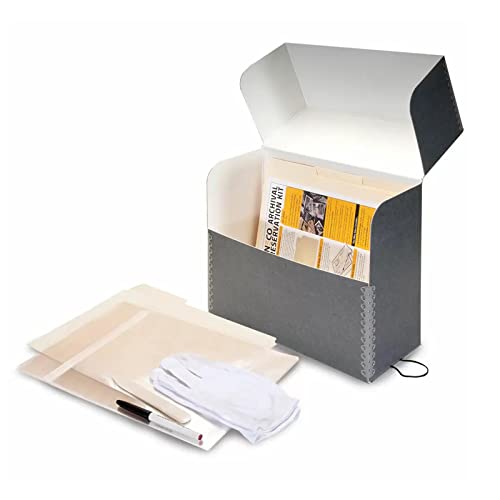
The Lineco Archival Document Storage Box with 12 Folders is the best starter kit in this guide, because it is the only pick that arrives as a working archive rather than an empty box. Inside the gray acid-free box are 12 letter-size acid-free folders, a pair of gloves, a bone folder, a pH testing pen, 10 photo bags and the box itself, which measures 12.5 by 10.5 by 5 inches. The board is blue and gray acid-free buffered board with a white liner, and the box holds about 360 sheets. For a reader who has just inherited a box of family letters, a set of first editions with loose inserts, or a stack of documents that have been living between the pages of books, this is the pick that turns a pile into an archive in one order.
The folders are the feature that matters. Loose papers slump and curl without support, and a folder per subject, per correspondent or per decade keeps a stack upright and findable. The gloves keep skin oils off old paper, the bone folder creases interleaving tissue cleanly, and the pH testing pen lets a reader check whether a folder or an insert is acid-free before trusting it with a valuable page. The Library of Congress recommends acid- and lignin-free boxes for prolonged book storage and suggests boxing valuable damaged books rather than automatically attempting repairs, and this kit is the closest thing to that advice in a single listing.
The trade is size. At 12.5 by 10.5 by 5 inches, the box holds letter-size papers and small books, not large hardcovers and not oversized volumes. A standard hardcover at about 6 by 9 inches fits, but a family Bible does not, and neither does a large art book. The box is also the deepest pick here at 5 inches, which suits upright papers and hurts flat books, because a deep box invites stacking books on top of each other until the bottom one bears the weight of the rest. Use it for papers and small books, and use the museum box for anything large.
Specs
- Material: Blue and gray acid-free buffered board with white liner
- Outside dimensions: 12.5 x 10.5 x 5 in
- Opening: Lift-off lid
- Color: Gray
- Included: 12 acid-free folders, gloves, bone folder, pH testing pen, 10 photo bags
- Capacity: About 360 sheets
- Fits: Letter-size documents and small books
3. Golden State Art Clamshell Archival Storage Box

The Golden State Art Clamshell is the best clamshell value in this guide, because it gives a reader the gentlest opening in the category at the lowest cost of entry among the archival board picks. A clamshell opens completely flat, so you place a book rather than posting it into a slot, and for a fragile volume that is the gentlest possible handling. The board is acid-free, lignin-free 60-point stock, the same weight class as the Lineco and Gaylord picks, and the box is sized for letter-size documents and books, with a deep lid that closes tightly against dust and light.
The clamshell design is the reason to choose this box over the drop-front Lineco. A drop front still asks the book to slide, and sliding is fine for a sturdy hardcover and risky for a book with a loose binding or a detached board. A clamshell asks nothing of the book at all: open the lid, set the book in, close the lid. For a reader storing a single treasured volume, a signed first edition or a family Bible with a fragile spine, that handling difference is worth more than any other feature in this guide.
The trade is documentation. The listing records reviewed for this box do not publish its outside dimensions, so the exact size is recorded as not stated here rather than estimated from the maker’s drop-front sibling, which measures 9.25 by 11.75 by 3 inches with an 8.5 by 11 inch interior. Measure the book first, confirm the size on the live page before ordering, and use the reference table at the end to pin the exact listing. The box is also the weakest verification route in this lineup, resting on a roundup identifier rather than a direct listing crawl, so the live offer deserves a glance before posting.
Specs
- Material: Acid-free, lignin-free 60-point board
- Outside dimensions: Not stated
- Opening: Clamshell with deep lid
- Fits: Letter-size documents and books
- Board weight: 60 point
4. Pioneer Jumbo Scrapbook Storage Box
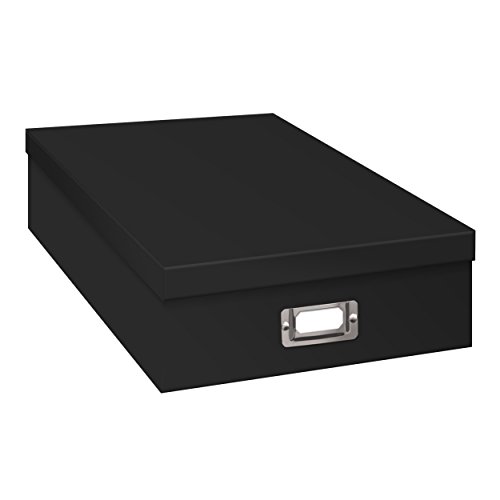
The Pioneer Jumbo Scrapbook Storage Box is the best plastic box in this guide, because it is the only pick that shrugs off closet humidity, resists crushing and will not yellow or feed acid into a collection over decades. The box is made of thick, durable plastic that is acid-free, lignin-free and PVC-free, which is the archival claim that matters for plastic: no wood fiber to break down, and no vinyl to off-gas onto paper. Outside it measures 14.75 by 13 by 3.75 inches, and inside it measures 14.5 by 12.75 by 3.5 inches, which fits standard 12 by 12 inch scrapbook pages with room for supplies. A metal nameplate on the front takes a label, so a shelf of identical black boxes stays findable.
The plastic construction is the argument. A board box in a damp room softens, and a damp board box is worse than no box at all, because it holds moisture against the books. The Pioneer box does not soften, and its rigid walls protect a scrapbook or a stack of books from the weight of whatever sits beside it. The box has been on the market since 2009, which is the longest listing record in this guide, and it is the pick for readers whose storage room runs humid, for books that travel to a cabin or a storage unit, and for scrapbooks that get carried to a table and back.
The trade is stacking. The maker’s own guidance and independent roundups both note that the box cannot be stacked when full, which is a real limit on a shelf where space is tight. It is also available only in black in the listing pinned here, and the box is heavy for its size, which matters when a full box has to come down from a high shelf. Treat it as a single-layer box: one box per shelf slot, label facing out, nothing on top.
Specs
- Material: Acid-free, lignin-free, PVC-free plastic
- Outside dimensions: 14.75 x 13 x 3.75 in
- Inside dimensions: 14.5 x 12.75 x 3.5 in
- Opening: Lift-off lid
- Color: Black
- Fits: 12 x 12 in scrapbook pages, books and supplies
- Stacking: Not stackable when full
- Date first available: February 2009
5. Gaylord Archival Newspaper Preservation Box

The Gaylord Archival Newspaper Preservation Box is the best oversized pick in this guide, because it is the only box here that holds an unfolded newspaper, a large art book or a stack of oversized volumes flat. The box measures 25 by 19 by 2.5 inches, built from 60-point acid-free, lignin-free buffered barrier board with reinforced metal edges, and the lift-off lid closes over a 25 liter volume. The board is buffered with an alkaline reserve, and the maker states that the box has passed the Photographic Activity Test, the standardized incubation test for staining and image fading, which is the single most meaningful credential on any box in this guide for anything that includes photographs.
The size is the whole point. Oversized books are the hardest books to store, because they do not fit a standard shelf and they do not fit a standard box, and they end up leaning in a stack where the bottom book carries the weight of the rest. A flat box ends that. The Gaylord box holds the oversized volume flat, keeps dust and light off it, and stacks squarely because the metal edges keep the corners true. The blue and gray colorway is the one pinned here, and a tan version of the same newspaper box exists in a larger 22.75 by 30.88 by 2.88 inch size, which is a different listing and is not the box pinned here.
The trade is freshness of evidence. The newest direct crawl of this exact listing is about 361 days old, the oldest in this lineup, so the live offer deserves a glance before posting. The box is also not water resistant, and at 25 inches long it needs a shelf deep enough to hold it, which rules out most standard bookcases. Measure the shelf before ordering, store the box off the floor, and do not overload it: flat storage protects a book only when the box is not asked to carry more than its walls can hold.
Specs
- Material: 60-point acid-free, lignin-free buffered barrier board with metal edges
- Outside dimensions: 25 x 19 x 2.5 in
- Opening: Lift-off lid
- Color: Blue and Grey
- Volume: 25 liters
- Certification: Passed Photographic Activity Test
- Water resistance: Not water resistant
Listing checks and the recall record
Confirm the size, the colorway and the contents on the live page, because all three are variant traps in this category. The Lineco museum box sells in a tan 14.75 by 18.75 inch size and in a gray 9.75 by 12.75 inch size, and the two are different boxes with different capacities. The Gaylord newspaper box sells in a blue and gray 19 by 25 inch size and in a tan 22.75 by 30.88 inch size, and again the two are different boxes. The Pioneer scrapbook box sells in black in the listing pinned here and in red, sky blue and spring green under separate listings, and the two-pack of the black box is a separate listing with its own identifier. The Lineco document case is a kit, and the kit contents are part of the listing: 12 folders, gloves, a bone folder, a pH testing pen and 10 photo bags. Confirm all three details on the live page before ordering, and use the reference table at the end to pin the exact listing.
Treat unpublished dimensions as questions, not details. The Golden State Art clamshell in this guide does not publish its outside dimensions in the records reviewed, and that figure is recorded as not stated rather than estimated from the maker’s drop-front sibling, because a quarter inch is the difference between a book that fits and a book that does not. The check takes a moment on the live page and matters most for the largest book in the collection, which is the book the box is being bought for. Where a live page does not state an inside dimension either, the safe assumption is that the inside runs about a quarter inch smaller than the outside on each side, which is the gap the Pioneer pick publishes.
A storage box is not a safe, and no box in this guide protects against water. Board boxes soften with moisture, plastic boxes keep humidity out but do not seal against a flood, and no pick here claims water resistance. Store every box off the floor on a sturdy shelf, in a dry room, away from exterior walls and away from pipes. The Library of Congress guidance behind this whole category is preventive care: good handling, good storage and a good environment are the most effective and economical preservation strategy, and a box is the storage half of that advice, not a substitute for the environment half. Keep books out of attics and basements where temperature and humidity swing, and keep the boxes where the books would be comfortable to read.
The recall record for this category is empty, and the adjacent records this site carries belong to other products. A search of the federal recall record found no recall covering book storage boxes as a product class and no recall covering any of the five picks or their makers, and that finding is stated plainly because it is the finding. The adjacent records worth naming are the ones this site’s reading-accessory guides already carry. The first is a line of painted poly-stone decorative bookends in a Harry Potter theme, sold between June 2004 and January 2006, recalled because the paint on the figures contained lead. The scope matters more than the headline: the recall covered that one painted decorative line, it did not cover metal or acrylic bookends, it did not cover unpainted decorative ends, and it does not touch any pick in this guide, all five of which are unpainted storage boxes with no figure work. The second group is a set of small electronics and stationery records: SumDirect LED mini lights recalled in February 2026 and Sunnyyes LED mini lights recalled in March 2026, both miniature lights and not storage boxes; Primark DTR Stitch highlighters, a stationery recall; a line of Disney Store themed gadget pencil cases recalled in 2015; and a 2022 recall of an Amazon-branded pencil pouch. None of those records covers a storage box, a board box or a plastic box, and none touches any pick here. They are named so a reader who has seen them elsewhere knows they were checked and scoped, not missed.
Frequently asked questions
What size book storage box do I need for hardcover books?
A standard hardcover runs about 6 by 9 inches, so any box in this guide holds one, and the decision is really about how many books go in one box and whether they lie flat or stand upright. For a small stack laid flat, the Lineco museum box at 14.75 by 18.75 by 3 inches is the right size, and for a single treasured volume the Golden State Art clamshell is the gentlest fit. For oversized books, measure the largest book first and buy the box to that measurement, not to the average book on the shelf, and confirm the inside dimensions on the live page, because the inside runs about a quarter inch smaller than the outside on each side.
Are acid-free boxes worth it for ordinary books?
For books that will be read and replaced, no, and an ordinary sturdy box does the job. For books that will be kept for decades, for first editions, for family Bibles and for anything signed or irreplaceable, yes, because ordinary cardboard carries acid and lignin that migrate into paper and brown and embrittle it over decades. The acid-free claim costs little in this category and the damage it prevents is slow, invisible and permanent, which is the worst combination. Buy the archival box for the books that matter and the ordinary box for the books that do not.
Can I store books upright in a storage box?
Yes, and the Lineco document case is built for exactly that, with folders that keep papers and small books upright and supported. The rule is support: books stored upright need to be packed snugly enough that they do not lean, because a leaning book warps at the spine, and they need spacer boards or folders to fill any empty space. Books stored flat should be stacked no more than a few high, with the largest and heaviest at the bottom, and a deep box invites stacking until the bottom book bears the weight of the rest, which is why the 5 inch document case suits upright papers and the 3 inch museum box suits flat books.
Do archival boxes protect against water damage?
No, and no box in this guide claims water resistance. Board boxes soften with moisture, and a damp board box holds moisture against the books inside, which is worse than no box at all. Plastic boxes keep humidity out and resist a splash, but they do not seal against a flood. The protection a box gives is against dust, light, handling and acid migration, and the water protection has to come from the room: a dry shelf, off the floor, away from exterior walls and pipes, in a room where temperature and humidity do not swing.
Conclusion
A book storage box asks for five things: board or plastic that will not feed acid into the paper, a size measured against the largest book it will hold, an opening that lets the book out without bending, corners strong enough to stack, and a dry shelf to sit on. The Lineco Museum Archival Storage Box is the answer for most readers, genuine archival board with a drop front and metal edges in a size that fits large books flat. The Lineco Archival Document Storage Box with 12 Folders is the answer for readers starting an archive, a complete kit with folders, gloves and a pH testing pen. The Golden State Art Clamshell is the value answer, the gentlest opening in the category at the lowest cost of entry among the archival board picks. The Pioneer Jumbo Scrapbook Storage Box is the plastic answer, humidity-proof and crush-resistant for damp rooms and traveling books. The Gaylord Archival Newspaper Preservation Box is the oversized answer, the only box here that holds an unfolded newspaper or a large art book flat, with a passed Photographic Activity Test behind it. Buy them in that order of need, size first and decoration last, confirm the size, the colorway and the contents on the live page, and store the box where the books would be comfortable to read.
More from Amazon
Programs that pair well with the guide above. Offers and eligibility are set by Amazon and may change.
Read from a large library of eBooks and audiobooks on any device. Check Amazon for current plans.
Explore Kindle UnlimitedAudiobooks and podcasts to listen to on the go. Eligible new members can start with a free trial.
Try Audible freeFree shipping on eligible items, Prime Video and more. Eligible new members can start with a free trial.
Start a Prime free trialAd-free music streaming. Eligible new subscribers can start with a free trial.
Try Music Unlimited freeAs an Amazon Associate we earn from qualifying purchases.