Key takeaways
- Compare the best literary board games for book lovers, from Sherlock Holmes deduction to cooperative Tolkien and Lovecraft card games, with specs and FAQs.
- Top Pick: The Lord of the Rings: The Card Game Revised Core Set
- Runner-up: Arkham Horror: The Card Game Revised Core Set
- Also consider: Mansions of Madness Second Edition
Short on time? The best literary board game depends on how your group likes to read together. Pick Sherlock Holmes Consulting Detective for pure deduction driven by text, The Lord of the Rings: The Card Game for cooperative deck building in Middle-earth, Arkham Horror: The Card Game for a story campaign that grows chapter by chapter, Mansions of Madness for an app-guided haunted house, and Once Upon a Time for light storytelling with younger players.
As an Amazon Associate, we earn from qualifying purchases.
Literary board games turn the books on your shelf into the game on your table. The five picks below are built directly on famous texts and authors: Arthur Conan Doyle’s Sherlock Holmes stories, J.R.R. Tolkien’s Middle-earth, and H.P. Lovecraft’s Cthulhu mythos, plus one storytelling game that lets players invent a fairy tale of their own. Each entry lists the published player count, age guidance, playing time, and contents, so you can match a game to your group before ordering.
Table of Contents
- What Counts as a Literary Board Game?
- How to Choose a Literary Board Game
- Quick Comparison
-
- Sherlock Holmes Consulting Detective: The Thames Murders & Other Cases
-
- The Lord of the Rings: The Card Game Revised Core Set
-
- Arkham Horror: The Card Game Revised Core Set
-
- Mansions of Madness Second Edition
-
- Once Upon a Time: The Storytelling Card Game (3rd Edition)
- Before You Buy: Reading Load, Replay, and Expansions
- FAQ
- Conclusion
- Product and ASIN Reference
What Counts as a Literary Board Game?
A literary board game takes its setting, characters, or structure from books rather than from a generic theme pasted onto dice and pawns. The strongest designs borrow the method of the source as well as its world. Sherlock Holmes Consulting Detective copies Holmes’s own method: read the evidence, visit the scene, and reason to a solution. The two Fantasy Flight card games below borrow the chapter structure of a novel, unfolding a campaign across linked scenarios the way a book unfolds across chapters.
That distinction matters when you buy. A game that merely prints a famous cover on a standard roll-and-move board will disappoint a reading group, while a game built on deduction, narrative choices, or storytelling gives book lovers the same pleasures they get from a novel: inference, character, and a plot that rewards attention. Every pick in this roundup earns its place on the strength of that connection.
How to Choose a Literary Board Game
Start with the source material your group already loves. Holmes readers get the most from Consulting Detective, Tolkien readers from The Lord of the Rings: The Card Game, and horror readers from the two Arkham Files games. A familiar world shortens the learning curve, because players already understand the stakes.
Check the player count against your real group. The card games play well solo and up to four players, Mansions of Madness seats up to five, Consulting Detective stretches from one to eight, and Once Upon a Time needs at least two and shines with a full table. A game that only works at a count you rarely reach will sit on the shelf.
Weigh the reading load. Consulting Detective is almost entirely reading and discussion, the card games put text on every card, Mansions of Madness lets its app narrate much of the story aloud, and Once Upon a Time asks for nothing more than single words on cards. Match the load to the least confident reader at the table.
Consider session length and commitment. A Consulting Detective case runs about ninety minutes, a scenario in either card game fits in an evening, and Mansions of Madness asks for a long evening of two to three hours. The two card games also offer campaigns that continue across sessions, which suits a standing game night and frustrates a one-off gathering.
Finally, decide how you feel about screens and expansions. Mansions of Madness requires its free companion app, which handles narration and bookkeeping; the other four picks are fully analog. The two card games follow the Living Card Game model, so expansions are fixed packs with no random cards, and each core set is a complete game on its own.
Quick Comparison
| Product | Style | Players | Tier |
|---|---|---|---|
| Sherlock Holmes Consulting Detective: The Thames Murders & Other Cases | Cooperative deduction | 1 to 8 | Mid-range |
| The Lord of the Rings: The Card Game Revised Core Set | Cooperative card game campaign | 1 to 4 | Premium |
| Arkham Horror: The Card Game Revised Core Set | Cooperative horror card game campaign | 1 to 4 | Mid-range |
| Mansions of Madness Second Edition | App-guided exploration and horror | 1 to 5 | Premium |
| Once Upon a Time: The Storytelling Card Game (3rd Edition) | Storytelling card game | 2 to 6 | Budget |
1. Sherlock Holmes Consulting Detective: The Thames Murders & Other Cases
Consulting Detective is the closest a board game comes to reading a Holmes story with friends. Each of the ten cases opens with a booklet of narrative text that sets the crime and the questions to answer. Players then direct the investigation together, choosing which addresses to visit on the map of Victorian London, looking up names and businesses in the London directory, and reading period newspapers for clues. There are no dice and no board movement to hide behind; the only tool is reasoning, and every paragraph read is evidence weighed.
At the end of a case, the group states its solution and compares it with Holmes’s own explanation, which is printed in the case booklet. The design, by Raymond Edwards, Suzanne Goldberg, and Gary Grady, dates to 1981 and won the Spiel des Jahres in 1985; this Space Cowboys edition is the revised and retranslated version of that classic. The honest limitation is replay: once your group knows a case’s solution, that case is solved for good, which makes this box a wonderful candidate for passing along to another reading group when the ten cases are done. Choose it for mystery readers who would rather argue about a paragraph than roll for anything.
Specs
- Publisher: Space Cowboys (Asmodee); designers Raymond Edwards, Suzanne Goldberg, and Gary Grady
- Tier: Mid-range
- Players: 1 to 8
- Ages: 14 and up, per the Amazon listing
- Playing time: about 90 minutes per case
- Contents: 10 case booklets, map of London, London directory, 10 newspapers, rulebook
- Style: cooperative deduction; paragraph-driven play with no dice and no board movement
2. The Lord of the Rings: The Card Game Revised Core Set

Fantasy Flight’s Living Card Game sends one to four players questing across Middle-earth against a scenario deck that plays the part of the enemy. Players build decks around heroes from Tolkien’s legendarium, commit characters to quests, travel to locations, and fight enemies in a structure that alternates planning, travel, and combat. Because the card pool is fixed rather than random, deck building is a puzzle of known pieces, and the game rewards readers who enjoy tuning a deck the way an editor tunes a chapter.
The Revised Core Set, designed by Nate French, updates the original core in two ways that matter. A single box now supports up to four players, where the original supported two, and it adds a campaign mode in which boons and burdens earned in one scenario carry into the next, giving a run of scenarios the continuity of a novel. The box is a complete game, and the long line of expansions adds new quests and player cards for groups that finish the core scenarios. Choose it for Tolkien readers who want a cooperative challenge with real deck construction and a strong solo mode.
Specs
- Publisher: Fantasy Flight Games (Asmodee); model MEC101; designer Nate French
- Tier: Premium
- Players: 1 to 4
- Ages: 14 and up
- Playing time: 30 to 120 minutes
- Format: Living Card Game core set; fixed card distribution with no random packs
- Contents note: supports four players from one box; campaign mode with boon and burden cards
3. Arkham Horror: The Card Game Revised Core Set
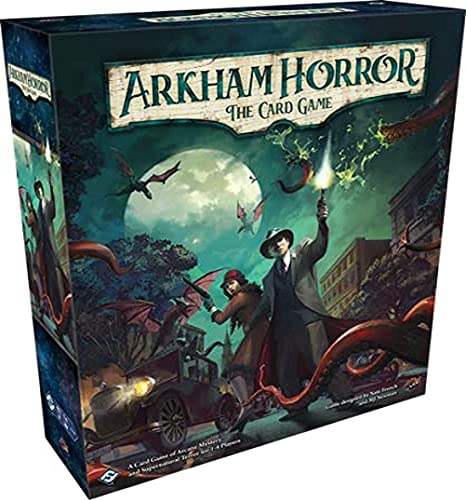
Arkham Horror: The Card Game moves Lovecraft’s Arkham into a campaign card game where each player is an investigator with a deck that improves, and sometimes deteriorates, between scenarios. Skill tests are resolved by drawing tokens from a chaos bag rather than rolling dice, so a desperate test can swing on a single draw, and the story branches based on what the investigators achieved or failed to stop. The writing carries the game: scenario text, act and agenda decks, and location descriptions build a horror narrative that remembers earlier choices.
The Revised Core Set contains the Night of the Zealot campaign, a three-scenario introduction to the game, and five pre-built investigator decks so a group can open the box and play without deck building first. Like its Middle-earth sibling, it supports up to four players from a single box and expands with fixed campaign and investigator expansions for groups that want a longer story. Readers should know the two Fantasy Flight picks share the Arkham Files setting with Mansions of Madness below, so horror fans may eventually want both, while groups should pick one to start. Choose this one for Lovecraft readers who want their choices to follow them from session to session.
Specs
- Publisher: Fantasy Flight Games (Asmodee); model FFGAHC60; revised edition released 2021
- Tier: Mid-range
- Players: 1 to 4
- Ages: 14 and up
- Playing time: 1 to 2 hours per scenario
- Contents: Night of the Zealot campaign with 3 scenarios; 5 pre-built investigator decks
- Format: Living Card Game core set; fixed card distribution with no random packs
4. Mansions of Madness Second Edition

Mansions of Madness is the most theatrical game in this roundup. One to five investigators explore a haunted Arkham location built from map tiles, while a free companion app handles the work a game master once did: it narrates the story, places monsters and tokens, randomizes the layout, and presents puzzles on screen. The result is a fully cooperative game with no player stuck running the monsters, and a mansion that is never arranged quite the same way twice.
The physical box is substantial, with 24 map tiles, 235 cards, 32 plastic figures, 239 tokens, and 5 dice, plus two rulebooks, and it includes 8 investigators and 4 scenarios. Sessions run long at two to three hours, and the app is required rather than optional, running on iOS, Android, Mac, and PC, so a charged phone, tablet, or laptop is part of the setup. Groups comfortable with that screen will find the app removes most rules bookkeeping and keeps the horror moving. Choose it for readers who want Lovecraft as an event, with figures on a map and a story that unfolds around the table.
Specs
- Publisher: Fantasy Flight Games (Asmodee); model MAD20
- Tier: Premium
- Players: 1 to 5
- Ages: 14 and up
- Playing time: 2 to 3 hours
- Components: 2 rulebooks, 24 map tiles, 235 cards, 32 plastic figures, 239 tokens, 5 dice
- Contents: 8 investigators and 4 scenarios included
- App: free companion app required; available for iOS, Android, Mac, and PC
5. Once Upon a Time: The Storytelling Card Game (3rd Edition)
Once Upon a Time turns the table into co-authors of a fairy tale. One player narrates, playing story cards from hand as the elements on them appear in the tale: a crown, a key, a forest, a character asleep. Any player who hears an element named that matches a card in hand can interrupt and seize the story, steering it toward the ending on their own secret ending card. The round ends when a narrator plays out every card and lands the tale on their ending, which is harder, and funnier, than it sounds.
The third edition from Atlas Games, designed by Richard Lambert, Andrew Rilstone, and James Wallis, holds 114 story cards and 51 ending cards in a compact box, and the rules fit on a few pages. With an age guidance of 8 and up and no reading beyond single words and short phrases, it is the one pick here that works across generations, and it doubles as a gentle writing prompt engine for young storytellers. Choose it for families, classrooms, and book clubs that want a light closer after a heavier discussion.
Specs
- Publisher: Atlas Games; model AG1030; designers Richard Lambert, Andrew Rilstone, and James Wallis
- Tier: Budget
- Players: 2 to 6
- Ages: 8 and up
- Edition: third edition, 2012
- Contents: 114 story cards and 51 ending cards, per the publisher sell sheet
- Box dimensions: 9.25 x 6.25 x 1.75 in
- Playing time: not published in the listing data retrieved; sessions are short and set by the group
Before You Buy: Reading Load, Replay, and Expansions
Check the reading load against your least confident reader. Consulting Detective is a novella per case, the two card games put rules and story text on nearly every card, Mansions of Madness shifts much of its text into app narration, and Once Upon a Time needs only single words. A mismatch here is the most common reason a literary game night falls flat.
Check the replay shape. Consulting Detective’s ten cases are one-time solves for a given group, which is fine if the box will circulate among friends. The card games replay through deck rebuilding and branching campaigns, and Mansions of Madness randomizes its maps and events, so those three boxes keep giving the same group new evenings.
Check the expansion path only if your group plays often. Both card games are complete in the box, and their expansions are fixed packs, so there is no random buying involved; add them when the core scenarios are finished, not before. Mansions of Madness adds scenarios through its app and boxed expansions. Once Upon a Time needs nothing further at all.
FAQ
What is the best literary board game for a book club?
Sherlock Holmes Consulting Detective, for most clubs. A case is a shared reading exercise: the group reads the same paragraphs, debates the same evidence, and defends a solution, which maps neatly onto how a club already discusses a novel. Keep Once Upon a Time in reserve for meetings that run short or include younger guests.
Can these literary board games be played solo?
Four of the five can. Consulting Detective plays solo as a pure deduction exercise, both card games are designed with solo play in mind, and Mansions of Madness works alone because its app runs the house. Once Upon a Time is the exception; it needs at least two players and is best with a group telling the story together.
How much reading do these games actually involve?
More than most board games, by design, but the load varies widely. Consulting Detective is almost entirely text. The card games spread their reading across card abilities and scenario introductions. Mansions of Madness narrates through its app, and Once Upon a Time asks for single words at a time, which is why it carries the youngest age guidance in this roundup.
Do the card games require expansions to be worth playing?
No. Both Revised Core Sets are complete games with full campaigns in the box, and the Living Card Game model means expansions are fixed packs with known contents rather than random packs. Expansions are a way to continue a campaign your group already enjoys, not a requirement for a satisfying first play.
Conclusion
The right literary board game is the one that matches the books your group already argues about. Pick Consulting Detective for Holmes-style deduction in its purest form, The Lord of the Rings: The Card Game for cooperative deck building across Middle-earth, Arkham Horror: The Card Game for a horror campaign that remembers your choices, Mansions of Madness for an app-guided evening of Lovecraft theater, and Once Upon a Time for storytelling that the whole family can join. Confirm the player count and reading load against your table, and any of the five turns a reading habit into a game night.
More from Amazon
Programs that pair well with the guide above. Offers and eligibility are set by Amazon and may change.
Read from a large library of eBooks and audiobooks on any device. Check Amazon for current plans.
Explore Kindle UnlimitedAudiobooks and podcasts to listen to on the go. Eligible new members can start with a free trial.
Try Audible freeFree shipping on eligible items, Prime Video and more. Eligible new members can start with a free trial.
Start a Prime free trialAd-free music streaming. Eligible new subscribers can start with a free trial.
Try Music Unlimited freeAs an Amazon Associate we earn from qualifying purchases.